Have you ever typed “que” and then stopped? Something looked wrong. You were right.
Many people search “queue or que” because the word feels odd. It has five letters. Four of them are vowels. Yet you say only one sound: “Q.”
People search this keyword for a simple reason. They want to spell the word right. Maybe you are writing an email. Maybe you are posting online. You do not want a typo.
Here is the confusion. “Que” looks like a short, easy form of “queue.” It is not. “Que” is not an English word. It is a word in French, Spanish, and Portuguese. In those languages, it means “what” or “that.”
This article clears it up fast. You will get a quick answer first. Then you will learn where the word came from. You will see US and UK differences, common mistakes, real examples, and a FAQ. Use this guide to spell the word with confidence every time.
Quick Answer
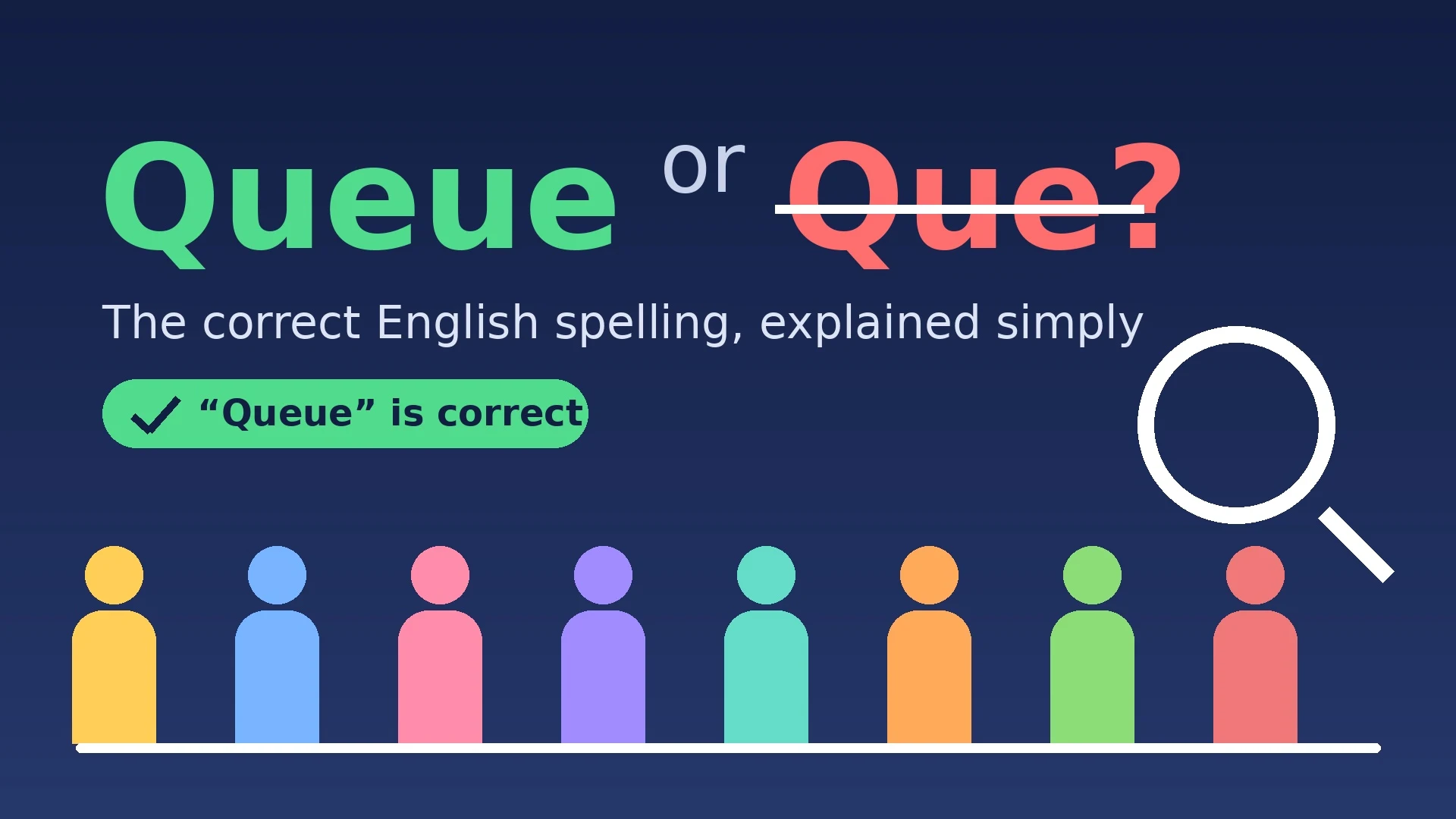
“Queue” is correct in English. “Que” is not.
A queue is a line of people or things waiting for their turn.
- There was a long queue at the bank.
- Please join the queue.
- Your song is in the queue.
“Que” is not an English word. You may see it in Spanish or French:
- ¿Qué hora es? (Spanish: What time is it?)
- Je pense que oui. (French: I think so.)
If you write in English, always write queue.
The Origin of “Queue”
The word “queue” comes from French. In French, queue means “tail.” The French word comes from the Latin word cauda, which also means “tail.”
Think of a line of people. It looks like a tail. That is how the word got its meaning.
English borrowed the word many years ago. At first, it was used in other ways, such as a tail in heraldry. Later, it came to mean a line of people waiting. Today, it also means a list of tasks, songs, or videos waiting to play.
So why does the spelling look strange? English often keeps the spelling of borrowed words. The French spelling stayed. The pronunciation changed to a simple “kyoo.”
Why do people write “que”? There are two reasons:
- They hear only the “Q” sound and try to shorten the word.
- They have seen “que” in Spanish, French, or Portuguese.
British English vs American English Spelling
Good news: both British and American English spell the noun “queue.” There is no “que” in either.
The real differences are in word choice and in the verb forms. Americans often say “line” in daily life. British speakers often say “queue.”
| Meaning | British English | American English |
| Line of people waiting | queue | line |
| To wait in a line | to queue / to queue up | to wait in line / to stand in line |
| Waiting in a line (-ing form) | queueing or queuing | queuing or queueing |
| Skipping the line | jump the queue | cut in line |
| Computer or data list | queue | queue |
Notes:
- Both “queueing” and “queuing” are accepted. “Queueing” keeps the final “e.” It has five vowels in a row. “Queuing” drops it.
- In the US, “queue” is common in tech. You will see “print queue” and “video queue.”
- In the UK, “queue” is common in daily speech.
Which Spelling Should You Use?
Use “queue” in all cases. Never use “que” in English.
For a US audience:
- Say “line” for people waiting.
- Use “queue” for computers, music, and video lists.
For a UK, Ireland, or Commonwealth audience:
- Use “queue” for people waiting.
- Use “queue up” for the action.
- Use “queue.” Most English readers know it.
- If you are unsure, pick the word that fits your reader best.
- Pick one and use it throughout your text. Do not mix them.
Common Mistakes with “Queue”
| Mistake | Correction | Why |
| Please join the que. | Please join the queue. | “Que” is not English. |
| Please join the cue. | Please join the queue. | “Cue” means a signal or a pool stick. |
| Please join the queu. | Please join the queue. | Missing the last “e.” |
| Please join the quee. | Please join the queue. | Wrong letters. |
| We are queing now. | We are queuing (or queueing) now. | Do not drop the “u.” |
| Que up the next song. | Queue up the next song. | “Queue up” means to line up. |
Cue vs queue is the most common mix up:
- Cue = a signal. The actor missed his cue.
- Queue = a line. The fans stood in a queue.
Both are said “kyoo.” That is why people mix them up.
“Queue” in Everyday Examples
- Your request is in our queue. We will reply soon.
- Please add this task to the queue.
News
- Thousands stood in a long queue to see the show.
- Court cases are waiting in a queue.
Social media
- Just joined the queue for the new phone!
- My video is stuck in the upload queue.
Formal writing
- Applications are processed in the order they join the queue.
- The system places each request in a queue.
Everyday talk
- Do not jump the queue.
- The queue moved fast today.
“Queue” vs “Que” Usage and Google Trends
I have not pulled live Google Trends data for this article, so I will not give exact numbers. You can check the latest figures yourself on trends.google.com. Here is what usually shows up for words like these:
- “Queue” is used mostly in the UK, Ireland, Australia, India, Singapore, and other Commonwealth places. It is also common in the US in tech.
- “Line” often wins in everyday US talk.
- “Que” searches often come from Spanish and Portuguese speakers. Some also come from English writers who are unsure of the spelling.
- Searches like “queue or que” are usually spelling checks.
Tip: In Google Trends, compare “queue” and “line” by country. Then check “que” separately. You will see that “que” has a very different crowd.
Keyword Variations Side by Side
| Word | Is it English? | Meaning | Example |
| queue | Yes | A line of people or things | We joined the queue. |
| que | No (Spanish, French, Portuguese) | “what” or “that” | Creo que sí. |
| cue | Yes | A signal or prompt | Wait for your cue. |
| queuing | Yes | Waiting in a line | They are queuing now. |
| queueing | Yes | Waiting in a line | They are queueing now. |
| Q | Yes (a letter) | The letter Q | Q for queen. |
FAQs
1. Is it queue or que?
It is “queue.” “Que” is not an English word.
2. How do you say “queue”?
Say “kyoo.” It sounds like the letter Q.
3. Why is “queue” spelled with so many vowels?
It comes from French. English kept the French spelling.
4. Is “queue” British or American?
Both. The spelling is the same. The British use it more often for people waiting. Americans often say “line.”
5. Is it “queuing” or “queueing”?
Both are correct. Pick one and stay with it.
6. What is the difference between “cue” and “queue”?
A cue is a signal. A queue is a line. They sound the same.
7. Can I use “que” in English texts?
No. Use it only when you write in Spanish, French, or Portuguese.
8. What does “queue up” mean?
It means to line up and wait for your turn.
Conclusion
Let us sum it up. The right spelling in English is queue. “Que” is not English. It belongs to Spanish, French, and Portuguese.
The word “queue” comes from the French word for “tail.” English kept the spelling, but the sound changed to “kyoo.” That is why the word looks so strange.
British and American English both use “queue.” The difference is in daily talk. Many Britons say “queue” for people waiting. Many Americans say “line.” Both say “queue” for computer lists, music, and video.
Watch out for easy mistakes. Do not write “que,” “queu,” or “quee.” Do not mix up “cue” and “queue.” And remember that “queuing” and “queueing” are both fine. Just choose one.
Here is the best advice. You will always be right.
Now you know the answer. Spell it with confidence.