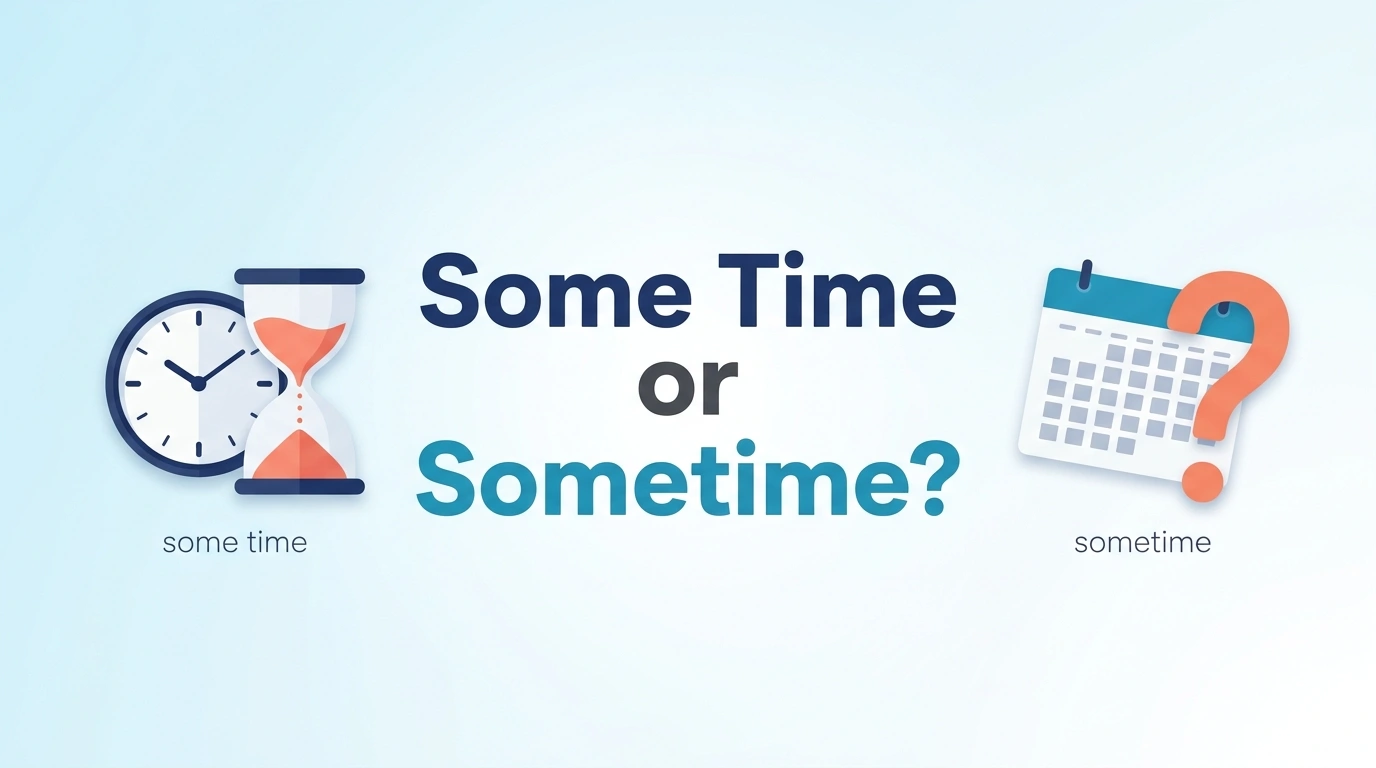
Have you ever stopped mid sentence and wondered: is it “some time” or “sometime”? You are not alone. Many people search for this every year. The two forms look almost the same. They sound the same too. But they do not mean the same thing.
People search for some time or sometime because one small space can change your meaning. “I will call you sometime” is a loose promise. “I need some time” is a request for space. Mix them up, and your email, essay, or text may confuse the reader.
Many people also ask if this is a British versus American spelling issue. It is not, and this guide clears that up.
First, you will get a quick answer. Then you will learn where the words came from, how US and UK writers use them, and which mistakes to avoid. You will also see real examples, comparison tables, and an FAQ. By the end, you will know exactly which one to use. Let’s start.
Quick Answer
Some time (two words) means an amount of time. Think “a while.”
Sometime (one word) means at an unknown point in time. Think “at some point.”
Examples:
- “It took some time to finish.” (a while)
- “Let’s meet sometime next week.” (at some point)
- “I waited for some time.” (a long while)
- “She will call sometime today.” (at some point)
Easy test: Swap in “a while.” If it works, use two words. Swap in “at some point.” If it works, use one word.
The Origin of Some Time and Sometime
Both words come from two very old English words. “Some” comes from Old English sum. “Time” comes from Old English tīma. For a long time, people wrote them as two words.
Over the years, writers joined them in certain uses. This is common in English. Words that often sit side by side can merge, like “any one” and “anyone.” So “sometime” became a word for “at an unknown time.” It also once meant “formerly,” as in “the sometime king.”
So where do spelling differences come from? Not from country. They come from meaning. The one word form took on a special job. The two word form kept the original job. That is why people mix them up. The pieces are the same, but the roles are different.
British English vs American English Spelling
Here is the surprise: there is no major British vs American split here. Both follow the same rule. Unlike “color” and “colour,” this is not a regional spelling change. It is a meaning rule.
| Use | American English | British English |
| A length of time | some time | some time |
| An unknown point in time | sometime | sometime |
| “Formerly” (formal) | sometime | sometime |
| “Now and then” | sometimes | sometimes |
Small habits do exist. Some British writers are a bit stricter about keeping the two forms apart in formal writing. Some American writers use “sometime” more loosely in casual speech. But the core rule is the same on both sides of the ocean.
Which Spelling Should You Use?
Use the rule, not the region.
- US readers: Follow the meaning rule. One word for “at some point,” two words for “a while.”
- UK and Commonwealth readers: Same rule. Formal writing and exams often check this closely.
- Global readers: Stick to the standard rule. It is safe everywhere.
Pro tip: If you are unsure, rewrite the sentence. Say “at some point” or “a while” instead. Clear writing beats a risky guess.
Common Mistakes with Some Time or Sometime
Mistake 1: Using one word for a length of time.
- Wrong: “It took sometime to load.”
- Right: “It took some time to load.”
Mistake 2: Using two words for an unknown point.
- Wrong: “Let’s grab lunch some time.”
- Right: “Let’s grab lunch sometime.”
- Wrong: “I sometime go there.”
- Right: “I sometimes go there.” (now and then)
- Better: “Some time ago, I moved here.”
- Wrong: “I lived there for sometime.”
- Right: “I lived there for some time.”
Some Time or Sometime in Everyday Examples
Email: “Can we talk sometime this week?” and “I need some time to review the file.”
News: “The vote will happen sometime in May.” and “Talks have gone on for some time.”
Social media: “We should hang out sometime!” and “Took me some time, but I got it.”
Formal writing: “The report will be ready sometime next quarter.” and “The project required some time and care.”
Google Trends & Usage Data
I can’t show exact numbers without live data, so here is what to expect in general. Questions about this phrase usually come from English speaking countries such as the US, UK, Canada, Australia, and India. Students, writers, and office workers search it most. Interest often rises when people write emails, essays, and reports.
To see the real numbers, open Google Trends and type “some time vs sometime.” Then compare countries and date ranges. Check the “Related queries” box too. It shows what people really want to know.
Comparison Table: Keyword Variations
| Form | Meaning | Example |
| some time | an amount of time | “I need some time.” |
| sometime | at an unknown point | “Call me sometime.” |
| sometimes | now and then | “I sometimes walk.” |
| some times | a few occasions | “Some times are hard.” |
| sometime (old use) | former | “The sometime mayor spoke.” |
FAQs
1. Is it “some time” or “sometime”?
It depends on meaning. Use “some time” for a while. Use “sometime” for an unknown point.
2. Is “sometime” correct in British English?
Yes. British and American English use it the same way.
3. What is the difference between “sometime” and “sometimes”?
“Sometime” means at some point. “Sometimes” means now and then.
4. Can I write “some time ago”?
Yes. Always use two words there.
5. Is “sometime” one word or two?
Both exist. One word means “at some point.” Two words mean “a while.”
6. Is “for sometime” correct?
No. Write “for some time.”
7. What is a quick way to check?
Try “a while” or “at some point” in its place. The one that fits tells you the answer.
Conclusion
The rule for some time or sometime is short. Use “some time” when you mean a length of time. Use “sometime” when you mean an unknown point in time. Both British and American English follow this same rule, so you do not need to guess based on your country.
Remember the quick test. If “a while” fits, use two words. If “at some point” fits, use one word. Watch out for common slips like “sometime” for “sometimes,” or “for sometime.” Those small errors can make your writing look careless.
Good writing is about being clear. A reader should never stop and wonder what you meant. When you pick the right form, your emails, essays, and posts sound sharp and professional.
Keep this guide handy. Bookmark it, share it, and use the swap test whenever you feel unsure. With a little practice, you will get it right without thinking. Now you can write with confidence, if you are sending a text or a formal report.