You are typing a sentence. You want to say someone is looking at something with interest. Then you stop. Is it “eyeing” or “eying”? You are not alone. Many people ask this every month, because both spellings look odd. One has three vowels in a row. The other has a strange “y” in the middle.
People search for “eyeing or eying” because spell check often stays quiet. Both forms look real. Both show up in books, news stories, and social media posts. That leaves writers unsure, especially in emails, school papers, and work reports.
This guide clears up the confusion fast. You will get a short answer first. Then you will learn where the word came from, how British and American English treat it, and which spelling to pick for your reader. You will also see common mistakes, real examples, usage trends, and answers to popular questions.
By the end, you will know exactly what to type and why. No more second-guessing. Let’s start with the answer.
Quick Answer
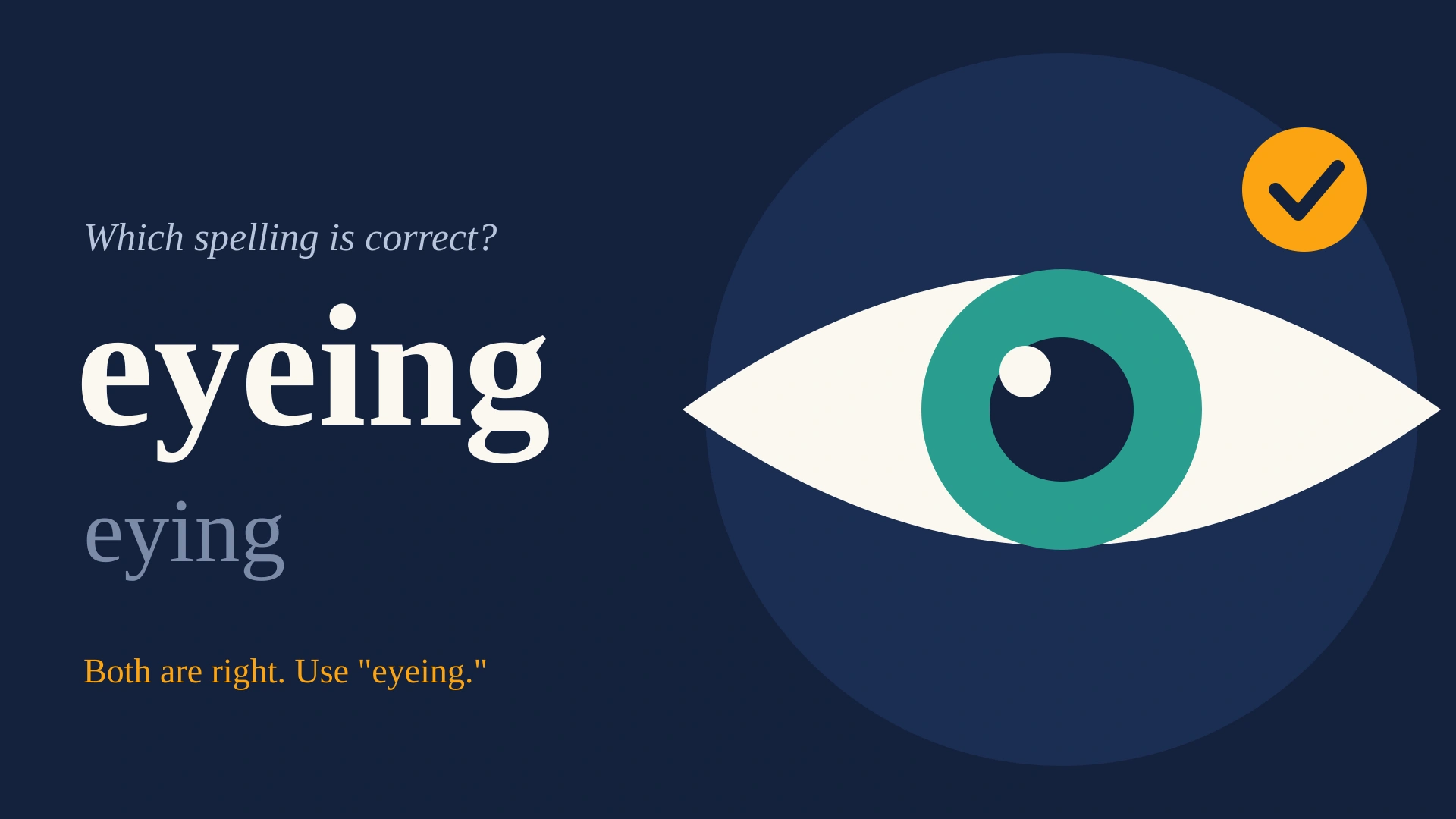
Both are correct. “Eyeing” is the better choice.
“Eyeing” is the most common spelling in American and British English. “Eying” is a rare variant. Most dictionaries list it, but many editors mark it as a mistake.
Examples:
- She was eyeing the last slice of pizza.
- The buyers are eyeing a new house downtown.
- He kept eyeing the clock during the meeting.
If you want one simple rule, use “eyeing” every time. You will never be wrong.
The Origin of Eyeing and Eying

The word starts with “eye.” In Old English, the word was ēage. Over time, people began using “eye” as a verb too. It meant to look at something closely or with interest.
Now the spelling problem. English has a common rule: when you add “-ing” to a word ending in a silent “e,” you drop the “e.” For example, “make” becomes “making.” If you apply that rule to “eye,” you get “eying.”
But English has another habit. Some words keep their “e” so the base word stays easy to see. Look at “dye,” which becomes “dyeing.” That keeps it apart from “dying,” which comes from “die.” Words like “see” and “hoe” also keep the “e” (seeing, hoeing).
“Eyeing” follows the keep-the-e pattern. “Eying” follows the drop-the-e pattern. Both had support, so both spellings lived on. Over time, “eyeing” won out.
British English vs American English Spelling
Here is a surprise. Unlike “color” and “colour,” this word is not a big US-versus-UK split. Both regions use “eyeing” most of the time. “Eying” shows up a bit more in American writing, mostly as an accepted variant.
| Feature | American English | British English |
| Main spelling | eyeing | eyeing |
| Variant spelling | eying (accepted, rare) | eying (rare, often avoided) |
| Dictionary status | Both listed | “Eyeing” preferred |
| Style guides | “Eyeing” is safest | “Eyeing” is safest |
| Example | “She is eyeing a promotion.” | “She is eyeing a promotion.” |
Other words that follow the same pattern:
| Word | -ing form | Note |
| dye | dyeing | Keeps “e” to avoid “dying” |
| singe | singeing | Keeps “e” to avoid “singing” |
| hoe | hoeing | Keeps “e” |
| eye | eyeing (or eying) | Both accepted |
Which Spelling Should You Use?
Writing for a US audience: Use “eyeing.” It is the most common form and the one editors expect. “Eying” is allowed, but it may look like a typo.
Writing for a UK or Commonwealth audience: Use “eyeing.” British writers rarely use “eying,” and it can look wrong.
Writing for a global audience: Use “eyeing.” It works everywhere and looks right to almost every reader.
Writing for school or work: Choose “eyeing.” Then use it the same way in the whole document. Never switch between the two.
Bottom line: Pick “eyeing” and move on.
Common Mistakes with Eyeing and Eying

Mistake 1: Mixing both spellings in one document.
Wrong: “He was eyeing the prize. She was eying it too.”
Right: “He was eyeing the prize. She was eyeing it too.”
Mistake 2: Confusing “eying” with “dying.”
“Eying” has nothing to do with dying. It comes from “eye,” not “die.”
Mistake 3: Writing “eyin'” or “eyeng.”
Neither is correct. Use “eyeing.”
Mistake 4: Thinking one spelling is British and one is American.
Both regions prefer “eyeing.”
Mistake 5: Using “eyeing” when you mean “eying” from “eyes” in a list.
Some people write “eyes” and “eying” together by mistake. Keep it simple: “eyes” is the noun or present verb, and “eyeing” is the -ing form.
Eyeing in Everyday Examples
Email:
“We are eyeing next Friday for the launch. Does that work for you?”
News headline:
“Investors Are Eyeing Tech Stocks After Strong Earnings”
Social media:
“Eyeing that new phone all week. Should I buy it? 👀”
Formal writing:
“The committee is eyeing several options for the new budget.”
Casual chat:
“I saw you eyeing my coffee. Want a sip?”
In all five cases, “eyeing” reads clean and natural.
Eyeing or Eying Google Trends and Usage Data

Search and usage data tell a clear story, though you should check Google Trends yourself for current numbers.
- “Eyeing” is used far more than “eying” in books, news, and web content.
- News writing leans heavily on “eyeing,” especially in business and sports headlines (“eyeing a deal,” “eyeing the title”).
- The United States shows the most searches for the spelling question, likely because “eying” is listed as an accepted variant there.
- The UK, Canada, Australia, and India also use “eyeing” as the standard.
- Social media almost always uses “eyeing,” often with the 👀 emoji.
You can test this on Google Trends. Compare “eyeing” and “eying” over the past five years, then filter by country. You will see “eyeing” stay well ahead.
Eyeing vs Eying Side by Side Comparison
| Category | Eyeing | Eying |
| Correct? | Yes | Yes (variant) |
| Popularity | Very high | Very low |
| Used in US | Yes, most common | Sometimes |
| Used in UK | Yes, standard | Rare |
| Looks like a typo? | No | Often |
| Best for formal writing | Yes | Not advised |
| Follows “keep the e” pattern | Yes | No |
| Follows “drop the e” pattern | No | Yes |
| Safest choice | ✅ | ❌ |
FAQs About Eyeing and Eying
1. Is “eying” a real word?
Yes. Many dictionaries list it as a variant of “eyeing.” But it is much less common.
2. Which is more correct, eyeing or eying?
Both are correct. “Eyeing” is more common and is the safer choice.
3. Is “eyeing” British or American?
Both. It is the standard spelling in the US, UK, and other English-speaking countries.
4. Why do some people write “eying”?
They follow the rule that says to drop the silent “e” before “-ing.” It is the same rule that turns “make” into “making.”
5. Will spell check flag “eying”?
Sometimes. Tools vary. Some accept it and some do not. Using “eyeing” avoids the problem.
6. What does “eyeing” mean?
It means looking at something closely, often with interest or desire. For example: “She is eyeing the last cookie.”
7. Can I use “eying” in an essay or on a website?
You can, but it may look like an error to readers. Use “eyeing” to be safe.
8. Is “eyeing” one word or two?
One word. Never write “eyeing.”
Conclusion
Here is the short version. “Eyeing” and “eying” are both real spellings. But “eyeing” is the clear winner.
“Eying” comes from a rule that says to drop the silent “e” before ” ing.” “Eyeing” follows a different rule that keeps the “e,” as in “dyeing” and “seeing.” Both rules exist, but readers have picked “eyeing” over time.
Your best move is simple. Use “eyeing” every time. It looks right to nearly every reader. It avoids typo complaints from editors and teachers. And it keeps your writing clean and consistent.
If you ever meet “eying” in someone else’s writing, do not panic. It is not wrong. It is just rare. Now you know the rule, the history, and the smart choice. Go ahead and type “eyeing” with confidence.

I am a professional blogger and content writer specializing in synonyms. With a strong focus on research-based writing and clear communication, I creates high-quality content designed to inform, educate, and add long-term value for readers.I am committed to maintaining accuracy, consistency, and professionalism across all published work.