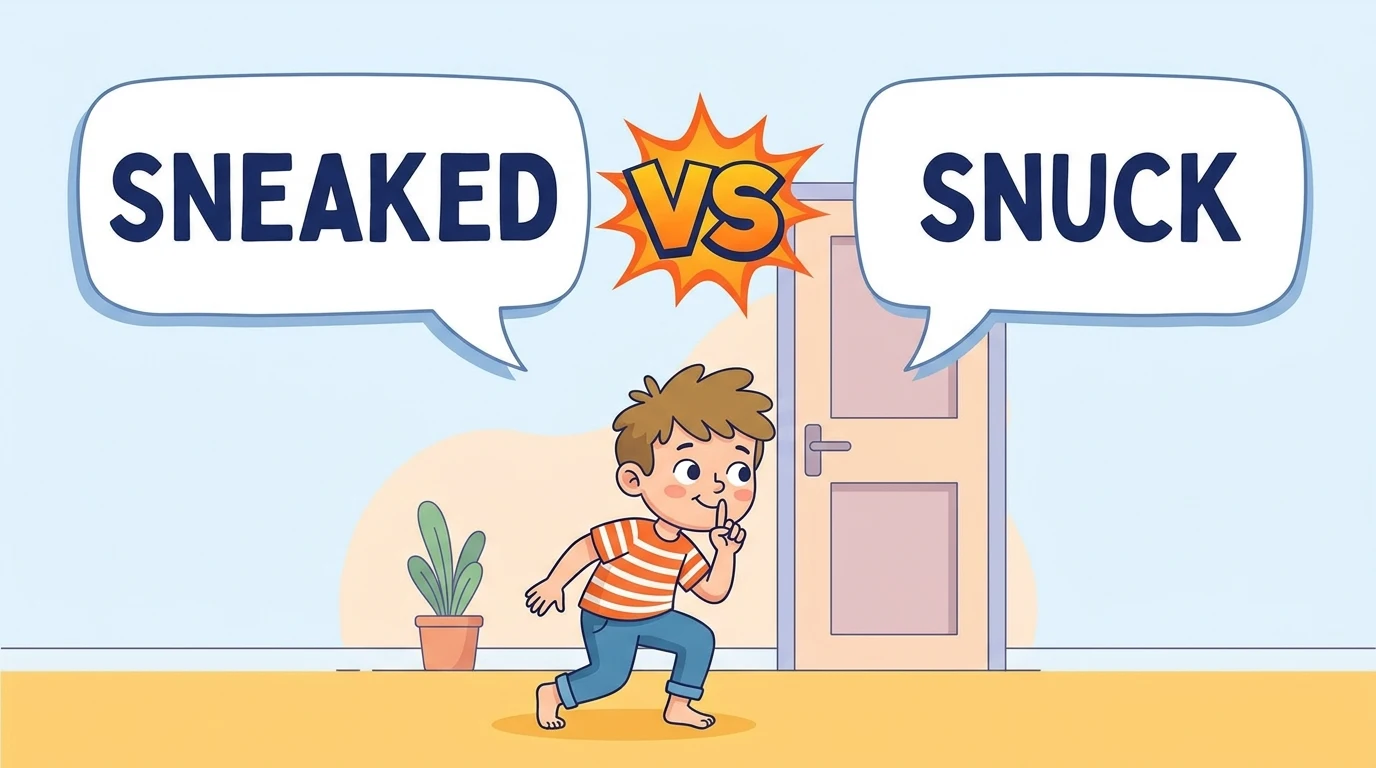
You tell a friend you “snuck” into the movie. Then you stop. Is it “sneaked”? Does one of them sound wrong?
You are not alone. Every day, people search for “sneaked or snuck” because both words look right and both sound right. Writers worry about it. Students worry about it. Even editors argue about it.
People search for this keyword because they want a fast, safe answer. They want to write an email, a school paper, or a post without a mistake. They also want to know if the answer changes in the US and the UK.
Here is the confusion. “Sneak” is a verb. Most verbs add “ed” in the past tense. That gives you “sneaked.” But some verbs change inside, like “stick” and “stuck.” That gives you “snuck.” Both forms are in the dictionary. So which one wins?
In this guide, you get a quick answer first. Then you get the history, the US and UK differences, real examples, common mistakes, and simple FAQs. By the end, you will know which word to pick.
Quick Answer
Both are correct. They are two past tense forms of the verb “sneak.”
- Sneaked is the older, traditional form. It is safe everywhere.
- Snuck is a newer form. It is very common in American English.
Examples:
- She sneaked out of the room. (Correct)
- She snuck out of the room. (Correct)
- The kids sneaked a cookie. (Correct)
- The kids snuck a cookie. (Correct)
Simple rule: When you are not sure, use “sneaked.” It never looks wrong. Use “snuck” in casual American writing and speech.
The Origin of Sneaked and Snuck
The word “sneak” showed up in English in the late 1500s. It likely grew from an older word that meant “to creep” or “to crawl.” Back then, it was a regular verb. Regular verbs add “ed.” So the past tense was “sneaked.”
“Snuck” came later. It appeared in American speech in the 1800s. People began to say it out loud first. Writing came after.
Why did this happen? English has a habit. Many verbs follow a pattern like this:
- stick → stuck
- strike → struck
- dig → dug
- spin → spun
“Sneak” sounds like these verbs. So speakers started saying “snuck.” It felt natural.
This is why the spelling differences exist. Language changes in speech before it changes on the page. American speakers took up “snuck” fast. British speakers held on to “sneaked” longer. Today, “snuck” is still seen as an American habit in the UK.
British English vs American English Spelling
Both countries share the word “sneaked.” Only one side uses “snuck” a lot.
| Feature | American English | British English |
| Common past tense | Both “sneaked” and “snuck” | Mostly “sneaked” |
| Casual speech | “Snuck” is very common | “Snuck” sounds American |
| Formal writing | “Sneaked” is the safe pick | “Sneaked” is the standard |
| Dictionary status | Both listed as correct | “Snuck” often marked as chiefly US |
| Past participle (has/have/had) | “Has snuck” or “has sneaked” | “Has sneaked” |
Examples:
- American: “He snuck into the party.”
- British: “He sneaked into the party.”
- Both: “She had sneaked a look at the gift.”
Note that the rule is not strict. Many Americans still write “sneaked.” Some British speakers say “snuck” after seeing it in movies and shows. The gap is getting smaller.
Which Spelling Should You Use?
The best choice depends on who will read your words.
US audience: Both work. “Snuck” feels natural and friendly. “Sneaked” feels a bit more formal.
UK and Commonwealth audience: Use “sneaked.” This includes the UK, Australia, Canada (in formal writing), India, and New Zealand. Readers in these places may see “snuck” as an Americanism.
Global audience: Use “sneaked.” It is the one form that every reader accepts.
Formal or academic writing: Use “sneaked.” Teachers, editors, and style guides tend to prefer it.
Casual writing, like texts and social posts: Use whichever sounds like you.
One more tip: Pick one form and stick with it in the same piece. Do not write “sneaked” in paragraph one and “snuck” in paragraph three.
Common Mistakes with Sneaked or Snuck
Here are the errors people make most often.
1. Writing “sneeked”
- Wrong: He sneeked past the guard.
- Right: He sneaked past the guard.
2. Writing “snucked”
- Wrong: She snucked in late.
- Right: She snuck in late. (Or: She sneaked in late.)
3. Thinking “snuck” is not a real word
- It is real. Major dictionaries list it. It is just less formal in some places.
4. Using “snuck” in strict UK style writing
- A British school paper or company report may expect “sneaked.”
5. Mixing both forms in one text
- Wrong: She sneaked in. Later, he snuck out.
- Right: She snuck in. Later, he snuck out.
6. Mixing up “sneak peek” and “sneak peak”
- Right: A sneak peek at the new phone. A peek is a quick look.
- Wrong: A sneak peak. A peak is a mountain top.
7. Using the wrong tense
- Wrong: Yesterday, I sneak out.
- Right: Yesterday, I snuck out. (Or: sneaked out.)
Sneaked or Snuck in Everyday Examples
Here is how the words look in real life.
In emails
- Formal: “I sneaked a quick look at the report before the meeting.”
- Casual: “I snuck in a few edits last night.”
In news writing
- “Police said the man sneaked into the building through a back door.”
- “A fan snuck onto the field during the game.”
On social media
- “Totally snuck a snack into the cinema. Don’t tell anyone.”
- “Sneaked out for coffee before work. Best part of my day.”
In formal writing
- “The spy sneaked across the border at night.”
- “The author sneaked humor into every chapter.”
In books and stories
- “The cat sneaked up on the bird.”
- “They snuck down the hall in the dark.”
Notice the pattern. News and formal pieces lean toward “sneaked.” Casual and spoken-style pieces lean toward “snuck.”
Google Trends and Usage Data
Exact numbers change all the time, so check Google Trends for live data. Here is the general picture that language researchers and dictionary editors describe.
By country
- United States: People search and use “snuck” often. It is common in speech, TV, and casual writing. Many people also search to check if it is “correct.”
- United Kingdom and Commonwealth: “Sneaked” is the main form. Searches here are often from people who saw “snuck” and wonder if it is an error.
- Other English-speaking and learner markets: Learners often search to find the “right” one. They are safest with “sneaked.”
By context
| Context | Which form is more common |
| Casual speech (US) | Snuck |
| Casual writing (US) | Snuck, with a lot of sneaked |
| News and formal writing | Sneaked |
| UK writing | Sneaked |
| Fiction and dialogue | Both, depending on the voice |
Why people search
Searches often rise during school terms, when students write essays. They also rise when a popular show or post uses the word in a new way. The trend over time shows “snuck” growing, but “sneaked” has not gone away.
Tip: Open Google Trends, type “sneaked” and “snuck” side by side, and filter by country. You will see the difference in your own region.
Sneaked vs Snuck Side by Side Comparison
| Word or Form | Correct? | Where It Is Used | Example |
| sneak | Yes (present tense) | Everywhere | I sneak a snack every day. |
| sneaked | Yes (past tense) | Everywhere, best for formal and UK writing | She sneaked out. |
| snuck | Yes (past tense) | Mostly US, casual | She snuck out. |
| sneaking | Yes (ing form) | Everywhere | He is sneaking a look. |
| has/have/had sneaked | Yes | Everywhere | They had sneaked in. |
| has/have/had snuck | Yes | Mostly US | They had snuck in. |
| sneeked | No | Nowhere | Avoid this. |
| snucked | No | Nowhere | Avoid this. |
Frequently Asked Questions
1. Is “snuck” a real word?
Yes. It is in major dictionaries. It is the past tense of “sneak.”
2. Is “sneaked” or “snuck” more correct?
Neither is wrong. “Sneaked” is the older and safer form. “Snuck” is very common in American English.
3. Should I use “snuck” in an essay?
Use “sneaked” to be safe. Some teachers prefer it. Check your style guide if you have one.
4. Do British people say “snuck”?
Some do, mostly after hearing it in American shows and music. But “sneaked” is still the main British form.
5. What is the past participle of “sneak”?
It is “sneaked” or “snuck.” Examples: “She has sneaked in.” “She has snuck in.”
6. Which one is older, sneaked or snuck?
“Sneaked” is older. “Snuck” showed up later, in American speech in the 1800s.
7. Is “sneeked” ever correct?
No. It is a spelling mistake. Use “sneaked” or “snuck.”
8. Can I use both in one article?
It is best not to. Pick one and keep it the same through the whole piece.
Conclusion
So, which is it: sneaked or snuck? The answer is simple. Both are correct.
“Sneaked” is the original past tense. It follows the normal “ed” rule. It works in everycountry and in every kind of writing. If you want the safest choice, pick “sneaked.”
“Snuck” is the newer form. It grew in American speech and now feels natural to many people in the US. It is fine in emails to friends, in social posts, and in casual stories.
Here are the key points to remember:
- Use “sneaked” for formal, academic, and global writing.
- Use “sneaked” for UK and Commonwealth readers.
- Use “snuck” for casual American writing and speech.
- Never write “sneeked” or “snucked.”
- Stay consistent. Pick one form per piece.
Language changes, and both words are here to stay. If you know your reader, you will always choose well. And when in doubt, “sneaked” will never let you down.