You see the word on a tool box. You see it in a news story. One writer types “ax.” Another types “axe.” Both look right. So which one is correct?
Many people search for “ax or axe” every year. They want a fast answer. They don’t want to look wrong in an email, a school paper, or a blog post.
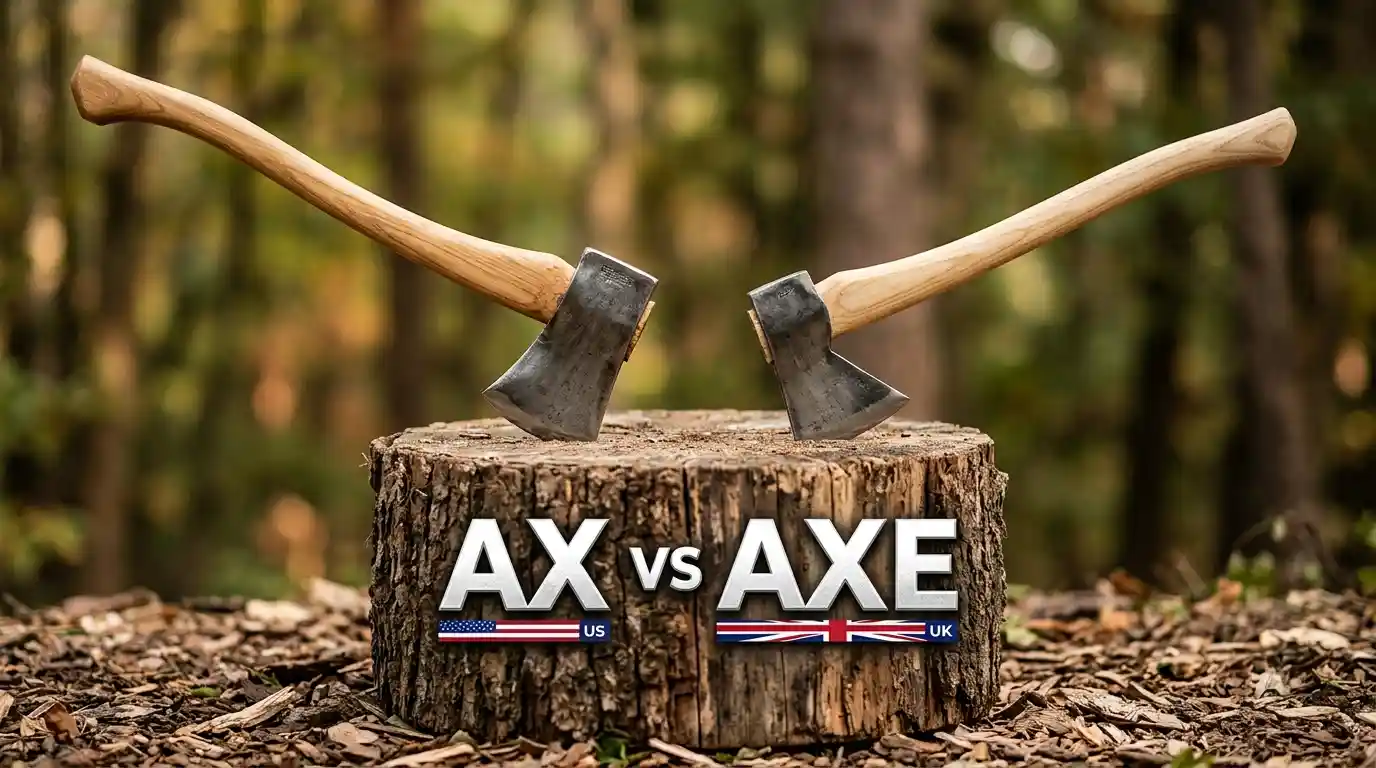
Here is the good news. Both spellings are correct. They mean the same thing. The only real difference is where your readers live and which style guide you follow.
In this article, you will get a quick answer first. Then you will learn where the word came from, how US and UK spelling differ, and which one to pick. You will also see common mistakes, real examples, usage trends, and answers to common questions. By the end, you will never wonder about “ax or axe” again.
Quick Answer
Both are correct. An ax (or axe) is a tool with a heavy blade on a handle. You use it to chop wood.
- Axe is the main spelling in the UK, Canada, Australia, and most of the Commonwealth.
- Ax is common in the US, especially in news writing.
- Axe is also widely used in the US, so neither one is wrong there.
Examples:
- He used an axe to split the logs. (UK style)
- He used an ax to split the logs. (US style)
- The company will axe 100 jobs. (UK style)
- The company will ax 100 jobs. (US style)
Rule of thumb: If you are unsure, use axe. Everyone knows it.
The Origin of Ax / Axe
The word is very old. In Old English, people wrote it as æx. It had no “e” at the end. Many old languages had a similar word for this tool.
Over time, English spelling changed. In the Middle English period, writers often added a silent “e” to the end of words. Some of those spellings stayed. That is how axe became common.
Why do two spellings exist today? Spelling in English was not fixed for a long time. Writers spelled words as they liked. Printers also had their own habits. Later, dictionary makers had to pick one form.
In the US, Noah Webster pushed for simpler spellings. He liked short forms with fewer extra letters. That is one reason ax stayed strong in American writing. In Britain, axe became the usual form.
So the split is not about right or wrong. It is about history and habit.
British English vs American English Spelling
Many British and American spellings differ. The “ax/axe” pair is a small part of that bigger story. American English often drops extra letters. British English often keeps them.
Here are some similar pairs:
- color (US) / colour (UK)
- center (US) / centre (UK)
- check (US) / cheque (UK, for money)
- program (US) / programme (UK, for a TV show)
The “ax/axe” pair is a little different. Both forms are used in the US. Only axe is normal in the UK.
| Word | American English | British English |
| The tool | ax or axe | axe |
| To cut a job or plan | ax | axe |
| Past tense | axed | axed |
| Ing form | axing | axing |
| Tool for digging | pickax or pickaxe | pickaxe |
| Old war weapon | battle-ax or battle-axe | battle-axe |
Note that the past tense and “ing” forms look the same in both countries. You drop the “e” in axing, and you do not write “axeing.”
Which Spelling Should You Use?
Pick the spelling that fits your readers.
Writing for a US audience:
Use ax if you follow AP style or write for news. Use axe if your style guide allows it. Both are fine. Just stay the same all the way through.
Writing for a UK or Commonwealth audience:
Use axe. This includes the UK, Canada, Australia, New Zealand, and India. Using ax may look like a typo to these readers.
Writing for a global audience:
Use axe. It is the most widely known form. It also matches the spelling of the popular body spray brand, so readers see it often.
Tip: Check your style guide first. If your school, boss, or client has one, follow it. If not, pick one spelling and stick with it.
Common Mistakes with Ax / Axe
1. Mixing both spellings in one text.
Wrong: “He grabbed the ax. Then he swung the axe.”
Right: Pick one and keep it.
2. Writing “axeing.”
Wrong: The firm is axeing staff.
Right: The firm is axing staff.
3. Using ax in UK writing.
This can look like a mistake to British readers. Use axe.
4. Mixing up axes with axis.
The plural of axe is axes. The plural of axis is also axes. Context shows the meaning. “He sharpened two axes.” “The graph has two axes.”
5. Spelling “ask” as “ax.”
Some people say “ax” when they mean “ask,” and they write it that way. In writing, use ask for questions.
6. Dropping the hyphen or the “e” in compounds.
Right: pickaxe or pickax. Right: battle-axe or battle-ax. Just be consistent.
Ax / Axe in Everyday Examples
In an email:
“Hi Sam, I need to buy an axe for our camping trip. Do you want to share the cost?”
In the news:
“The city plans to ax the bus line next year.” (US news style)
“The council will axe the bus route.” (UK news style)
On social media:
“New axe, new hobby. Wish me luck with the firewood! 🪓”
In formal writing:
“The museum holds a Bronze Age axe from the region.”
In a figure of speech:
“She got the axe” means she lost her job. “He has an axe to grind” means he has a personal grudge.
In music slang:
Guitar players sometimes call their guitar an “axe.” This slang almost always uses the axe spelling.
Google Trends & Usage Data
Google Trends shows how often people search for a word. It does not show exact counts. It shows interest on a scale from 0 to 100.
Here is what you can expect when you compare “ax” and “axe”:
- UK, Canada, Australia, and Ireland: axe leads by a large margin. Few people use ax.
- United States: Both spellings show up. Axe is very common in search. Ax appears often in news headlines.
- Worldwide: Axe is stronger overall.
Context also matters. Many searches for “axe” are for the body spray brand or for tools. Searches for “ax” are often about job cuts in news headlines, such as “ax falls on staff.”
Want the latest numbers? Go to Google Trends, type both words, and compare them by country and by date. The data changes over time, so check it before you publish.
Spelling Variations Side by Side
| Variation | Where Used | Status |
| axe | UK, Canada, Australia, worldwide, also the US | Correct |
| ax | Mostly the US | Correct |
| axes | Plural of axe or ax | Correct |
| axed | Past tense | Correct |
| axing | Present participle | Correct |
| axeing | None | Wrong |
| pickaxe / pickax | UK / US | Correct |
| aks | None | Wrong (for “ask”) |
FAQs
1. Is it ax or axe?
Both are correct. Axe is the main spelling in the UK and the Commonwealth. Ax is common in the US.
2. Is “ax” a typo?
No. It is a real spelling, mostly used in American English.
3. Which spelling is more popular?
Axe is more popular around the world. In the US, both are common.
4. How do you spell the past tense?
Write axed. It is the same in all English types.
5. Is it “axing” or “axeing”?
Write axing. “Axeing” is wrong.
6. What is the plural of axe?
It is axes. The plural of axis is also axes, so use context to show your meaning.
7. Do news outlets use ax or axe?
It depends on the style guide. AP style in the US uses ax. British outlets use axe.
8. Can I use both spellings in the same article?
No. Pick one and stay with it. This keeps your writing clean and professional.
Conclusion
So, ax or axe? The answer is simple. Both are right. They mean the same thing, and they come from the same old word.
Here are the key points to remember:
- Axe is the standard spelling in the UK, Canada, Australia, and most of the world.
- Ax is common in the US, especially in news writing and AP style.
- Use axe if you are not sure. Almost all readers know it.
- Stay consistent. Do not use both forms in one text.
- Write axed and axing. Never write “axeing.”
- Do not confuse axes (tools) with axes (the plural of axis), and do not write “ax” for “ask.”
Your best choice depends on your readers. Think about who will read your work. Check your style guide. Then pick one spelling and use it every time.
With this guide, you can write with confidence. If you chop wood, cut a budget, or play a guitar, you now know how to spell it.