Meta description: Speach or speech? Learn the correct spelling, why people mix them up, and how to use speech right in writing.
You are about to type a word. You stop. Is it “speach” or “speech”? You are not alone. Thousands of people ask this question every month. The word looks simple, but the spelling trips up many writers.
People search for “speach or speech” for a few reasons. Some are writing a school essay. Some are writing an email to a boss. Others are working on a toast for a wedding. They all want one thing: the right spelling, fast.
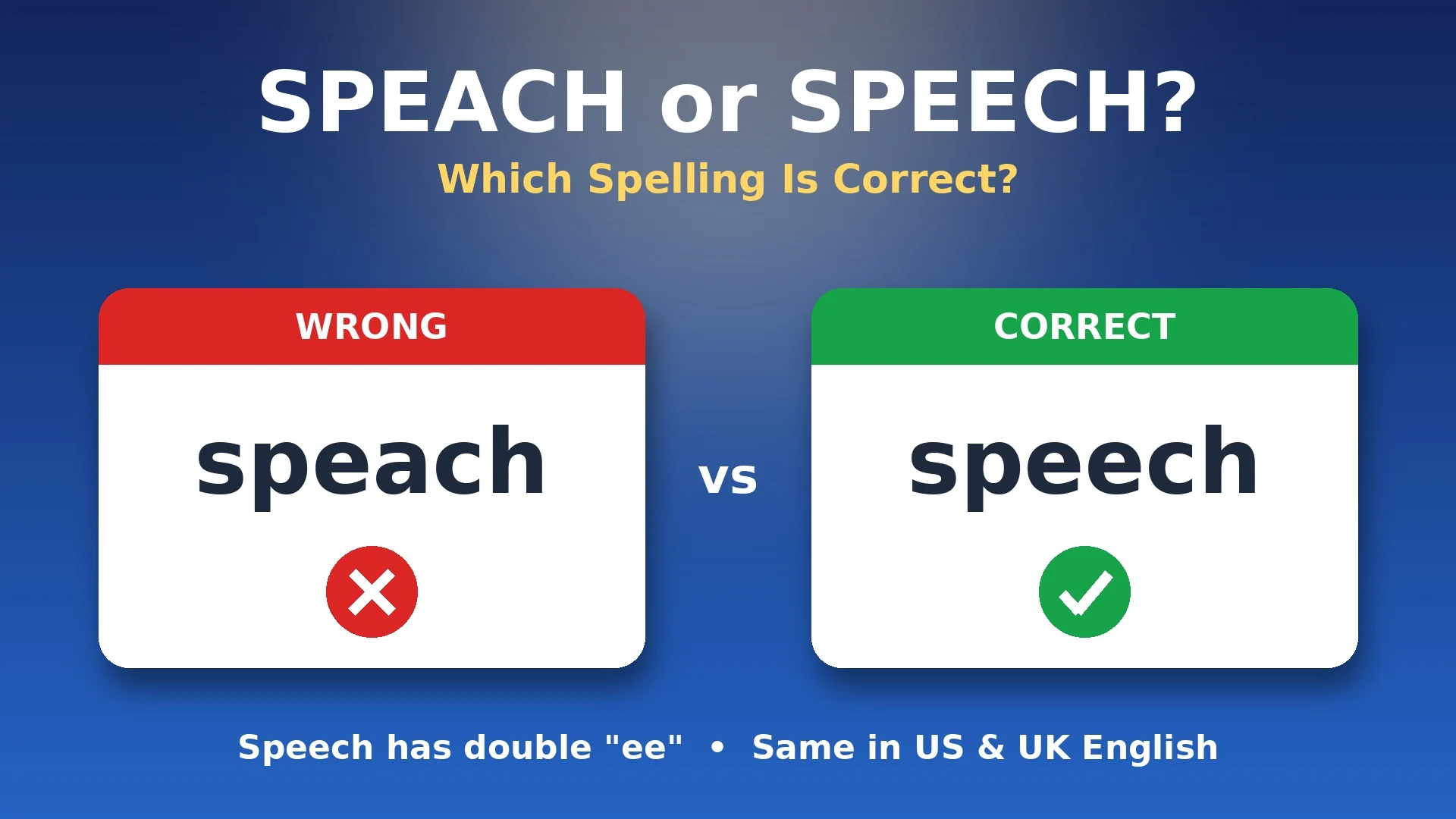
Here is the short answer. “Speech” is correct. “Speach” is a spelling mistake.
Why the confusion? The word “speak” has “ea” in it. So many people think “speech” should have it too. English spelling is full of traps like this.
In this guide, you will get a quick answer, the word’s history, spelling rules, common mistakes, real examples, usage data, and an FAQ. Let’s clear it up for good.
Quick Answer
Speech is the only correct spelling.
Speach is not a word in English dictionaries. If you see it, it is a typo.
Examples:
- The president gave a short speech. ✅
- She has a speech problem after her surgery. ✅
- He wrote a speach for the party. ❌
- Freedom of speech is a basic right. ✅
A simple trick: speech has ee. Think of the double “e” as two eyes watching the speaker. Speech = two e’s.
The Origin of Speech
The word “speech” is very old. It comes from Old English. The early forms were sprǣc and spǣc. They meant “the act of speaking” or “a talk.” Over time, the “r” dropped away, and people said speche in Middle English. Later, the final “e” was dropped, and we got “speech.”
The verb “speak” has the same family. In Old English it was sprecan, and later specan. That is why the two words look alike but are not spelled the same.
Why do spelling differences exist?
- English borrowed from many languages, so its spelling rules are messy.
- Sounds changed over the centuries, but spelling stayed fixed.
- The long “ee” sound can be written as “ee” (speech, see, week) or “ea” (speak, read, teach).
So “speach” is not an old form or a regional form. It is a mix-up between “speech” and “speak.”
British English vs American English Spelling
Here is the good news. There is no difference between British and American English for this word. Both use “speech.”
Many words do change between the two. Here is a table to show the contrast.
| Word type | American English | British English | Same for “speech”? |
| Speech | speech | speech | ✅ Same |
| Color / Colour | color | colour | No |
| Center / Centre | center | centre | No |
| Organize / Organise | organize | organise | No |
| Defense / Defence | defense | defence | No |
| Traveler / Traveller | traveler | traveller | No |
| Speak | speak | speak | ✅ Same |
“Speach” does not appear in either column. No major dictionary lists it as a variant.
Which Spelling Should You Use?
The answer is easy: always use “speech.”
- US audience: Use “speech.”
- UK and Commonwealth audience (Canada, Australia, India, South Africa, and others): Use “speech.”
- Global audience: Use “speech.”
There is no region where “speach” is right. If you write for school, work, or the web, “speach” can make you look careless. It can also hurt your SEO if it appears in titles and headings.
Tip for writers: Turn on spell check. Most tools flag “speach” right away.
Common Mistakes with Speech
| Mistake | Correction | Why |
| speach | speech | The correct word has “ee.” |
| speachless | speechless | Add “less” to the correct word. |
| speach therapy | speech therapy | Same rule. |
| speaches | speeches | Plural is “speeches.” |
| freedom of speach | freedom of speech | Keep “ee.” |
| speek | speak | The verb uses “ea.” |
| speaking vs. speeching | speaking | “Speeching” is not a standard word. |
Another common mix-up: “speech” is a noun. “Speak” is a verb.
- ✅ I will speak at the event.
- ✅ I will give a speech at the event.
- ❌ I will speech at the event.
Speech in Everyday Examples
In an email:
Hi Sam, I have finished the draft of my speech. Can you review it before Friday?
In the news:
The mayor gave a speech on new city rules. Many people cheered.
On social media:
Best speech I have heard all year. Goosebumps! #inspiration
In formal writing:
The right to freedom of speech is protected by law in many countries.
In school:
My teacher asked us to write a five-minute speech about our hero.
In health settings:
My son sees a speech therapist once a week.
In every case, the spelling stays the same.
Speach or Speech Google Trends & Usage Data
Tools like Google Trends show how much interest a search gets over time. They show relative interest, not exact counts, so it is best to check the live chart yourself.
Here is what you can usually expect from a keyword like this:
- Correct spelling dominates. “Speech” is searched far more than “speach.”
- The misspelling is mostly a typo search. People who type “speach” often just want to confirm the right spelling.
- Interest often rises with the school calendar. Students write speeches and essays during term time.
- News events create spikes. Big political speeches, award shows, and graduations bring more searches.
- Searches come from many countries. English-speaking and English-learning regions, such as the US, UK, India, Nigeria, and the Philippines, often show a lot of interest in spelling questions.
- Context matters. “Speech” appears in many topics: public speaking, free speech, speech therapy, and speech-to-text tools.
How to check: Open Google Trends, type “speech” and “speach,” and compare them by country and time range.
Keyword Variations Side by Side
| Variation | Correct? | Meaning | Example |
| speech | ✅ Yes | Talk given to an audience; the ability to speak | She gave a great speech. |
| speach | ❌ No | A common misspelling | (Avoid) |
| speeches | ✅ Yes | Plural of speech | His speeches were short. |
| speechless | ✅ Yes | Unable to speak from shock or joy | I was speechless. |
| speak | ✅ Yes | Verb: to talk | Please speak slowly. |
| speaker | ✅ Yes | Person who speaks | The speaker was calm. |
| speaking | ✅ Yes | Act of talking | Public speaking is hard. |
FAQs
1. Is it speach or speech? It is “speech.” “Speach” is a spelling mistake.
2. Is “speach” a British spelling? No. British English also uses “speech.”
3. Is “speach” an American spelling? No. American English uses “speech” too.
4. Why do people write “speach”? The verb “speak” has “ea.” People copy that pattern by mistake.
5. How do I remember the right spelling? Speech has two e’s, like “see” and “week.” Think: two e’s, two eyes on the speaker.
6. What is the plural of speech? The plural is “speeches.”
7. Is “speechless” spelled with ee? Yes. It is “speechless.” It means you cannot find words.
8. Is “speech” a noun or a verb? It is a noun. The verb is “speak.”
Conclusion
So, speach or speech? The answer is clear. Speech is the right spelling. “Speach” is a common mistake, and it is not correct in any form of English.
Let’s recap the key points:
- “Speech” is correct in US, UK, and global English.
- “Speach” is only a typo, not a regional spelling.
- The word comes from Old English sprǣc, which is why it is not spelled like “speak.”
- Watch for related errors like “speachless” and “speach therapy.”
- Use the double “e” memory trick: two e’s in speech.
- Remember: “speech” is a noun, and “speak” is a verb.
My advice is simple. Always write “speech,” and let spell check back you up. Before you hit send, take two seconds to scan for this word. Clean spelling builds trust with your reader, if you write an email, a school paper, or a blog post.
Now you know the answer. Go write that speech with confidence.

I am a professional blogger and content writer specializing in synonyms. With a strong focus on research-based writing and clear communication, I creates high-quality content designed to inform, educate, and add long-term value for readers.I am committed to maintaining accuracy, consistency, and professionalism across all published work.