You are typing an email. You stop. Is it “realize” or “realise”? A red line appears under your word, and now you doubt yourself.
You are not alone. Many people search “realize or realise” every month. Most just want a fast answer: is one spelling wrong?
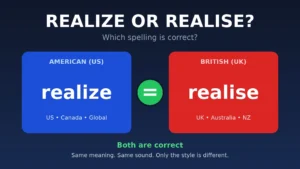
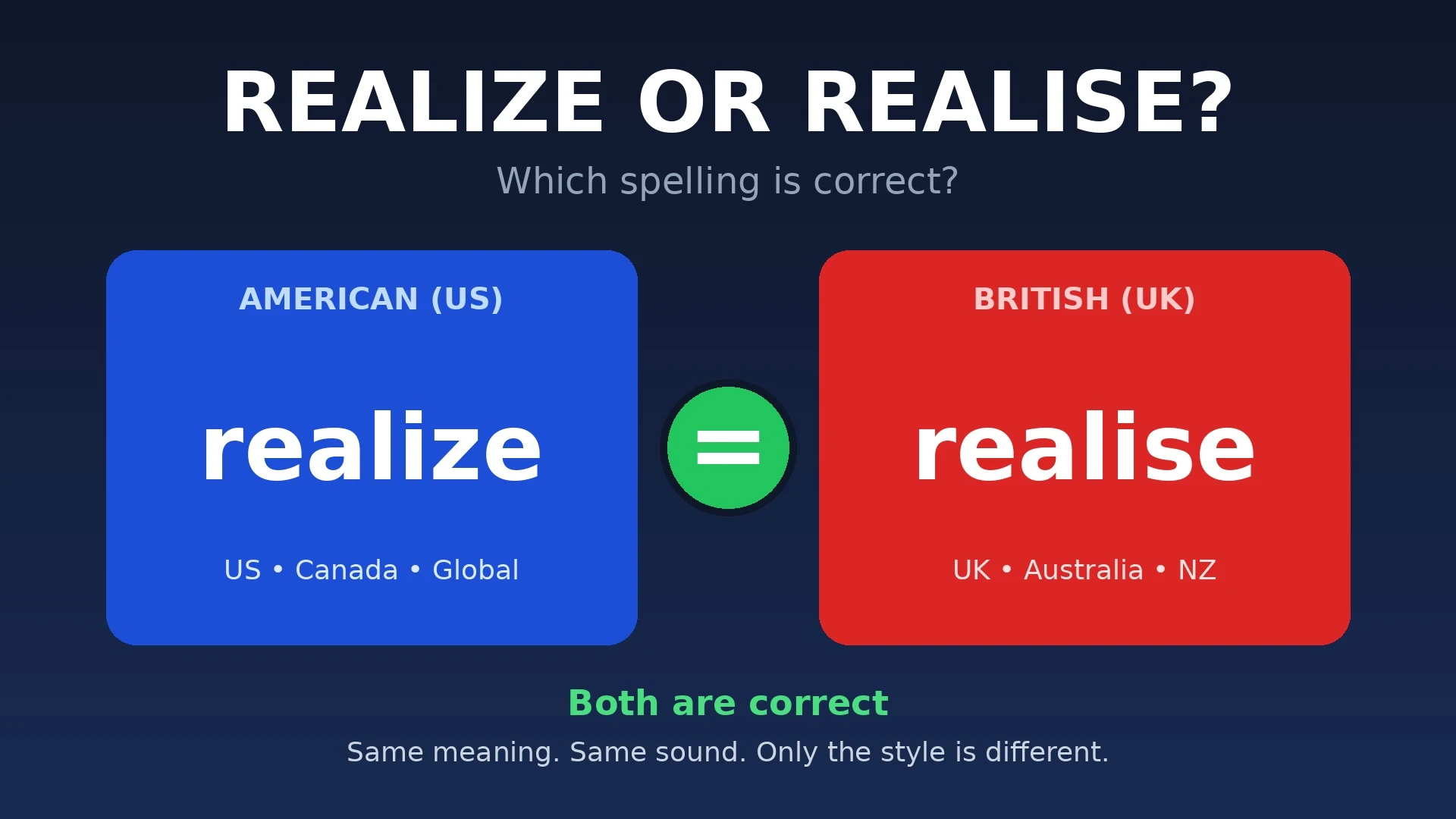
Here is the good news. Both spellings are correct. They mean the same thing and sound the same. The only difference is where you live and who you write for.
The confusion comes from English having two main spelling styles, American and British. Spell checkers make it worse. A tool set to US English flags “realise.” A tool set to UK English may flag “realize.” Neither tool tells you the whole story.
In this guide, you will get a quick answer, the word’s history, simple rules, real examples, and clear advice. By the end, you will know which spelling to pick and why.
Quick Answer
Both are correct.
- Realize is the American spelling. It is also the most common spelling worldwide.
- Realise is the British spelling. It is common in the UK, Australia, New Zealand, and South Africa.
The meaning is the same: to understand something, or to make something real.
Examples:
- I realize I was wrong. (US)
- I realise I was wrong. (UK)
- She realized her dream of becoming a doctor. (US)
- She realised her dream of becoming a doctor. (UK)
Pick one spelling and use it every time in the same piece of writing.
The Origin of Realize or Realise
The word starts with the Latin word realis, which means “real.” French turned it into réaliser, which means “to make real.” English borrowed it in the 1500s and 1600s.
At first, it meant “to make something real.” Later, it also came to mean “to understand.”
So why two spellings? The ending ize comes from the Greek izein. Latin and then French used it too. In French, the ending became iser. English writers began copying the French style, so ise spread in Britain.
In the 1800s, Noah Webster, an American writer, wanted simple spelling. He kept ize for American English. Britain kept both. Even today, some famous British publishers, such as Oxford University Press, prefer ize.
So -ize is not just an American spelling. It has old roots in British English too.
British English vs American English Spelling
The rule is simple. Many verbs can end in ize (US) or ise (UK).
| Word Type | American (US) | British (UK) |
| Verb | realize | realise |
| Past tense | realized | realised |
| Ongoing | realizing | realising |
| Noun | realization | realisation |
| Other examples | organize | organise |
| recognize | recognise | |
| apologize | apologise | |
| criticize | criticise |
Careful: Some words use -ise everywhere, in both the US and UK. Do not change these:
- advise
- revise
- surprise
- exercise
- compromise
- supervise
- improvise
Also, “analyze” (US) and “analyse” (UK) follow their own pattern. They use -yze and -yse, not -ize or -ise.
Which Spelling Should You Use?
Think about your reader.
- Writing for the US: Use realize.
- Writing for the UK, Australia, New Zealand, or South Africa: Use realise. Most readers there expect it.
- Writing for Canada: Use realize. Canadians usually prefer -ize.
- Writing for a global audience: Use realize. It is the most widely used and is accepted almost everywhere.
- Writing for a company or school: Follow the style guide. If there is none, follow your reader’s country.
The golden rule: Be consistent. Do not write “realize” in one line and “realise” in the next.
Common Mistakes with Realize or Realise
1. Mixing both spellings in one text
- Wrong: I realised my mistake, and then I realized it was big.
- Right: I realized my mistake, and then I realized it was big.
2. Thinking one spelling is a typo
- Neither is a typo. They are two accepted styles.
3. Changing words that always end in -ise
- Wrong: advize, suprize, exercize
- Right: advise, surprise, exercise
4. Trusting the spell checker blindly
- Check that your tool is set to the right language, such as English (US) or English (UK).
5. Mixing up “realize” and “realise” with “reanimate” or “relies”
- These are different words. Check your meaning before you send.
6. Mixing other spelling styles
- Wrong: I realise my favorite color is blue. (UK verb, US nouns)
- Right: I realise my favourite colour is blue. (all UK)
- Right: I realize my favorite color is blue. (all US)
Realize or Realise in Everyday Examples
Email (US)
Hi Sam, I just realized I forgot to attach the file. Sorry about that!
Email (UK)
Hi Sam, I’ve just realised I forgot to attach the file. Apologies!
News headline
Many Workers Realize They Need Better Sleep
Social media
Just realised it’s Friday. Best day ever! 🎉
Formal writing
The company realised a profit of £2 million this year.
Business report (US)
We realized a 10% increase in sales during the third quarter.
Notice that the meaning does not change. Only the spelling changes.
Google Trends & Usage Data
I can’t pull live Google Trends numbers here, so I won’t invent any. Check current figures at trends.google.com. Here is what usage patterns generally show:
- “Realize” is searched and written more often worldwide. The US has the largest English-speaking audience, and many global websites use US spelling.
- “Realise” is strongest in the UK, Australia, New Zealand, and South Africa.
- Canada leans toward “realize.”
- Context matters. Formal British news sites often use “realise,” while global tech and business sites often use “realize.”
- People search the question itself. Many searches ask “realize or realise” or “is realise correct,” which shows that people want proof the other spelling is not wrong.
Tip: Enter both spellings in Google Trends and filter by country. You will see the pattern yourself.
Keyword Variations Side by Side
| Keyword Variation | Spelling Style | Used In | Correct? |
| realize | American | US, Canada, global | Yes |
| realise | British | UK, Australia, NZ, South Africa | Yes |
| realized / realised | Past tense | Same as above | Yes |
| realizing / realising | Ongoing | Same as above | Yes |
| realization / realisation | Noun | Same as above | Yes |
| realyze / realyse | Mix-up with “analyze” | None | No |
| relize | Typo | None | No |
FAQs
1. Is it realize or realise?
Both are correct. “Realize” is American. “Realise” is British.
2. Is “realise” wrong in American English?
It is not wrong, but it looks unusual to US readers. Most US style guides prefer “realize.”
3. Is “realize” wrong in British English?
No. Some British publishers, including Oxford University Press, accept or prefer -ize.
4. Which spelling is more common?
“Realize” is more common worldwide.
5. Do both spellings mean the same thing?
Yes. Both mean to understand something or to make something real.
6. What do Canada, Australia, and New Zealand use?
Canada mostly uses “realize.” Australia and New Zealand mostly use “realise.”
7. Can I use both in one document?
No. Choose one and stay consistent.
8. Do all words ending in ize have an ise version?
Most do, but not all. Words like “advise,” “surprise,” and “exercise” always use -ise.
Conclusion
“Realize or realise” is not a question of right or wrong. Bothspellings are correct. They have the same meaning and the same sound. The only difference is style.
Here are the key points:
- Realize is the American spelling and the most common one worldwide.
- Realise is the British spelling, used in the UK, Australia, New Zealand, and South Africa.
- Both come from the Latin realis and the French réaliser.
- Some words, like “advise” and “surprise,” always end in ise.
- The biggest mistake is mixing spellings in one text.
My advice:
- Know your reader.
- Pick the spelling that matches their country.
- If you are unsure, use “realize.”
- Set your spell checker to the right language.
- Stay consistent from start to finish.
Next time you stop mid-sentence, you will know the answer. Type your word with confidence and keep writing.

I am a professional blogger and content writer specializing in synonyms. With a strong focus on research-based writing and clear communication, I creates high-quality content designed to inform, educate, and add long-term value for readers.I am committed to maintaining accuracy, consistency, and professionalism across all published work.