You are about to sign off an email. “Sincerely, Yours”? Or “Your’s”? You pause. Something looks off. You are not alone. Thousands of people search this question every month.
People search “yours or your’s” for one simple reason. Both look right. Many English words use an apostrophe to show ownership, like “Sam’s book.” So “your’s” feels like it should work too. It does not.
This guide clears up the confusion fast. You will get a short answer first. Then you will learn where the word comes from, how British and American English compare, and which spelling to use in emails, letters, and posts. You will also see common mistakes, real examples, and answers to common questions.
By the end, you will never second guess this word again. Let’s start with the answer.
Quick Answer
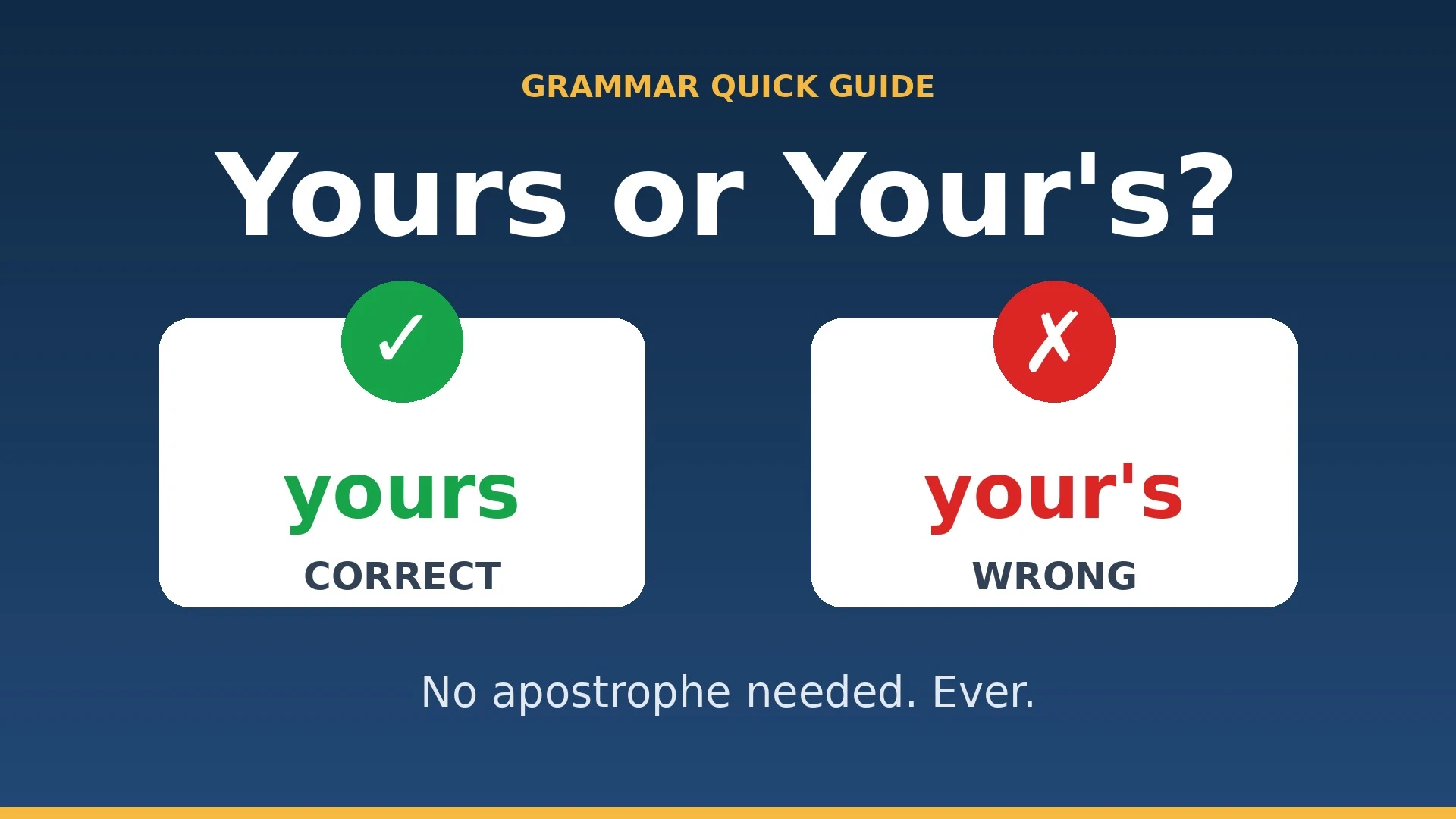
“Yours” is correct. “Your’s” is wrong.
“Yours” is a possessive pronoun. It shows that something belongs to you. It never takes an apostrophe.
Here are simple examples:
- This seat is yours. (Correct)
- Is this pen yours? (Correct)
This seat is your’s.(Wrong)- Please send yours by Friday. (Correct)
The same rule applies to other possessive pronouns: hers, ours, theirs, its. None of them use an apostrophe.
A fast trick: if you can swap the word with “mine,” use “yours.” You would never write “min’e.” So do not write “your’s.”
The Origin of Yours or Your’s
“Yours” is very old. It grows out of the word “your,” which comes from Old English. Long ago, English speakers had words like eower for “belonging to you all.”
Over time, speakers added an -s to some possessive words. This made a form that could stand alone. That gave us yours, hers, ours, and theirs. Writers used these forms by the 1300s and 1400s.
So where did “your’s” come from? It came from a mix-up. In English, the apostrophe-s shows ownership for nouns. We write “the dog’s bone” and “Maria’s car.” Writers saw the -s at the end of “yours” and thought it needed the same mark.
In the 1600s and 1700s, spelling was less fixed. Some writers did use apostrophes in odd places. Later, grammar books set clear rules. Pronouns do not take apostrophes. Yet the old habit stuck around in casual writing.
There is one more reason. An apostrophe often replaces missing letters, as in “don’t” for “do not.” People guess that “your’s” must be short for “your is.” It is not.
Important note: this is not a British versus American issue. Both sides of the Atlantic agree. “Yours” is correct everywhere.
British English vs American English Spelling
Here is the good news. British and American English spell “yours” the same way. There is no split.
Both styles also agree that “your’s” is wrong. The two styles do differ on many other words, though. That is why people often worry about spelling at all.
Here is a quick comparison.
| Word or Phrase | American English | British English | Same or Different? |
| Possessive pronoun | yours | yours | Same |
| Common error | your’s (wrong) | your’s (wrong) | Same |
| Letter sign-off | Yours truly | Yours sincerely / Yours faithfully | Different style |
| Color | color | colour | Different |
| Favorite | favorite | favourite | Different |
| Center | center | centre | Different |
| Organize | organize | organise (or organize) | Different |
The main difference is not spelling. It is sign off style. In the UK, “Yours sincerely” is used when you know the person’s name. “Yours faithfully” is used when you do not. In the US, people more often write “Sincerely,” “Best,” or “Yours truly.”
The spelling of “yours” stays the same in all of them.
Which Spelling Should You Use?
Use “yours.” Every time. In every country.
But the best sign-off depends on your reader.
If your audience is in the US:
- Use “Sincerely,” “Best regards,” or “Yours truly.”
- Keep it short and friendly.
If your audience is in the UK, Australia, India, or other Commonwealth countries:
- Use “Yours sincerely” if you know the name.
- Use “Yours faithfully” if you do not.
- Note that “Yours sincerely” is formal and common in business letters.
- Pick “Best regards” or “Kind regards.” They work everywhere.
- If you want “yours,” write “Yours sincerely.” People worldwide understand it.
In all cases, never write “your’s.” It can make you look careless. In a job application or a client email, that small error can cost trust.
Common Mistakes with Yours or Your’s
Here are the errors people make most. Each one comes with a fix.
Mistake 1: Adding an apostrophe to “yours.”
- Wrong: This book is your’s.
- Right: This book is yours.
Mistake 2: Mixing up “your” and “you’re.”
- Wrong: Your welcome!
- Right: You’re welcome! (“You’re” means “you are.”)
- Wrong: Is this yours bag?
- Right: Is this your bag? Or: Is this bag yours?
- Wrong: Your’s sincerely, Tom
- Right: Yours sincerely, Tom
- Wrong: The decision is yours’.
- Right: The decision is yours.
Easy memory tip: “Your” goes before a noun (your car). “Yours” stands alone (the car is yours). “You’re” always means “you are.” No form of “yours” ever needs an apostrophe.
Yours or Your’s in Everyday Examples
See how “yours” works in real life.
In emails:
- “Thanks for your note. Mine is attached. Please send yours when ready.”
- “Yours sincerely, Priya Shah”
In news writing:
- “The land is not yours to sell, the judge told him.”
- “Our team won last year. This year the title could be yours.”
On social media:
- “My coffee is cold. How is yours?”
- “Tag a friend whose Monday is worse than yours.”
In formal writing:
- “The responsibility is yours.”
- “Yours faithfully, J. Carter”
In casual chat:
- “That phone is mine. The red one is yours.”
Notice a pattern. In every example, “yours” ends the thought or stands alone. It never has an apostrophe.
Yours or Your’s Google Trends & Usage Data
Search interest in this topic is steady all year. People often look it up before writing letters, cover letters, and emails. Interest tends to rise around job-hunting seasons and school terms.
A few patterns show up in most search data:
- United States: People often search the rule itself, such as “yours or your’s.” They want a quick check.
- United Kingdom: People often pair it with letter endings, such as “yours sincerely or yours faithfully.”
- India, Pakistan, Nigeria, and the Philippines: Search interest is strong. English is widely used in school and work there. Learners want to get formal writing right.
- Australia and Canada: Interest follows a similar pattern to the UK and US, with a focus on business writing.
In written text, “yours” is far more common than “your’s.” Still, “your’s” appears often enough in casual posts that people keep searching.
Tip: For exact, up-to-date numbers, open Google Trends and compare “yours” with “your’s” by country and date range.
Here is a side by side view of the variations.
| Variation | Correct? | Where You May See It | Fix |
| yours | Yes | Everywhere | None needed |
| your’s | No | Casual posts, texts | Use “yours” |
| yours’ | No | Rare errors | Use “yours” |
| your | Yes (before a noun) | Everywhere | Use before a noun only |
| you’re | Yes (means “you are”) | Everywhere | Do not use for ownership |
| Yours sincerely | Yes | UK letters | Use when you know the name |
| Yours faithfully | Yes | UK letters | Use when you do not know the name |
| Yours truly | Yes | US letters | Fine for many settings |
FAQs
1. Is it “yours” or “your’s”? It is “yours.” “Your’s” is never correct.
2. Why does “your’s” look right to me? Many English nouns use an apostrophe to show ownership, like “Tom’s hat.” The brain expects the same pattern. But pronouns follow a different rule.
3. Does “yours” ever take an apostrophe? No. Not in British English. Not in American English. Not in any style guide.
4. Is “your’s” ever correct in old writing? You may see it in very old books and letters, when spelling rules were loose. Today it is treated as an error.
5. What is the difference between “your” and “yours”? “Your” comes before a noun: your phone. “Yours” stands alone: the phone is yours.
6. Should I write “Yours sincerely” or “Yours faithfully”? In UK-style writing, use “Yours sincerely” when you know the name. Use “Yours faithfully” when you do not.
7. Is “Yours truly” okay for business emails? Yes, but it can feel old-fashioned. “Best regards” or “Kind regards” is a safe modern choice.
8. Is “yours” the same in British and American English? Yes. The spelling is the same. Only sign-off habits differ.
Conclusion
Here is what to remember.
“Yours” is correct. “Your’s” is wrong. There is no exception. There is no British or American difference. Possessive pronouns, like yours, hers, ours, and theirs, never take an apostrophe.
The mistake comes from a common habit. Nouns use apostrophes to show ownership, so writers assume pronouns do too. They do not. A quick trick helps: swap in “mine.” If “mine” works, use “yours.”
For letters and emails, choose your sign-off by audience. In the US, “Sincerely” or “Best regards” works well. In the UK and Commonwealth countries, use “Yours sincerely” when you know the name and “Yours faithfully” when you do not. For a global audience, “Kind regards” is simple and safe.
Also watch the other look-alikes. “Your” goes before a noun. “You’re” means “you are.” “Yours” stands alone.
Getting this small word right makes your writing look sharp and professional. Now, the next time you sign an email, you can do it with confidence. The answer is yours.

I am content creator and comparison blogger focused on analyzing key differences between terms, concepts, and ideas to deliver accurate, easy-to-understand information. So I decided to create a platform where these differences are explained in the simplest way possible.