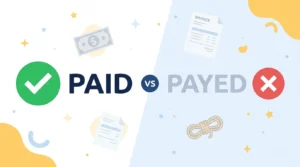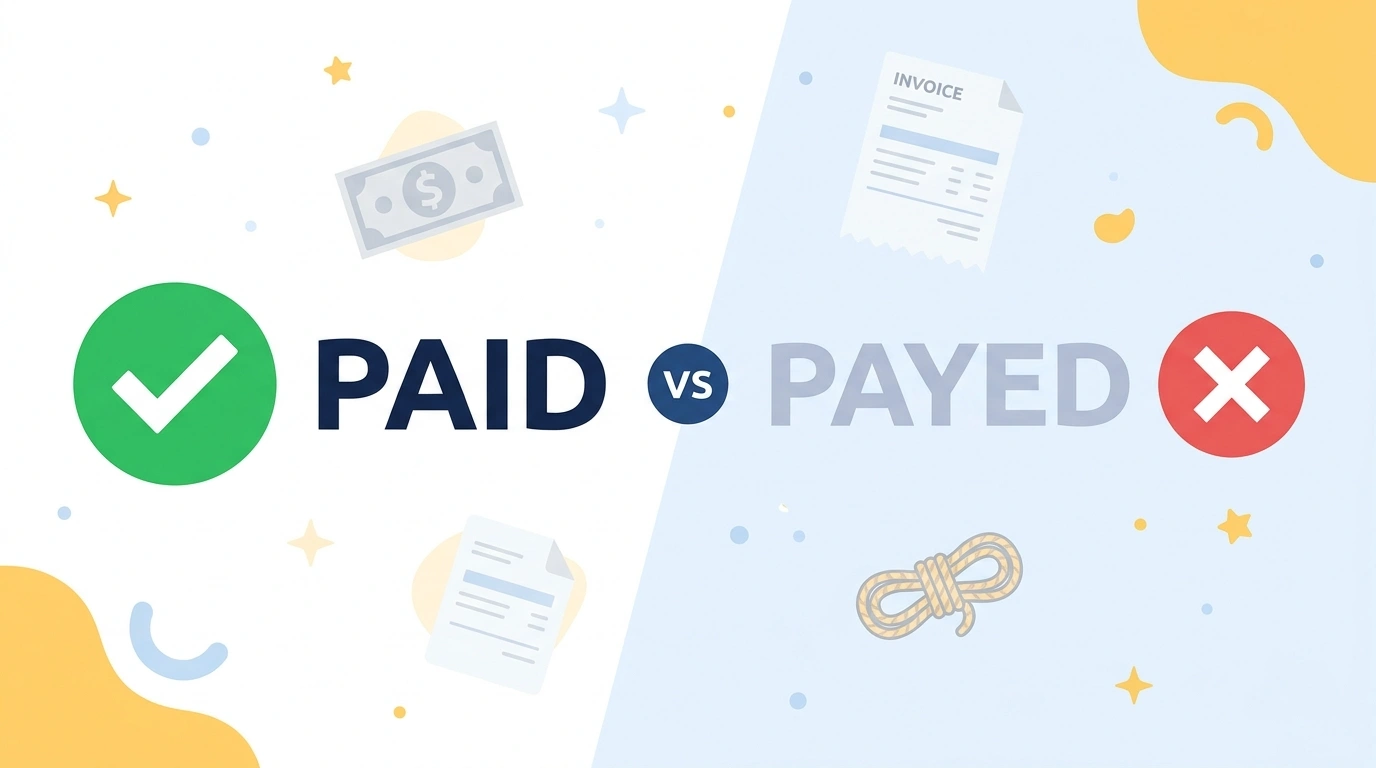
Then you stop. Something looks wrong. Is it paid or payed?
You are not alone. Many people search for “paid or payed” every day. The word “pay” does not follow the usual rule. Most verbs add ed in the past tense. Walk becomes walked. Play becomes played. So it seems like pay should become payed. But English likes to break its own rules.
This guide clears up the confusion. You get a quick answer first. Then you learn where the word came from, how British and American English compare, and when “payed” is truly correct. You will also see common mistakes, real examples, and answers to the questions people ask most.
Quick Answer
Use “paid.” It is the past tense of “pay.” It is also the past participle, the form that follows “have,” “has,” or “had.”
- I paid the bill yesterday.
- She has paid for the tickets.
- They were paid on Friday.
- We paid attention in class.
“Payed” is very rare. You use it only in one special case: letting out a rope at sea (more on that below). For money, bills, wages, or attention, it is always “paid.”
Easy memory trick: pay → paid. Say → said. Lay → laid. The “y” turns into “i.”
The Origin of Paid and Payed
The word “pay” is old. It comes from the Latin word pacare, which meant “to calm” or “to make peaceful.” That word grew from pax, the Latin word for peace. The idea was simple: when you pay a person, you calm them down. They are no longer upset about the debt.
Old French turned the word into paier. English borrowed it in the Middle Ages. Back then, spelling was not fixed. People wrote words the way they sounded. You could see both “payed” and “paid” in old books. Over time, “paid” won for the money meaning.
Why does “payed” still exist? There is a second word “pay.” It means to cover a ship’s seams with tar or pitch to keep out water. It comes from a different Latin word, picare, which relates to pitch. Sailors also use it for letting out a rope: “He payed out the line.” This second word kept the regular -ed ending.
So two different words share one spelling. One became “paid.” The other stayed “payed.”
Spelling differences also grew because English had no strict rules for hundreds of years. Big dictionaries, such as Samuel Johnson’s in 1755 and Noah Webster’s in 1828, helped lock spellings in place. For the money meaning, they both settled on “paid.”
British English vs American English Spelling
Here is the good news. British and American English agree on this one. There is no UK spelling and US spelling of “paid.” Both use “paid.”
| Meaning | British English | American English |
| Past tense of pay (money) | paid | paid |
| Past participle (have/has/had) | paid | paid |
| Letting out a rope (nautical) | payed out | payed out |
| Present tense | pay | pay |
| -ing form | paying | paying |
| Common spelling mistake | payed | payed |
Many British and American spelling differences exist, like colour/color and centre/center. This is not one of them. If you see “payed” in either country, it is almost always a mistake.
Which Spelling Should You Use?
The answer is the same for every reader.
- US audience: Use “paid.”
- UK, Canada, Australia, and other Commonwealth readers: Use “paid.”
- Global audience: Use “paid.”
- Sailing, boats, or ropes: Use “payed out” only for the rope or tar meaning.
If you write for a business, a school, or a website, “paid” keeps your work clean and professional. A wrong spelling can make readers doubt you, even when your message is strong.
Common Mistakes with Paid or Payed
| Wrong | Right |
| I payed the bill. | I paid the bill. |
| Have you payed yet? | Have you paid yet? |
| She payed attention. | She paid attention. |
| He was payed well. | He was paid well. |
| We prepayed the fee. | We prepaid the fee. |
| They repayed the loan. | They repaid the loan. |
| She was overpayed. | She was overpaid. |
| The bill is unpayed. | The bill is unpaid. |
Why do people make this mistake? The usual rule says to add -ed. Also, “payed” is a real word in boating, so some spell checkers do not flag it. Always read your words twice.
Watch the prefixes. Words like prepaid, repaid, overpaid, underpaid, and unpaid all use “paid” at the end. Never use “payed” in them.
Paid or Payed in Everyday Examples
- “Thank you. I have paid the invoice today.”
- “Our records show the fee was paid on May 3.”
News
- “The company paid $5 million to settle the case.”
- “Workers were paid less than last year.”
Social media
- “Just paid my last bill. Feels great!”
- “Got paid today. Time for pizza.”
Formal writing
- “The tenant has paid all rent due under the lease.”
- “Taxes must be paid by April 15.”
Sailing (the one time “payed” fits)
- “The sailor payed out the rope as the boat left the dock.”
Google Trends & Usage Data
I do not have live Google Trends numbers, so I will not guess figures. Here is how to read the data yourself and what it usually shows.
What Google Trends shows: It shows interest over time on a scale from 0 to 100. It does not show exact search counts. A higher number means more interest compared to the peak.
What you will likely see:
- Searches for “paid or payed” come from large English-speaking countries like the US, UK, Canada, and Australia.
- Interest is often strong in countries where many people learn English, such as India, the Philippines, and Nigeria.
- Writing tools, school terms, and job seasons can make interest rise. People write resumes, emails, and essays, and they stop to check spelling.
- In real text, “paid” appears far more often than “payed.” Where “payed” appears, it is mostly in boating talk or in typing errors.
How to check it yourself:
- Go to Google Trends.
- Type “paid or payed” and pick your country.
- Compare “payed out” with “paid out” to see the rope meaning against the money meaning.
Paid or Payed Comparison Table of Word Forms
| Word form | Correct? | Example |
| pay | Yes | I pay rent monthly. |
| pays | Yes | She pays on time. |
| paying | Yes | We are paying today. |
| paid | Yes | He paid the bill. |
| payed | Only for rope/tar | The crew payed out the line. |
| prepaid | Yes | I prepaid the fee. |
| repaid | Yes | She repaid the loan. |
| overpaid | Yes | They overpaid by $10. |
| unpaid | Yes | The bill is unpaid. |
| prepayed, repayed, overpayed | No | Use the “paid” forms above. |
FAQs
1. Is “payed” a real word?
Yes, but only in a narrow sense. It means letting out a rope or sealing a ship’s seams with tar. It is not the past tense of pay for money.
2. Is “payed” British English?
No. British English uses “paid” for money, just like American English.
3. Can I ever use “payed” for money?
No. For money, wages, bills, or attention, always write “paid.”
4. Why is “pay” not “payed” if most verbs add ed?
English has many irregular verbs. Pay, say, and lay all change the “y” to “i” in the past tense: paid, said, laid.
5. Is “paid” the past tense and the past participle?
Yes. Examples: “I paid yesterday” (past tense) and “I have paid” (past participle).
6. Why does my spell checker accept “payed”?
Because “payed” is a real word in sailing. A spell checker may not know which meaning you want. Check it yourself.
7. What is the correct form: “paid attention” or “payed attention”?
“Paid attention.” You are not letting out a rope, so use “paid.”
8. What is the rope meaning of “payed”?
It means to let a rope or cable slip out slowly. Example: “She payed out the anchor line.”
Conclusion
The answer to “paid or payed” is simple. Use paid.
Payed is rare. You only need it for one special case: ropes at sea. When a sailor lets a rope out, the line is “payed out.” The same goes for sealing a ship’s seams with tar. If you are not talking about boats, do not use payed.
Remember a few easy tips. Pay, paid, paid. Say, said, said. Lay, laid, laid. These verbs change the y to i. Also remember that “payed” is not a British spelling or an American spelling. It is just a mistake in most cases.
Next time you write about money, you can type with confidence. You paid the bill. They have paid in full. Check your drafts for “payed” and fix it fast. Clear spelling makes your writing look sharp and professional.

I am content creator and comparison blogger focused on analyzing key differences between terms, concepts, and ideas to deliver accurate, easy-to-understand information. So I decided to create a platform where these differences are explained in the simplest way possible.