You are typing a sentence. You stop. Is it “sneak a peek” or “sneak a peak”? You are not alone. Many people search “peek or peak” every month. The two words sound the same. They look almost the same. But they mean very different things.
People search this keyword because they want a fast, safe answer. They do not want to look silly in an email, a school paper, or a post. Some also think it is a British versus American spelling issue. It is not. This is a mix-up between two different words.
This guide clears up the confusion. You will get a quick answer first. Then you will learn where each word came from, how people use them, and which mistakes to avoid. You will see real-life examples from emails, news, and social media. You will also find a handy table and an FAQ. By the end, you will never mix up peek and peak again. Let’s start.
Quick Answer
Peek means to take a quick look. Peak means the top of something.
- Peek (verb or noun): a quick, often secret look.
- “I took a peek at the gift.”
- “Can I peek inside the box?”
- Peak (noun, verb, or adjective): the highest point.
- “We reached the peak of the mountain.”
- “Sales peak in December.”
Memory trick: Peek has two es, like two eyes. Peak has a, like the a in “mountain top.”
The Origin of Peek and Peak

Peek and peak are homophones. That means they sound the same but have different meanings and spellings.
Peak has been in English for hundreds of years. It is linked to words for something pointed, like a spike or a sharp edge. That is why a mountain top is called a peak. Over time, it also came to mean the best or highest point of anything, like “peak fitness.”
Peek is also old. It appeared in Middle English as a word for looking quickly or slyly. Experts are not fully sure where it came from. Some link it to similar looking-words in other Germanic languages.
Why the confusion? English spelling does not always match sound. Many words are said the same but spelled differently, such as “see” and “sea.” Peek and peak are two more of these pairs. When we speak, we never see the spelling. So when we write, we may pick the wrong one.
British English vs American English Spelling
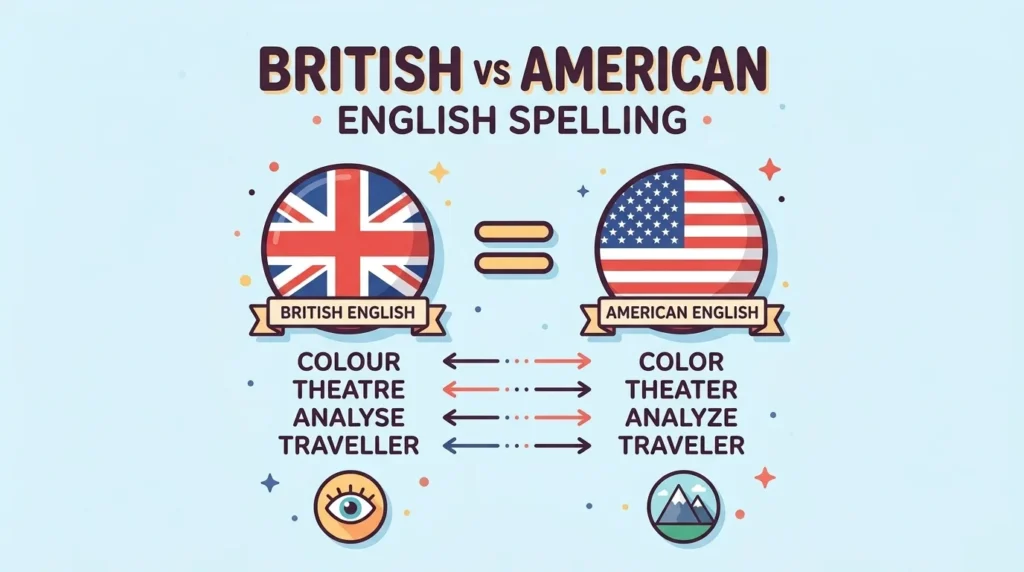
Here is the key point: there is no British or American spelling difference for peek and peak. Both countries use both words in the same way.
People often mix this up with real spelling differences like “color” and “colour.” Peek and peak are not like that. They are two separate words everywhere.
| Word | American English | British English | Meaning |
| Peek | peek | peek | A quick look |
| Peak | peak | peak | Highest point |
| Peeked | peeked | peeked | Looked quickly |
| Peaked | peaked | peaked | Reached the top |
| Peeking | peeking | peeking | Looking quickly |
| Peaking | peaking | peaking | Reaching the top |
The spelling is the same on both sides of the ocean. Only the meaning changes.
Which Spelling Should You Use?
The right choice depends on your meaning, not your country.
- US readers: Use peek for a look and peak for a top. Same rule.
- UK and Commonwealth readers (Australia, Canada, India, and more): The same rule applies.
- Global audience: Keep the rule simple. Look = peek. Top = peak.
Ask yourself one question: “Am I talking about looking, or about a top?”
- Looking? Write peek.
- Top, high point, or best moment? Write peak.
Common Mistakes with Peek and Peak
1. “Sneak peak.” This is the most common error. You sneak a look, so write sneak peek. Some people use “sneak peak” in ads, but most style guides call it a mistake.
2. “Peak-a-boo.” The game is peekaboo. You peek at someone.
3. “Peek performance.” You want the best level, so write peak performance.
4. “Peeked my interest.” The correct phrase is piqued my interest. Pique is a third word that sounds the same. It means to stir up.
5. “Peaked inside.” Peaked means reached a top. For looking, write peeked inside.
| Wrong | Right |
| sneak peak | sneak peek |
| peak-a-boo | peekaboo |
| peek hours | peak hours |
| peeked my curiosity | piqued my curiosity |
| peeked at 90 percent | peaked at 90 percent |
Peek and Peak in Everyday Examples
Emails
- “Here is a sneak peek of our new plan.”
- “Traffic is at its peak at 5 p.m., so let’s meet at 3.”
News
- “Hikers reached the peak before sunrise.”
- “Prices peaked in July.”
Social media
- “Sneak peek of my new room! 👀”
- “Peak summer vibes. ☀️”
Formal writing
- “The company reached peak output in the third quarter.”
- “The committee will provide a peek at the draft report next week.”
Notice how “peek” always links to looking and “peak” links to height or the best point.
Google Trends & Usage Data

I can’t pull live Google Trends numbers here, so I won’t make up percentages. For exact, current data, check Google Trends yourself and compare “peek vs peak” and “sneak peek” over time.
Here is what usage patterns typically look like:
- Most searches come from English-speaking countries, such as the US, UK, Canada, Australia, India, and Nigeria.
- Interest rises around movie trailers, game launches, and product reveals. People use “sneak peek” a lot then, and many check the spelling.
- “Peak” is popular in business, weather, travel, and fitness. Think “peak season” and “peak performance.”
- Student searches often rise during school terms, when people write essays and check grammar.
The confusion is global because the sound is the same everywhere.
Peek vs Peak Side by Side Comparison
| Phrase | Correct? | Why |
| sneak peek | ✅ Yes | A secret quick look |
| sneak peak | ❌ No | Peak means top |
| peekaboo | ✅ Yes | A game of quick looks |
| peak season | ✅ Yes | The busiest time |
| peek season | ❌ No | Nothing to look at |
| peak performance | ✅ Yes | Best level |
| pique interest | ✅ Yes | Stir interest |
| peak interest | ⚠️ Different meaning | Interest at its highest |
FAQs
1. Is it “sneak peek” or “sneak peak”?
It is sneak peek. You take a quick look.
2. Are peek and peak spelled differently in the UK and US?
No. Both countries use the same spelling for both words.
3. What does “peek” mean?
It means to look quickly or in secret.
4. What does “peak” mean?
It means the top or highest point of something, such as a mountain or a busy period.
5. How do I remember the difference?
Peek has two es, like two eyes. Peak has an a, like the top of a mountain.
6. Is “pique” the same as “peek” or “peak”?
No. Pique is a third word. It means to stir up, as in “pique my interest.”
7. What is the past tense of each word?
Peek becomes peeked. Peak becomes peaked. They mean different things, so choose by meaning.
8. Is “sneak peak” ever acceptable?
It appears in some ads, but most guides say it is wrong. Use “sneak peek” to be safe.
Conclusion
Peek and peak sound the same, but they are not the same word. Peek is about looking. Peak is about the top. That one rule solves almost every case.
Remember that this is not a British versus American spelling issue. Both countries use both words the same way. So you do not need to change anything for your audience. You only need to check your meaning.
Watch out for the common slips. And if you want to say something stirred your curiosity, write “piqued.”
When you are unsure, ask yourself: “Is this about a look or a top?” Use your two-eyes trick for peek and your mountain trick for peak. With a little practice, the choice will feel natural.
Now you can write with confidence in emails, reports, posts, and school work. Clear words make you look sharp, and now you know the right ones.

I am a professional blogger and content writer specializing in synonyms. With a strong focus on research-based writing and clear communication, I creates high-quality content designed to inform, educate, and add long-term value for readers.I am committed to maintaining accuracy, consistency, and professionalism across all published work.