Have you ever stopped mid-sentence and thought, “Is it whether or weather?” You are not alone. Millions of people search for this every year. The two words sound the same. They look almost the same. But they mean very different things.
People search for “whether or weather” for a simple reason. They want to write the right word, and they want to do it fast. One wrong word in an email, a school paper, or a job application can look sloppy. Nobody wants that.
This guide clears up the mix-up. You will get a quick answer first. Then you will learn where each word came from, how people use them, and which mistakes to avoid. You will also see easy examples and a side-by-side table.
One note before we start. Some people think this is a British versus American spelling issue. It is not. Whether and weather are two different words. Both are spelled the same way in the US and the UK. By the end of this guide, you will know which word to pick every time.
Quick Answer
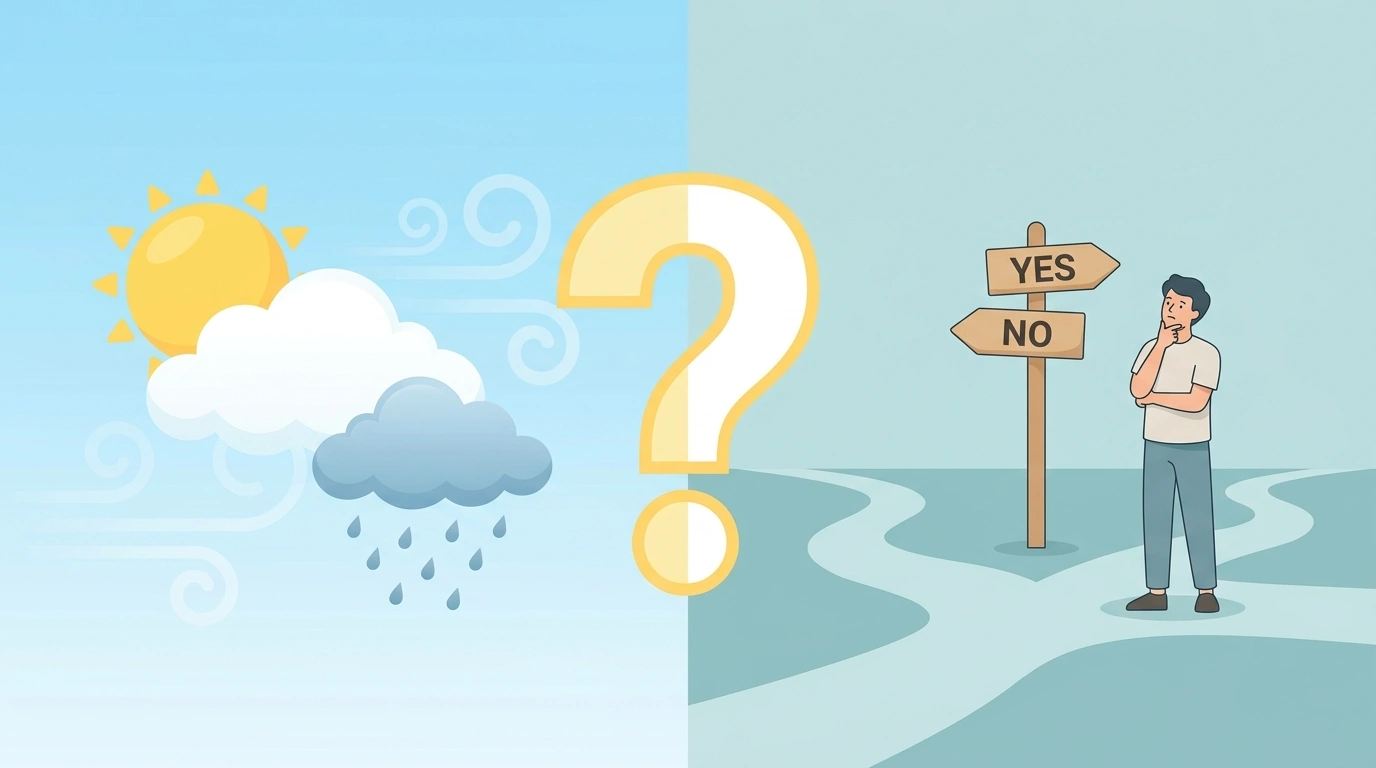
Weather is what happens outside. Think sun, rain, wind, snow, and heat.
Whether shows a choice. It means “if” or “one or the other.”
Examples:
- The weather is cold today.
- I will check the weather before we leave.
- I don’t know whether I should go.
- She asked whether the store was open.
A simple trick: Weather has “eat” and “heat” sounds in it. It is about the sky. Whether has “her” inside it. Think “he or her.” That is a choice.
Still unsure? Swap in the word “if.” If the sentence still works, use whether. If you are talking about rain or sun, use weather.
The Origin of Whether and Weather
Both words are very old. They come from Old English, the language people spoke in England over 1,000 years ago.
Weather comes from the Old English word weder. It is linked to words for wind and air. Other Germanic languages have similar words. German has Wetter. Dutch has weer.
Whether comes from the Old English word hwæther. It meant “which of two.” It is a cousin of the words either and neither. You can see the “ther” ending in all three.
So why do they look alike today? Over time, the sounds of the two words slid together. Spelling in English was also not fixed for a long time. When printing spread in the 1400s and 1500s, spellings slowly became standard. Both words kept their “th” ending and the “e” before it. Many English speakers now say them the same way. A few accents, such as some Scottish and Irish ones, still say the “wh” in whether with a soft puff of air.
British English vs American English Spelling
Here is the key fact: there is no British or American difference for these two words. Both countries spell them the same way.
Many other words do change. Here is how they compare:
| Word Type | American English | British English | Same in Both? |
| Rain, sun, sky | weather | weather | Yes |
| Choice, “if” | whether | whether | Yes |
| Hue | color | colour | No |
| Middle | center | centre | No |
| Gray tone | gray | grey | No |
| Plan | organize | organise | No |
Spelling rules that help:
- American English often drops the “u” (color) and swaps “re” for “er” (center).
- British English keeps “our” and “re” in many words (colour, centre).
- Weather and whether follow neither rule. They stay the same everywhere.
If you are choosing between them, you are choosing meaning, not region.
Which Spelling Should You Use?
The answer depends on what you mean, not where you live. Still, here is advice for each reader.
US readers: Use weather for the sky and whether for a choice. Use American spelling for other words, like color.
UK and Commonwealth readers: The rule is the same. Use weather and whether the same way. Keep British spelling for other words, like colour.
Global readers: Pick one style, US or UK, and stay with it. Switching halfway looks messy. The words weather and whether will never be the problem.
Quick checklist before you hit send:
- Is it about sun, rain, or wind? Use weather.
- Is it about a choice or “if”? Use whether.
- Is the rest of the page in one spelling style? Good.
Common Mistakes with Whether and Weather
Here are the errors people make most often.
1. Mixing them up in a sentence
- Wrong: I don’t know weather to go.
- Right: I don’t know whether to go.
2. Using “whether” for the sky
- Wrong: The whether is nice today.
- Right: The weather is nice today.
3. Spelling errors
- Wrong: wheather, wether, whather
- Right: weather or whether
Watch out for wether. It is a real word, but it means a male sheep. It is not what you want.
4. Mixing up look-alike words
- Whither means “to where” and is very old-fashioned.
- Wither means to dry up, like a plant.
5. Using “whether or not” when “whether” is enough
- I wonder whether it will rain. This is fine.
- I wonder whether or not it will rain. This is also fine, but longer.
Use “whether or not” only when you want to stress both sides, such as: We will play, whether or not it rains.
Whether and Weather in Everyday Examples
In emails:
- “Please tell me whether you can join the call.”
- “Due to bad weather, the meeting is moved online.”
In news:
- “Storms are coming. The weather office warns of heavy rain.”
- “Voters are unsure whether the plan will work.”
In social media:
- “Rain or shine, I love this weather!”
- “Can’t decide whether to nap or run.”
In formal writing:
- “The court must decide whether the rule applies.”
- “The report studies how weather affects crops.”
Fun tongue twister:
- “Whether the weather is cold, or whether the weather is hot, we’ll weather the weather, whatever the weather, whether we like it or not.”
Yes, weather can also be a verb. It means to get through something hard. “We will weather the storm.”
Whether or Weather Google Trends and Usage Data
Exact numbers change all the time, so check Google Trends for the latest picture. Here is what usually holds true.
Search patterns:
- “Weather” gets far more searches than “whether.” People check the forecast every day.
- “Whether or weather” is a smaller search, but it stays steady. It comes from people who want to write correctly.
- Searches tend to rise during school terms and exam season. Students write more then.
By country and context:
- English-speaking countries with many students and learners often show strong interest in spelling and grammar questions.
- In the US and UK, people mostly search for forecasts. Grammar searches are a smaller share.
- Work and school contexts drive most “which word is right” searches.
Tip: Open Google Trends and compare “whether or weather” with “weather vs whether.” Filter by country and time to see the latest data.
Comparison Table: Word Variations Side by Side
| Word | Meaning | Example Sentence | Common Use |
| weather | Sun, rain, wind, temperature | The weather is warm. | Everyday talk, news |
| weather (verb) | To get through something hard | We will weather the storm. | Speeches, writing |
| whether | “If” or a choice | I don’t know whether he left. | Questions, decisions |
| whether or not | Both choices count | We go, whether or not it rains. | Stressing both sides |
| wether | A male sheep | The wether ate the grass. | Farming only |
| whither | To where (old style) | Whither goest thou? | Old books, poems |
| wither | To dry up | The plant will wither. | Plants, hope, fading |
FAQs
1. Is it “whether or weather” or “weather or whether”?
Neither is a set phrase. Pick the word that fits the meaning in your sentence.
2. Do the UK and US spell these words differently?
No. Both countries spell whether and weather the same way.
3. Are whether and weather homophones?
Yes, for most speakers. They sound alike but have different meanings and spellings.
4. How can I remember the difference?
Weather has “eat” and “heat” in it, so think sky and sun. Whether has “her” in it, so think “he or her,” a choice.
5. Can I say “whether or not”?
Yes. It is correct. You can often drop “or not” and keep the same meaning.
6. Can “weather” be a verb?
Yes. It means to survive something tough, like “weather the storm.”
7. What is the difference between “whether” and “if”?
They are close. Use whether when you show two options: “I don’t know whether to stay or go.” Use if for conditions: “If it rains, we stay home.”
8. What is “wether”?
It is a male sheep that has been neutered. It is not a typo for either word.
Conclusion
The mix-up between whether and weather is easy to make. The words sound the same, and our fingers type fast. But the fix is simple.
Use weather when you talk about the sky. Think sun, rain, wind, and snow. Use whether when you talk about a choice. Think “if” or “one or the other.”
You also learned that this is not a US versus UK spelling problem. Both countries spell these words the same way. The only choice you make is about meaning. For the rest of your writing, pick one style, American or British, and keep it the same from start to end.
Watch out for common slips. Do not write wheather or wether. Do not mix up wither and whither with the two main words. If you ever feel stuck, try the “if” test. If “if” fits, write whether.
Save the memory trick: weather has “eat” and “heat,” and whether has “her.” A few seconds of checking can keep your writing clean, clear, and professional. Now you can write with confidence, whatever the weather.

I am a professional blogger and content writer specializing in synonyms. With a strong focus on research-based writing and clear communication, I creates high-quality content designed to inform, educate, and add long-term value for readers.I am committed to maintaining accuracy, consistency, and professionalism across all published work.