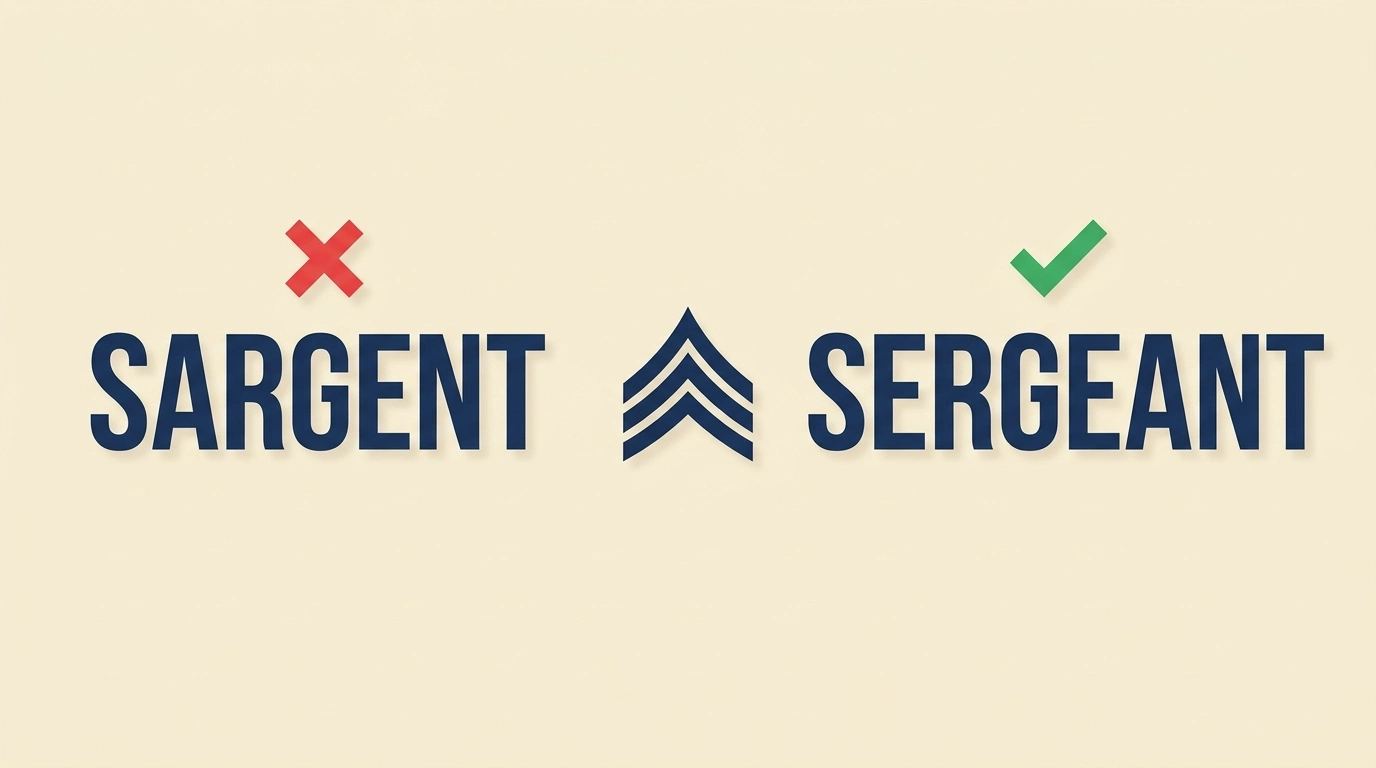
You are writing about a soldier or a police officer. You type the word, then stop. Is it “sargent” or “sergeant”? Something looks wrong, but you are not sure what.
You are not alone. Every day, people search for “sargent or sergeant” because the word does not sound like it looks. We say “SAR-jent.” But the usual spelling has an “e” and an “a” that we never say out loud. That gap between sound and spelling trips up students, writers, and even news editors.
Many people also wonder if this is a UK versus US difference, like “color” and “colour.” It is not. This guide clears up the confusion fast. You will get a quick answer, the word’s history, real examples, common mistakes, and answers to the top questions. By the end, you will know which spelling to use and why.
Quick Answer
Use “sergeant.” This is the correct spelling for the rank in both American and British English.
“Sargent” is not a standard spelling of the rank. It is mostly a last name, like the painter John Singer Sargent or the politician Sargent Shriver. If you are not writing someone’s name, use “sergeant.”
Right:
- Sergeant Miller led the team.
- The police sergeant took our report.
- She was promoted to staff sergeant.
Wrong:
- Sargent Miller led the team. (unless his name really is Sargent)
- The police sargent took our report.
The Origin of Sergeant
The word comes from Old French, sergent. That came from the Latin serviens, which means “one who serves.” It is related to the Latin verb servire, “to serve.”
At first, a sergeant was just a servant or an attendant. Over time, the word came to mean a person who held a duty, such as a court officer or a soldier. Later, it became a military rank.
Why the spelling is odd: In old French and early English, “er” in many words was said like “ar.” You can still see this in “clerk” (said “clark”), “Derby” (said “Darby”), and “Berkeley” (said “Barkley”). So English kept saying “sarjent.” But the spelling went back to follow the French and Latin roots, and the “ea” crept in. The sound stayed. The spelling changed. That is why the word looks so different from how it sounds.
“Sargent” is a spelling that follows the sound. It also lived on in family names, which often keep old spellings.
British English vs American English Spelling
Here is the surprise: there is no real British American split for this word. Both use “sergeant.” The only small twist is “serjeant,” an old British form still used in a few titles.
| Feature | American English | British English |
| Rank spelling | sergeant | sergeant |
| Spoken sound | SAR-jent | SAR-jent |
| Short form | Sgt. | Sgt (often no period) |
| “Sargent” as a rank | Incorrect | Incorrect |
| “Sargent” as a surname | Correct | Correct |
| “Serjeant” | Very rare | Used in some legal and military titles |
Takeaway: Do not worry about your audience for this word. “Sergeant” works everywhere.
Which Spelling Should You Use?
- US readers: Use “sergeant.” Military branches, police departments, and news outlets all use it.
- UK and Commonwealth readers (Canada, Australia, India, and others): Use “sergeant.” Only use “serjeant” if you are copying an official title that uses it.
- Global or mixed audience: Use “sergeant.” It is the safe, standard choice.
- Writing a person’s name: Spell it the way that person spells it. If it is Sargent, keep it Sargent.
When in doubt, use “sergeant” for the rank and check the name for people.
Common Mistakes with Sergeant
- Spelling the rank “sargent.”
Fix: Use “sergeant.” Remember that the word has “serve” hidden in it: sergeant. - Changing a surname to “sergeant.”
Fix: If someone’s name is Sargent, do not “correct” it. - Using “sergent” (missing the “a”).
Fix: Add the “a.” Try this memory trick: a sergeant has ears, so spell it with “ea.” - Writing “Sgt” in the wrong place.
Fix: Use “Sgt.” before a name: Sgt. Lee. Write out “sergeant” in normal sentences. - Forgetting the capital letter.
Fix: Capitalize it before a name (Sergeant Lee). Use lowercase when it stands alone (the sergeant said). - Mixing it up with “serjeant.”
Fix: Use “sergeant” unless an official title says otherwise.
Sergeant in Everyday Examples
Email:
Hi team, Sergeant Davis will lead tomorrow’s safety briefing. Please arrive by 9:00 a.m.
News headline:
Police Sergeant Honored for Rescue at Lake
Social media:
Proud of my dad, who just made sergeant today!
Formal writing:
Staff Sergeant Alvarez received the Meritorious Service Medal for her leadership.
Name usage:
The portrait was painted by John Singer Sargent.
Notice that the rank is always “sergeant,” while “Sargent” shows up only as a name.
Sargent or Sergeant Google Trends & Usage Data
I cannot pull live numbers here, so I will not invent any. Here is what usually shows up in search behavior, and how you can check it yourself.
- Why people search: Most searches come from people who hear “SAR-jent” and want to know the right spelling.
- Where interest tends to appear: English-speaking countries with large military or police forces, such as the US, UK, Canada, Australia, and India. English learners in many other countries also search for it.
- When interest rises: Searches often go up around military holidays, news about police or army events, and school or exam seasons.
- What “sargent” usually means online: Many “sargent” searches are about people or places with that name, not the rank.
Check it yourself: Open Google Trends, enter “sergeant” and “sargent,” and compare them by country and time. The “sergeant” line should be far higher.
Spelling Variations Side by Side
| Variation | Correct? | Used for | Example |
| sergeant | ✅ Yes | The rank (US and UK) | Sergeant Brown |
| Sargent | ⚠️ Name only | Surnames, places | John Singer Sargent |
| serjeant | ⚠️ Rare | Old British titles | Serjeant-at-Arms |
| sergent | ❌ No | Misspelling (or French) | — |
| Sgt. | ✅ Yes | Short form before names | Sgt. Lee |
| sarge | ✅ Informal | Casual nickname | “Yes, Sarge!” |
FAQs
1. Is it “sargent” or “sergeant”?
“Sergeant” is the correct spelling for the rank. “Sargent” is a surname.
2. Is “sargent” British or American spelling?
Neither. Both the UK and the US spell the rank “sergeant.”
3. Why is “sergeant” said “SAR-jent”?
Old English speakers said “er” like “ar” in many words. The sound stayed, but the spelling changed.
4. Is “Sargent” ever correct?
Yes, as a last name or place name. Keep the spelling people use for themselves.
5. What does “serjeant” mean?
It is an older British spelling of the same word. You mostly see it in some legal and military titles.
6. How do I abbreviate sergeant?
Use “Sgt.” in the US. In British writing, “Sgt” without a period is common.
7. Do I capitalize “sergeant”?
Yes, when it comes before a name (Sergeant Hill). No, when it stands alone (the sergeant arrived).
8. Is there an easy way to remember the spelling?
Think “a sergeant must serve, and has ears”: s-e-r-g-e-a-n-t.
Conclusion
The answer is simple: write “sergeant.” It is correct in American English, British English, and every other English speaking region. “Sargent” may look right because it matches the sound, but it is only used as a surname.
Here are the key points to remember:
- Sergeant is the rank. Use it everywhere.
- Sargent is a name. Use it only when it is someone’s name.
- Serjeant is a rare British form. Use it only in official titles that call for it.
- The odd spelling comes from the word’s French and Latin roots, while the sound stayed the same.
- Capitalize it before a name, and use “Sgt.” as the short form.
If you are unsure, use the memory trick: a sergeant must serve, and the word has ears. Spell it s-e-r-g-e-a-n-t, and you will be right every time. Now you can write the word with confidence in emails, reports, news stories, and social posts.

I am content creator and comparison blogger focused on analyzing key differences between terms, concepts, and ideas to deliver accurate, easy-to-understand information. So I decided to create a platform where these differences are explained in the simplest way possible.