You are typing an email. You write “The tool is useable.” Then you stop. Does that look right? Or should it be “usable”? You are not alone. Thousands of people search for “useable or usable” every month.
The confusion makes sense. The word “use” has an “e” at the end. So why would “usable” drop it? Spell check may not help either. Some tools flag one spelling. Others flag both.
People search this keyword for a few reasons. Some want to fix a mistake. Some write for a UK or US audience. Others want to look professional in a report, a résumé, or a website.
This article gives you the answer fast. It also explains where the word came from, how British and American English treat it, and which spelling to pick. You will see examples, common mistakes, and a simple FAQ.
By the end, you will never second-guess this word again.
Quick Answer
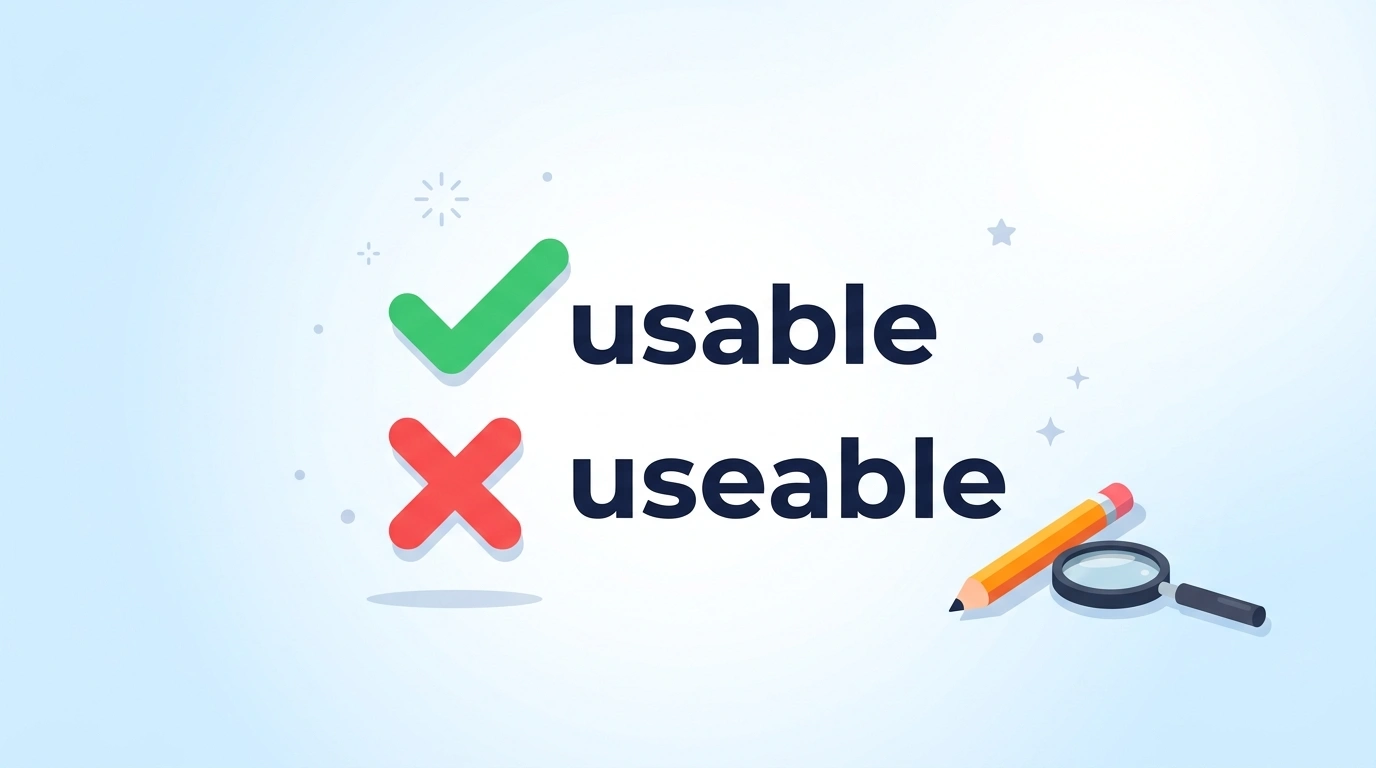
Use “usable.” It is the standard spelling in both American and British English.
“Useable” is a variant. Some dictionaries list it as acceptable. But it is less common, and many editors mark it as an error.
Examples:
- The app is easy to use and fully usable on phones.
- This old laptop is still usable.
- Is the room usable for meetings?
Easy rule: When in doubt, drop the “e.” Write usable.
The Origin of Useable and Usable
The word comes from the verb “use” plus the ending “-able.” “Use” came into English from Old French. It goes back to the Latin word uti, which means “to use.”
English has a spelling habit. When you add “-able” to a word that ends in a silent “e,” you often drop the “e.” Think of “love” and “lovable,” or “move” and “movable.” By that habit, “use” becomes “usable.”
“Usable” has been in English for centuries. It was used in the 1300s and 1400s.
“Useable” showed up later. Writers wanted to keep the “e” so the root word “use” stayed easy to see. That is why two spellings exist. Neither came from a mistake. But over time, “usable” won. Most dictionaries, style guides, and writers prefer it.
British English vs American English Spelling
Here is a surprise. Unlike words such as “color” and “colour,” this word does not split cleanly between the US and the UK. Both prefer “usable.” The “useable” spelling is just a smaller, rarer choice in both places.
British writers may keep the “e” a little more often in words like this. But it is still the minority choice.
| Word | American English | British English | Notes |
| Usable | Preferred | Preferred | Standard in both |
| Useable | Rare variant | Rare variant | Slightly more seen in the UK |
| Likable | Preferred | Both used | “Likeable” is common in the UK |
| Sizable | Preferred | Both used | “Sizeable” is common in the UK |
| Movable | Preferred | Both used | “Moveable” is a UK variant |
| Reusable | Preferred | Preferred | “Reuseable” is nonstandard |
The pattern: Americans usually drop the silent “e.” British writers are more relaxed and sometimes keep it. But for “use,” the shorter spelling is still the safe pick everywhere.
Which Spelling Should You Use?
Your audience matters. Here is simple advice.
If your readers are in the US: Write “usable.” Nearly all US style guides and dictionaries prefer it.
If your readers are in the UK, Australia, or other Commonwealth countries: Write “usable.” You may see “useable” in print, but “usable” is never wrong.
If your readers are global: Write “usable.” It works for everyone. It also matches what most people type into search engines.
If you work for a company or a client: Check the style guide. Then stay consistent. Do not mix “usable” and “useable” in one document.
Bottom line: “Usable” is the safe choice for every audience.
Common Mistakes with Useable and Usable
Mistake 1: Mixing both spellings in one text.
Wrong: “The app is usable. The site is useable.”
Right: “The app is usable. The site is usable.”
Mistake 2: Thinking “useable” is always wrong.
Mistake 3: Thinking “usable” is a US-only spelling.
It is not. British writers use it too.
Mistake 4: Writing “unuseable.”
Wrong: “The phone is unuseable.”
Right: “The phone is unusable.”
Mistake 5: Writing “reuseable.”
Wrong: “These bags are reuseable.”
Right: “These bags are reusable.”
Mistake 6: Mixing up “usable” and “useful.”
“Usable” means you can use it. “Useful” means it helps you. A tool can be usable but not useful.
Useable and Usable in Everyday Examples
Email:
“Hi Sam, the new template is ready and fully usable. Let me know if you need changes.”
News:
“Only half of the roads were usable after the storm, officials said.”
Social media:
“Finally found a usable budget phone! Battery lasts two days.”
Formal writing:
“The study tested if the software was usable for older adults.”
Product page:
“Our reusable bottles are strong, safe, and usable every day.”
In every example, “usable” fits. If you swapped in “useable,” the meaning would stay the same. But the text would look a little less polished to many readers.
Useable or Usable Google Trends and Usage Data
Search data tells a clear story. People search for “usable” far more often than “useable” in most countries. “Useable” gets a small share of searches, and much of that comes from people checking if it is correct.
Here is the general pattern. Check Google Trends yourself for current numbers:
- United States: “Usable” leads by a wide margin. “Useable” searches are small.
- United Kingdom: “Usable” leads too, but “useable” appears a bit more than in the US.
- Australia, Canada, and India: “Usable” is the main spelling here as well.
Context matters too. “Usable” appears often in tech, design, and business. Think “usable software” or “usable data.” “Useable” appears more in casual writing, such as property listings or classified ads.
Searches for the spelling itself (“useable or usable”) also tend to rise when people write reports, essays, or web content.
Takeaway: The crowd chooses “usable.” You should too.
Comparison Table: Keyword Variations Side by Side
| Spelling | Status | Where You See It | Should You Use It? |
| Usable | Standard | Everywhere | Yes |
| Useable | Accepted variant | Casual writing, some UK text | Only if a style guide says so |
| Unusable | Standard | Everywhere | Yes |
| Unuseable | Nonstandard | Rare, often a mistake | No |
| Reusable | Standard | Everywhere | Yes |
| Reuseable | Nonstandard | Rare, often a mistake | No |
| Usability | Standard | Tech, design, research | Yes |
Frequently Asked Questions
1. Is “useable” a real word?
Yes. It is an accepted variant of “usable.” But it is less common and often marked as an error.
2. Which is more correct, useable or usable?
“Usable” is more correct in practice. It is the preferred spelling in major dictionaries and style guides.
3. Is “usable” British or American?
Both. It is the standard spelling in the US and the UK.
4. Can I use “useable” in formal writing?
You can, but it is risky. Many editors will change it. “Usable” is safer.
5. What is the opposite of “usable”?
The opposite is “unusable.” Do not write “unuseable.”
6. Why do some people keep the “e”?
They want the root word “use” to stay visible. It looks closer to the original word.
7. Does it matter for SEO?
Yes, a little. Most people search for “usable,” so use it in titles and headings. You can mention “useable” once in the text to catch people who search for it.
Conclusion
Here is what to remember. “Usable” is the standard spelling in both American and British English. “Useable” is a rare variant. It is not a crime to use it, but it can make your writing look less polished.
The word comes from “use” plus “-able.” English usually drops the silent “e” before “-able,” which gives us “usable.” Some writers keep the “e,” and that is how the second spelling survived.
Unlike many US and UK spelling pairs, this one does not split by country. Both sides prefer “usable.” That makes your choice easy.
Be careful with related words. Write “unusable,” not “unuseable.” Write “reusable,” not “reuseable.” And stay consistent in every document.
When you want a quick answer, remember one line: drop the “e” and write usable. Your writing will look clean, correct, and professional.