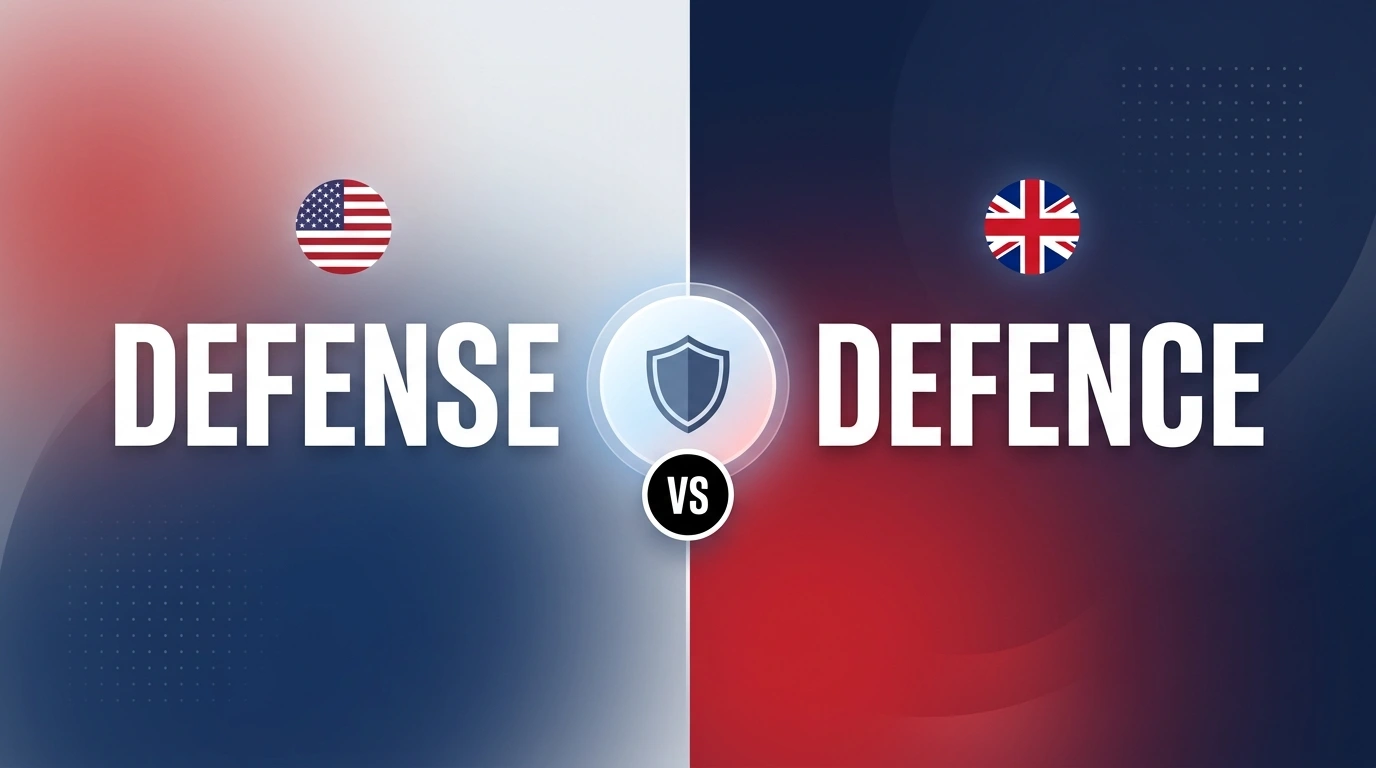
You are typing a word and stop. Is it defence or defense? Both look right. Both look wrong. You are not alone.
Millions of people search this every year. Writers, students, bloggers, and office workers all get stuck on it. The word is common. It shows up in sports, law, war, and daily talk. But the spelling changes by country.
Here is the good news. Neither spelling is a mistake. One is American. The other is British. They mean the same thing.
This guide clears up the confusion fast. You will get a quick answer first. Then you will learn where the word came from and why two spellings exist. You will see a side-by-side table, real examples, and common mistakes. You will also find answers to the questions people ask most.
By the end, you will know which spelling to pick. You will also know why. Let’s start.
Quick Answer
Use “defense” in American English. Use “defence” in British English.
That is the whole rule. The meaning does not change.
- US: The team played strong defense.
- UK: The team played strong defence.
- US: The Department of Defense released a statement.
- UK: The Ministry of Defence released a statement.
Canada, Australia, India, and most Commonwealth countries use defence. The United States uses defense.
Pick one spelling. Use it every time in the same piece of writing.
The Origin of Defence and Defense
The word comes from Latin. The Latin word defendere means “to ward off” or “to protect.” From it came defensa, meaning “a protection.”
The word then moved into Old French. There it was spelled defense or defens. English borrowed it around the 1300s. At that time, spelling was not fixed. People wrote words how they sounded. You could see defens, defense, and defence in the same book.
Over time, British writers settled on -ce. Many nouns ended that way, like fence and pretence.
Then came Noah Webster.
His choices stuck in the US. Britain kept -ce. That is why we have two spellings today.
British English vs American English Spelling
Many English words follow the same pattern as defence and defense. The US often uses -se. The UK often uses -ce for nouns.
| Word | American English | British English |
| Protection | defense | defence |
| Attack (law/sport) | offense | offence |
| Excuse | pretense | pretence |
| Permit (noun) | license | licence |
| Exercise (noun) | practice | practice |
| Color | color | colour |
| City planning | center | centre |
A few key points:
- In the UK, the noun is licence and the verb is license. Defence has no matching verb. The verb is simply defend.
- Both countries spell defensive and defensible with an s.
- Even in the UK, you will see “Defense” in some US names, like the “US Department of Defense.”
Which Spelling Should You Use?
Think about who will read your work.
Writing for a US audience? Use defense. This includes American websites, US businesses, and American schools.
Writing for a UK, Canadian, Australian, Indian, or other Commonwealth audience? Use defence.
Writing for a global audience? Pick the one that fits your main readers. Then stay consistent. If you are unsure, check where most of your traffic comes from.
Writing a school paper? Follow your teacher’s style guide. Many schools state which English to use.
Using a company name or official title? Copy the exact spelling. “Department of Defense” is American. “Ministry of Defence” is British. Do not change names.
A simple trick: set your spell-checker to the right language. Choose “English (US)” or “English (UK).” It will catch the difference for you.
Common Mistakes with Defence and Defense
1. Mixing both spellings in one article.
Wrong: “Our defence was strong, but their defense was stronger.”
Right: “Our defense was strong, but their defense was stronger.”
2. Changing an official name.
Wrong: “US Department of Defence”
Right: “US Department of Defense”
3. Using “defence” as a verb.
Wrong: “They will defence the castle.”
Right: “They will defend the castle.”
4. Writing “defensive” with a c.
Wrong: “defencive”
Right: “defensive” (this is the same in the US and UK)
5. Thinking one spelling is wrong.
Neither is wrong. They are just different regional styles.
6. Forgetting to match related words.
If you write “offence” (UK), match it with “defence.” If you write “offense” (US), match it with “defense.”
Defence and Defense in Everyday Examples
On social media:
“What a game! That defense was unreal! 🔥” (US fans)
“Great defence from our lads tonight.” (UK fans)
In formal writing:
“The defendant’s defense relied on new evidence.” (US)
“The defendant’s defence relied on new evidence.” (UK)
In sports (Canada):
“The Canadian team has the best defence in the league.”
Defence and Defense Google Trends & Usage Data
Search patterns follow geography. Here is what you can expect to see.
- “Defense” is searched more worldwide. The United States has a huge population and a huge amount of online content. This pushes “defense” higher in global totals.
- “Defence” is strong in the UK, Australia, India, Canada, Pakistan, and New Zealand. Local news and government pages in these places use it.
- Context matters. “Defense” often appears with US sports, like football and basketball. It also appears with law and military topics. “Defence” often appears with cricket, rugby, football (soccer), and government news.
- Spikes happen during events. Big sports games, military news, and court cases can raise searches for both words.
For the latest numbers, open Google Trends. Type both spellings and compare them by country and by date. Results change over time, so check fresh data before you decide.
Comparison Table: Keyword Variations Side by Side
| Term | Spelling Type | Where It Is Used | Example |
| defense | American | United States | “The defense held strong.” |
| defence | British | UK, Canada, Australia, India, Pakistan, NZ | “The defence held strong.” |
| defensive | Both | Worldwide | “He played a defensive game.” |
| defend | Both (verb) | Worldwide | “They defend the goal.” |
| defender | Both | Worldwide | “The defender cleared the ball.” |
| Department of Defense | Official US name | United States | “Department of Defense budget” |
| Ministry of Defence | Official UK name | United Kingdom and others | “Ministry of Defence report” |
FAQs
1. Is defence or defense correct?
Both are correct. Defense is American. Defence is British.
2. Do Canadians use defence or defense?
Canadians mostly use defence. You will see it in sports, news, and government titles.
3. Is “defense” wrong in the UK?
It is not a major error, but it looks American. UK readers expect defence.
4. Why do the US and UK spell it differently?
Noah Webster changed many American spellings in the early 1800s. Britain kept the older -ce style.
5. Is “defensive” spelled the same in both countries?
Yes. Both countries use defensive with an s.
6. Which spelling is best for SEO?
Use the spelling your main audience searches. If you serve both, you can write a guide like this one that covers both.
7. Can I use both spellings in one article?
Only when you compare them, like in this guide. Otherwise, pick one and stay consistent.
8. What about “offence” and “offense”?
They follow the same rule. UK writers use offence. US writers use offense.
Conclusion
Defence and defense mean the same thing. The only difference is where you live and who you write for.
Here are the key points to remember:
- Defense is the American spelling.
- Defence is the British and Commonwealth spelling.
- Canada, Australia, India, and the UK use defence.
- Defensive, defend, and defender are the same everywhere.
- Never use both spellings in one piece of writing, unless you are comparing them.
- Keep official names exactly as they are written, like “Department of Defense” or “Ministry of Defence.”
Here is a simple rule to follow. Ask yourself, “Who is reading this?” If the answer is Americans, write defense. If the answer is British or Commonwealth readers, write defence. If you serve a global crowd, choose your main audience and stay consistent.
Set your spell-checker to the right English. It will save you time and stop mistakes before they happen.
Now you can write with confidence. Neither spelling is a mistake. Just pick the right one for your reader.