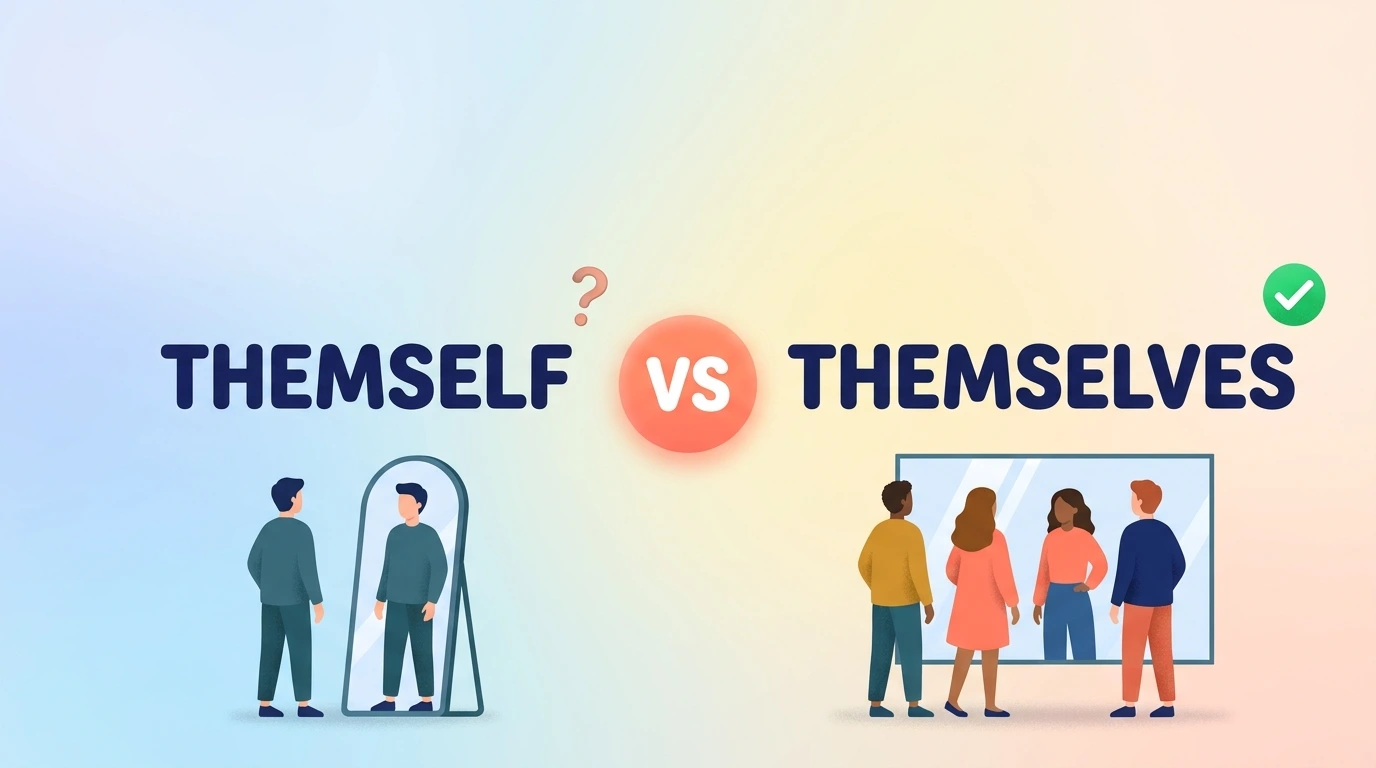
You are writing an email. You want to say that a person did something on their own. Your fingers stop. Is it “themself” or “themselves”?
You are not alone. Thousands of people search this question every month. The old rule was simple: “themselves” means more than one person. But today we often use “they” for one person. That makes the old rule feel shaky.
People search this keyword because they want a fast, safe answer. Many also worry that a wrong choice will look sloppy at work, in school, or online.
This guide clears up the confusion. You will get a quick answer first. Then you will learn where each word comes from, how US and UK writers treat them, and which one to pick for your reader. You will also see common mistakes, real examples, and answers to common questions.
By the end, you will know exactly what to write.
Quick Answer
“Themselves” is the safe choice in almost every case. Use it for two or more people. Use it for a single person too, when you use “they” for that person.
“Themself” is a newer, less common form. Some writers use it for one person. Some dictionaries now list it. But many editors and teachers still mark it as wrong.
Examples:
- The kids made lunch themselves. (many people: always “themselves”)
- Each student must introduce themselves. (safe, common)
- Alex said they would drive themself home. (some writers accept this)
- Alex said they would drive themselves home. (safest)
Short rule: When in doubt, write “themselves.”
The Origin of Themself and Themselves
Both words are built from two parts. “Them” is the pronoun. “Self” or “selves” is the ending that points back to the person doing the action. Grammar teachers call these reflexive pronouns.
Look at the pattern:
- my + self = myself
- him + self = himself
- her + self = herself
- them + self = themself?
- them + selves = themselves
“Self” is the word for one. “Selves” is the word for many. So “themself” fits the pattern for one person. Writers used it in English long ago. It then faded away.
Meanwhile, people have used “they” for one person since the 1300s. Think of “Someone left their coat.” Nobody blinks at that. When people used singular “they,” they also needed a reflexive form. Most picked “themselves,” because it was already common and familiar.
Why do two forms exist? Because English has no single rule that settled it. Usage decided it, and usage is still changing. Today more people use “they” for one person, including people who are nonbinary. That has brought “themself” back into the conversation.
British English vs American English Spelling
Here is a surprise. This is not like “color” and “colour.” There is no spelling that belongs only to the US or only to the UK. Both countries use the same two words. The difference is how much each one is accepted.
| Feature | American English | British English |
| Themselves (many people) | Standard | Standard |
| Themselves (one person, with “they”) | Common and accepted | Common and accepted |
| Themself (one person) | Growing, still debated | Growing, still debated |
| Style guides | Mostly accept singular “they” | Mostly accept singular “they” |
| Safest choice | Themselves | Themselves |
The lesson: do not pick based on country. Pick based on your reader and the style guide you follow. Check your school, company, or publisher rules first.
Which Spelling Should You Use?
Writing for a US audience: Use “themselves.” Newsrooms, schools, and businesses in the US still expect it. Use “themself” only if a style guide allows it, or if you are quoting someone who uses it.
Writing for a UK or Commonwealth audience: Use “themselves.” Formal British writing is often more traditional. “Themself” may look like a typo to some readers.
Writing for a global audience: Use “themselves.” Readers who learn English as a second language often study the old rule. “Themselves” avoids confusion.
Writing about identity: Some people prefer “themself” for one person who uses “they.” Respect the choice a person makes about their own words.
Rule of thumb: If no one told you otherwise, “themselves” never gets you in trouble.
Common Mistakes with Themself and Themselves
Mistake 1: Using “themself” for many people.
- Wrong: The players blamed themself.
- Right: The players blamed themselves.
Mistake 2: Writing “themselfs.”
- Wrong: They did it themselfs.
- Right: They did it themselves.
You may hear it in speech. It is not standard in writing.
- Wrong: They taught theirselves to code.
- Right: They taught themselves to code.
Mistake 4: Mixing singular and plural in one sentence.
- Confusing: The manager said they would handle it themself, and the team agreed to do it themselves.
- Better: Pick one form and stay with it.
Mistake 5: Using a reflexive word when you don’t need one.
- Wrong: Please send the form to John and themselves.
- Right: Please send the form to John and them.
A reflexive word is only for when the person doing the action is also the one receiving it.
Themself and Themselves in Everyday Examples
Email:
- “Each team member should introduce themselves at the meeting.”
- “If the client wants to review it themselves, send the file.”
News writing:
- “The mayor said they would remove themselves from the vote.”
- “Voters made up their minds for themselves.”
Social media:
- “Let people be themselves.”
- “Everyone has to find themselves at some point.”
Formal writing:
- “A candidate must prepare themselves for the interview.”
- “Participants identified themselves by number.”
In all four places, “themselves” reads smoothly. If you see “themself,” it is usually in casual posts or in writing about gender identity.
Google Trends and Usage Data
I did not pull live Google Trends numbers for this article, so I won’t invent any. Here are the patterns that language researchers and dictionary editors commonly report:
- “Themselves” is far more popular than “themself” in searches and in books.
- Interest in “themself” has risen as more people talk about singular “they.”
- Searches spike around school terms, new style guide updates, and public talk about pronouns.
- Most searches come from English speaking countries, such as the US, the UK, Canada, Australia, and India. Many come from students and workers who write often.
To see current data, open Google Trends and compare “themself” against “themselves.” Then filter by country and date range. You can also check the Google Books Ngram Viewer for long-term history.
Keyword Variations Side by Side
| Form | Number of People | Status | Example |
| Themselves | Many | Standard | They hurt themselves. |
| Themselves | One (with “they”) | Common, safe | Sam hurt themselves. |
| Themself | One (with “they”) | Growing, debated | Sam hurt themself. |
| Themselfs | Any | Wrong | They hurt themselfs. |
| Theirselves | Any | Non-standard | They hurt theirselves. |
FAQs
1. Is “themself” a real word?
Yes. Major dictionaries list it. It is used for one person. It is just less common than “themselves.”
2. Is “themself” correct in formal writing?
Not always. Many editors prefer “themselves.” Follow your style guide.
3. Can I use “themselves” for one person?
Yes. It is the most common choice when you use “they” for a single person.
4. Is “themselves” always plural?
It is plural in form. It is used for many people, and often for one person who uses “they.”
5. Which is better for school essays?
“Themselves.” Teachers expect it, and it is the safer choice.
6. Is “themself” British or American?
Neither. It is not tied to one country. Both countries debate it.
7. Is “theirselves” correct?
No. Use “themselves” instead.
8. What if someone says they prefer “themself”?
Respect that when you write about them. It is polite and accurate to use the words people choose for themselves.
Conclusion
Here is what to remember.
“Themselves” is the safe, standard choice. Use it for many people. Use it for one person too, when you write with singular “they.” No teacher, editor, or boss will mark it wrong.
“Themself” is real, but newer and less settled. Some dictionaries list it. Some writers prefer it for one person. Still, many readers see it as an error. Use it only when a style guide allows it or when a person asks for it.
The choice is not about the US versus the UK. Both countries use both forms, and both are still deciding. The real question is your reader. Ask who will read your work, and what rules if they follow.
Avoid the false forms: “themselfs” and “theirselves.” These are never right in writing.
If you are unsure, take one simple step: write “themselves.” It works in emails, essays, news stories, and posts. Language keeps changing, and “themself” may grow more common over time. For now, “themselves” is the choice that keeps you clear, correct, and confident.

I am a professional blogger and content writer specializing in synonyms. With a strong focus on research-based writing and clear communication, I creates high-quality content designed to inform, educate, and add long-term value for readers.I am committed to maintaining accuracy, consistency, and professionalism across all published work.