You are typing a message. You stop. Is it “where” or “were”? You are not alone. Millions of people pause on these two small words every day.
People search for “where or were” because the words look almost the same. They sound close, too. Spell check often cannot help, since both are real words. A wrong pick can make a good email look sloppy.
This guide clears up the confusion.
If you write school essays, work emails, or social posts, this page gives you a fast answer and the deeper reasons behind it.
Quick Answer
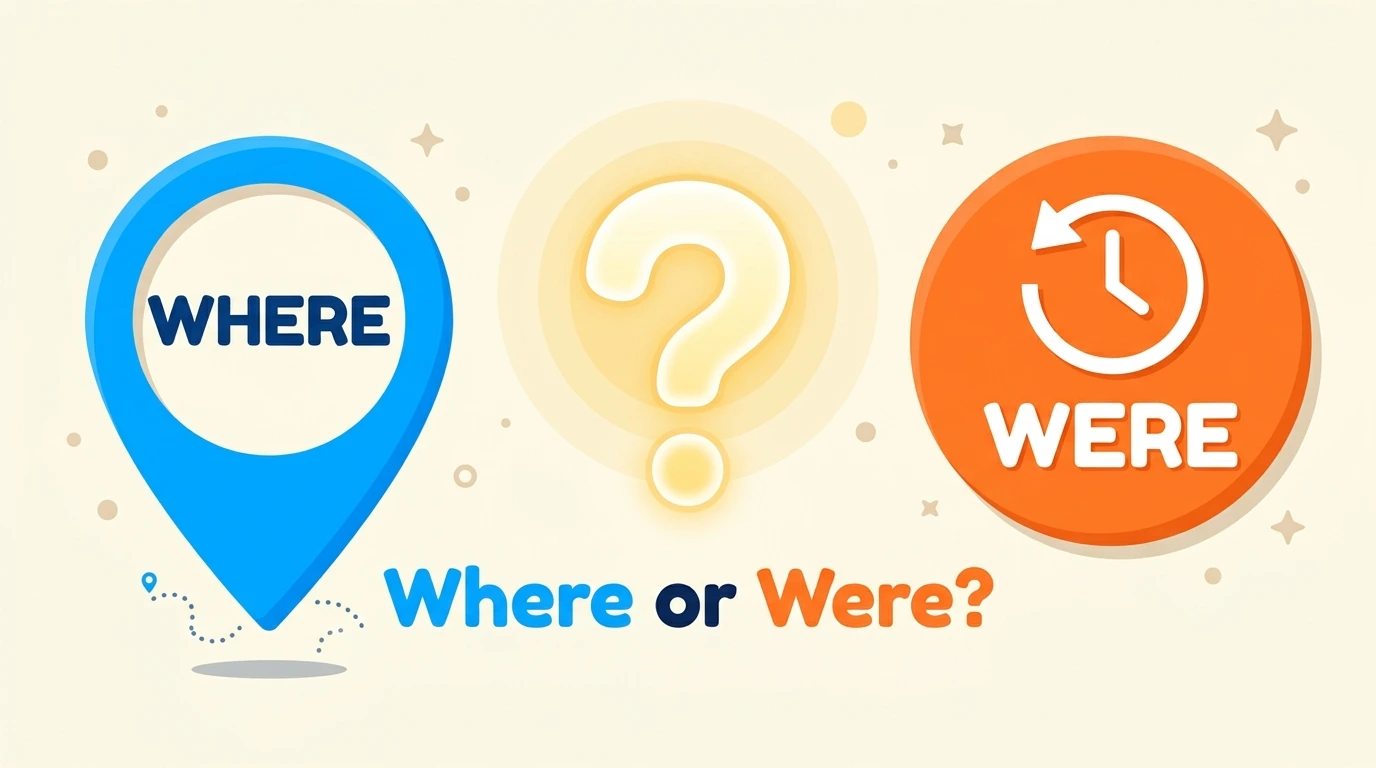
Use “where” when you talk about a place.
Use “were” when you talk about the past (a form of “to be”).
Examples with “where”:
- Where is the station?
- I know where you live.
- This is where we met.
Examples with “were”:
- We were late.
- They were happy.
- If I were you, I would wait.
Quick trick: Replace the word with “here” or “there.” If the sentence still works, use “where.” Notice that “where” has “here” hiding inside it.
The Origin of Where and Were
Both words come from Old English, the language spoken in England over a thousand years ago.
- Where comes from the Old English word hwǣr. It meant “at what place.”
- Were comes from Old English wǣre and wǣron. These were past forms of the verb “to be.”
Why do they look alike? Over time, English changed many spellings. The old “hw” at the start of words like hwǣr turned into “wh.” So “where” got its “wh.” “Were” stayed with a plain “w.”
Why do people mix them up? Many speakers say “wh” and “w” the same way today. So the ear cannot tell them apart. The eye has to do the work.
British English vs American English Spelling
Here is the good news. There is no spelling difference between British and American English for these words. Both use “where” and “were” the same way.
What differs is how people say them. Many Americans pronounce the “r” at the end. Many British speakers do not. This can change how the words sound, but not how you write them.
| Feature | American English | British English |
| Spelling of “where” | where | where |
| Spelling of “were” | were | were |
| “Where” sound | Often with a clear final “r” | Often a soft ending, no hard “r” |
| “Were” sound | Often with a clear final “r” | Often a soft ending, no hard “r” |
| Wishes (“If I ___ you”) | were | were |
| Common casual error | “were” for “where” | “were” for “where” |
So spelling rules will not save you here. Meaning will.
Which Spelling Should You Use?
The answer is simple. Pick by meaning, not by country.
- US readers: Use “where” for place and “were” for past. In formal writing, use “if I were” for wishes.
- UK and Commonwealth readers: Same rule. The words do not change.
- Global readers: Keep sentences short. Short sentences make the choice easier to check.
If you write for a mixed audience, there is nothing to adjust. Just check each sentence once before you hit send.
Common Mistakes with Where or Were
| Mistake | Fix | Why |
| Were are you going? | Where are you going? | You ask about a place. |
| We where late. | We were late. | You talk about the past. |
| They where happy. | They were happy. | “Were” goes with “they.” |
| If I where you… | If I were you… | A wish needs “were.” |
| I don’t know were it is. | I don’t know where it is. | You mean a place. |
| We were to go. (meaning “we wear”) | Use “wear” for clothes. | Wear is another word. |
Tip: Read your sentence out loud. Then ask: place or past?
Where or Were in Everyday Examples
Emails
- Please tell me where the file is.
- The team were not in the office on Friday. (More common in British English; American English often says “was.”)
News
- Police said they were looking for the driver.
- Officials have not said where the meeting will happen.
Social media
- Where are you going tonight?
- We were so tired after that trip!
Formal writing
- The report explains where the funds were spent.
- If the law were changed, the result would differ.
Where or Were Google Trends and Usage Data
I cannot show live Google Trends numbers here, so I will not invent any. Here is what you can expect, and how to check it yourself.
- By country: Interest in grammar questions like this usually appears in countries where English is widely used or taught, such as the US, UK, India, Canada, Australia, and Nigeria. Open Google Trends to compare real numbers.
- By time: Grammar searches often rise when school starts and during exam seasons.
- By context: People often search from phones while writing messages. They want a quick answer, not a long lesson.
To check the data, go to Google Trends. Type “where or were.” Then filter by country and date range.
Keyword Variations Side by Side
| Word | Type | Meaning | Example |
| where | Adverb | At what place | Where is my bag? |
| were | Verb (past of “be”) | Existed or happened before | We were at home. |
| we’re | Contraction | We are | We’re ready. |
| wear | Verb | Have clothes on | I wear a hat. |
FAQs
1. What is the difference between “where” and “were”?
“Where” is about a place. “Were” is a past form of “to be.”
2. How can I remember which one to use?
Swap in “here” or “there.” If it fits, use “where.” “Where” has “here” inside it.
3. Is the spelling different in British and American English?
No. Both use “where” and “were” in the same way.
4. Is “if I were” or “if I was” correct?
“If I were” is the standard form for wishes and unreal ideas. “If I was” is common in casual talk.
5. Is “we’re” the same as “were”?
No. “We’re” means “we are.” “Were” is a past form of “be.” Check the apostrophe.
6. Can spell check find this mistake?
Often not. Both are real words, so tools may miss the error. Read it out loud.
7. Is “wear” related to these words?
No. “Wear” is about clothes. It only sounds close.
Conclusion
Now you know the answer to “where or were.” Here is the short version.
“Where” talks about a place. “Were” is a past tense form of “to be.” That is the whole difference. They are not spelled differently in the US and the UK. Both countries use the same two words the same way.
Remember the trick: if you can swap in “here” or “there,” use “where.” Notice that “where” has “here” inside it. If the sentence talks about the past, or a wish like “if I were you,” use “were.”
Avoid the common slips. Do not write “were are you.” Do not write “we where late.” Read your sentence out loud, and ask one question: place or past?
For work emails, school papers, and social posts, this one check saves you from small errors. Small errors can cost trust. Good writing is often just careful checking.
Bookmark this guide and share it with a friend who keeps mixing them up. Next time you type “where or were,” you will know exactly which one to pick.