Have you ever typed a word and then stopped? You look at it. It looks wrong. You look again, and it still looks wrong. That happens a lot with the plural of monkey.
Is it monkies or monkeys? Many people search for this every month. They want a fast answer. They also want to know why the word is so confusing.
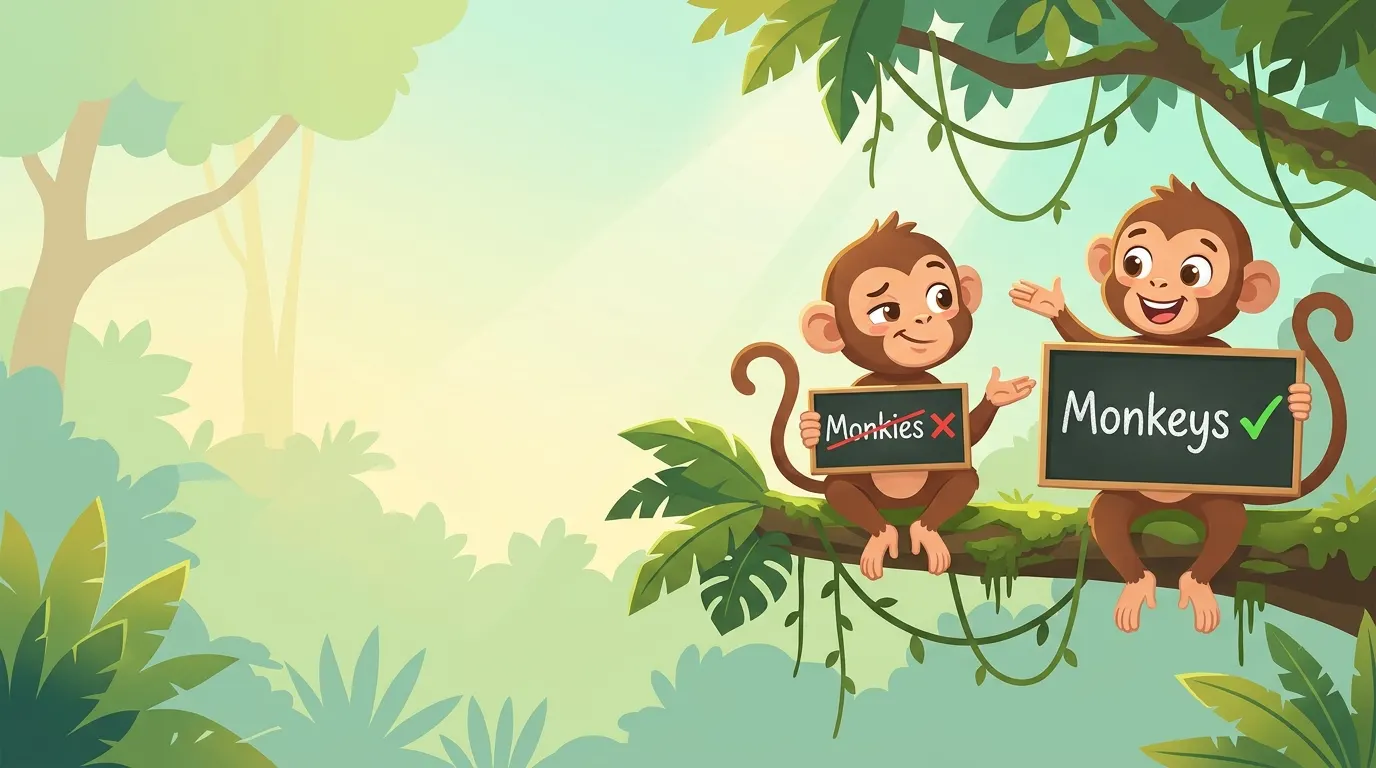
Here is the short truth. The correct spelling is monkeys. Monkies is a common mistake.
So why do people get it wrong? Many English words that end in y change to ies. Baby becomes babies. City becomes cities. It seems like monkey should follow the same path. But it does not.
In this guide, you will get a quick answer first. Then you will learn where the word came from. You will see how British and American English handle it. You will also see common mistakes, real examples, and answers to common questions.
By the end, you will never second-guess this word again. Let’s start.
Quick Answer
Monkeys is correct. Monkies is wrong in every kind of English.
The rule is simple:
- If a word ends in a vowel + y, add s.
- If a word ends in a consonant + y, change the y to ies.
Monkey ends in e + y. The letter before the y is a vowel (e). So you just add s.
Examples:
- One monkey, two monkeys.
- One key, two keys.
- One donkey, two donkeys.
- One boy, two boys.
- One baby, two babies (consonant + y, so this one changes).
The Origin of Monkey
Nobody knows for sure where “monkey” came from. It first showed up in English in the 1500s. Many word experts think it came from older European languages.
One popular idea links it to a story about Reynard the Fox. In that tale, the ape’s son was named Moneke.
Another idea says the word is related to old words for “ape” in Italian and French. The “key” part may be a small ending, like the “kin” in “lambkin.”
Why do spellings differ? English borrowed words from many places. Spelling rules grew slowly. Printers and writers changed words over time. Some words kept odd forms. That is why English feels messy.
The “ies” mistake is not about history. It comes from a rule that people over apply. They see the y and think “ies.”
British English vs American English Spelling
Good news: there is no difference here. Both the UK and the US use “monkeys.”
British and American English do differ in other words. But the y plural rule is the same in both.
| Word | American English | British English | Plural |
| Monkey | monkey | monkey | monkeys |
| Donkey | donkey | donkey | donkeys |
| Key | key | key | keys |
| Baby | baby | baby | babies |
| Color / Colour | color | colour | (differs, not the y rule) |
| Money | money | money | moneys or monies |
So if you worry that you need a “UK version” or “US version,” relax. There is only one.
Which Spelling Should You Use?
Use “monkeys.” Always.
- US readers: monkeys.
- UK and Commonwealth readers (Australia, Canada, India, and others): monkeys.
- Global audience: monkeys.
There is no case where “monkies” is the better choice. The only time you might type it is in a quote, a brand name, or an example of an error.
Common Mistakes with Monkies or Monkeys
Mistake 1: Using “monkies” as the plural.
- Wrong: Two monkies sat in the tree.
- Right: Two monkeys sat in the tree.
Mistake 2: Mixing up plural and possessive.
- Wrong: The monkey’s are loud. (This is a possessive, not a plural.)
- Right: The monkeys are loud.
- Right: The monkey’s tail is long. (This one belongs to one monkey.)
- Right: The monkeys’ cage is open. (The cage belongs to many monkeys.)
- Wrong: donkies, turkies, valleies
- Right: donkeys, turkeys, valleys
Quick tip: Look at the letter before the y. If it is a, e, i, o, or u, just add s.
Monkies or Monkeys in Everyday Examples
Email:
“The zoo trip is on Friday. The kids will see the monkeys first.”
News headline:
“Zoo Welcomes Three Baby Monkeys”
Social media:
“Watching monkeys at the park. Best day ever! 🐒”
Formal writing:
“Researchers studied how monkeys use tools in the wild.”
Casual phrase:
“Barrel of monkeys” is a popular saying. It uses “monkeys,” never “monkies.”
Google Trends & Usage Data
I can’t pull live Google Trends numbers here, so I won’t invent them. But the general pattern is easy to explain, and you can check it yourself.
What you will usually find:
- Searches for “monkeys” are far higher than searches for “monkies.” People search for the animal, not the spelling.
- Searches for the spelling question (“monkies or monkeys”) come in smaller waves. They often rise when students, writers, and non-native English speakers check their work.
- Interest in the spelling question shows up in many English-speaking countries, including the US, UK, India, Canada, and Australia. It is not tied to one country. That fits the fact that the rule is the same everywhere.
- Search interest in the animal goes up around school terms, zoo trips, and movie releases.
How to check it: Go to Google Trends. Type “monkeys” and “monkies” as two search terms. Set the region and date range you want. You will see which spelling people search for more.
Comparison Table: Keyword Variations
| Form | Correct? | Notes |
| monkeys | ✅ Yes | Standard plural in all English |
| monkies | ❌ No | Common spelling error |
| monkey’s | ✅ Sometimes | Possessive (one monkey owns something) |
| monkeys’ | ✅ Sometimes | Possessive (many monkeys own something) |
| monkeyes | ❌ No | Not a real form |
| monkee | ❌ No | Only used in the band name The Monkees |
FAQs
1. Is it monkies or monkeys?
It is monkeys. Monkies is a spelling mistake.
2. Why is monkey not monkies?
The letter before the y is a vowel (e). When that happens, you add s. You only change y to ies after a consonant.
3. Is “monkies” correct in British English?
No. British English also uses “monkeys.”
4. Is “monkies” ever correct?
No. It is not accepted in standard dictionaries.
5. What is the plural of donkey?
Donkeys. It follows the same rule as monkey.
6. Is it “money’s” or “monies”?
Both “moneys” and “monies” appear in finance and law. “Monies” is a special case. It is not a model for monkey.
7. What is the difference between monkeys and monkey’s?
“Monkeys” means more than one monkey. “Monkey’s” shows that one monkey owns something, like “the monkey’s banana.”
8. What about the band The Monkees?
That is a brand name. The spelling was chosen on purpose. It does not change the normal plural.
Conclusion
Let’s wrap it up. The right plural of monkey is monkeys. It does not matter if you write for the US, the UK, or the whole world. The spelling stays the same.
Remember the simple rule. If a word ends in a vowel plus y, add s. That gives you monkeys, donkeys, keys, and boys. If a word ends in a consonant plus y, change the y to ies. That gives you babies and cities.
Most people write “monkies” because they over-use the ies rule. It is an easy slip. Now you know how to avoid it.
Watch out for the possessive too. Use monkey’s for one monkey and monkeys’ for many. Do not add an apostrophe to a plain plural.
When in doubt, check the letter before the y. It will guide you every time. Share this rule with friends, students, or coworkers who ask. A small tip like this can make your writing look cleaner and more professional.
Next time you type it, you will know. Monkeys. Done.