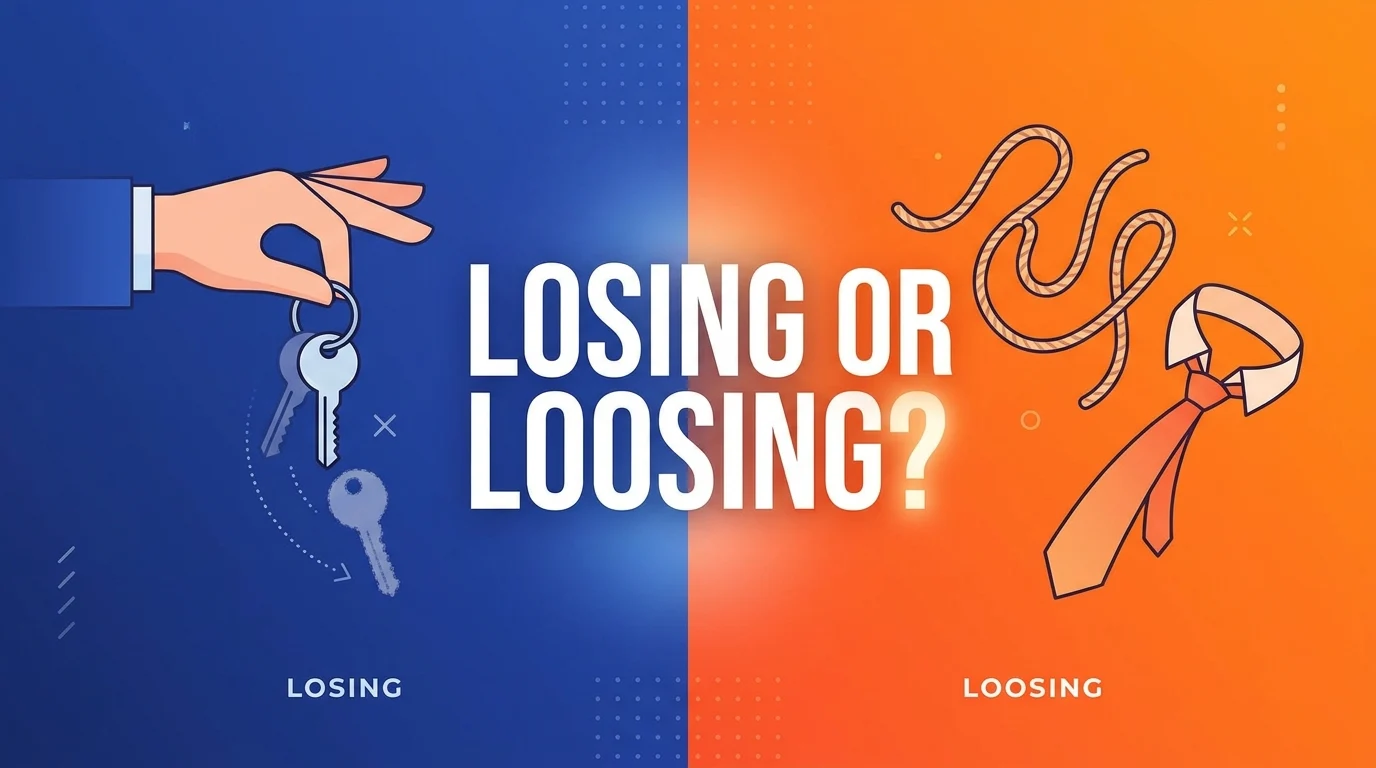
You are typing a sentence. You stop. Is it “I am losing my mind” or “I am loosing my mind”? You are not alone. Many people pause at this exact spot.
People search “losing or loosing” for a simple reason. The words look alike. They sound alike. And spell check does not always catch the mistake, because “loosing” is a real word. So the computer says nothing, and you are left guessing.
This confusion comes from two small words: lose and loose. But one extra letter “o” makes people mix them up.
This guide clears it up fast. You will get the quick answer first. Then you will see where the words come from, how to use them, and which mistakes to avoid. You will also get real examples, a handy table, and answers to common questions.
By the end, you will never second-guess this spelling again. Let’s begin.
Quick Answer
Use “losing” in almost every case.
“Losing” means failing to keep something, failing to win, or having less of something.
- I am losing my keys.
- Our team is losing the game.
- She is losing weight.
- He is losing patience.
“Loosing” is rare. It means setting something free or making it less tight.
- The guard is loosing the dogs.
- The archer is loosing an arrow.
If you are not sure, write “losing.” You will be right 99 times out of 100.
The Origin of Losing and Loosing
These two words come from different roots.
Lose comes from Old English losian. It meant “to be lost” or “to perish.” It is linked to the word loss. The word losing is just “lose” plus “-ing.” The “e” drops away, as in make → making.
Loose comes from Old Norse lauss. It meant “free” or “not tied.” The word loosing is “loose” plus “-ing.” The “e” drops here too.
So why the mix-up? There are three reasons.
- The “oo” trap. “Loose” has two o’s. “Lose” has one. Many people add the extra “o” by habit.
- The sound trap. “Lose” sounds like “looz.” “Loose” sounds like “looss.” The vowel sound is the same, so the ear does not help much.
- The look alike trap. Words like choose and loose have double o’s. Words like close and lose do not follow the same pattern. English spelling is not always fair.
British English vs American English Spelling
Here is a key fact: there is no British or American difference for this word pair. Both use “losing” and “loosing” the same way. The confusion is a spelling mistake, not a regional choice.
Many other words do change between the two. Here is a comparison.
| Word | American English | British English |
| Losing (to fail to keep) | losing | losing |
| Loosing (to set free) | loosing | loosing |
| Color | color | colour |
| Center | center | centre |
| Organize | organize | organise |
| Traveling | traveling | travelling |
So if someone says “loosing” is the British spelling of “losing,” they are wrong. “Loosing” is simply a different word.
Which Spelling Should You Use?
The answer is the same for every audience.
- US readers: Use “losing” for lose. Use “loosing” only for setting free.
- UK and Commonwealth readers: Same rule. Use “losing” for lose. Use “loosing” only for setting free.
- Global readers: Same rule. Choose the word by meaning, not by country.
Here is a quick test. Ask yourself: Am I talking about something gone, missing, or beaten? Use losing. Am I talking about something freed or made less tight? Use loosing.
Also remember this. “Loosing” is old fashioned. Most modern writers use “releasing,” “freeing,” or “loosening” instead. So you may never need it.
Common Mistakes with Losing or Loosing
These errors show up all the time.
| Wrong | Right |
| I am loosing weight. | I am losing weight. |
| We are loosing the match. | We are losing the match. |
| Don’t loose your phone. | Don’t lose your phone. |
| He is loosing his mind. | He is losing his mind. |
| She is loseing hope. | She is losing hope. |
| I am loosening the dogs. (when you mean releasing) | I am loosing the dogs. |
Three tips to avoid errors:
- Remember: lose has “lost” in it. Both have one “o.”
- Drop the “e” before “-ing.” It is “losing,” never “loseing.”
- Read the word out loud. If it ends with a “z” sound, you want one “o.”
Losing or Loosing in Everyday Examples
- “I am losing access to the shared folder. Can you help?”
- “Please do not lose this file.”
News headline
- “Retailer keeps losing customers as prices rise.”
- “Party is losing support in key states.”
Social media
- “I’m losing it 😂”
- “Anyone else losing sleep over this season finale?”
Formal writing
- “The company is losing market share.”
- “The committee warned against losing public trust.”
Rare use of “loosing” (often in stories or older texts)
- “The captain ordered the crew to begin loosing the sails.”
- “He stood by, loosing arrows at the gate.”
Notice the pattern. Nearly every real example uses “losing.”
Google Trends & Usage Data
I cannot pull live Google Trends numbers here, and I will not invent them. But the general pattern is clear and easy to check yourself.
What you will usually see:
- “Losing” is searched and written far more than “loosing” everywhere. It is a common everyday word.
- “Loosing” appears mostly as a typo or as a search by people who are unsure. That is why “losing or loosing” is a popular question.
- By country: Interest in the question shows up in English-speaking countries such as the US, UK, Canada, Australia, India, and Nigeria. Spelling help searches often come from places where English is a second language.
- By context: The mistake is most common in fitness (“losing weight”), games and sports, and emotional posts (“losing my mind”).
How to check it yourself:
- Go to Google Trends.
- Enter “losing” and “loosing” as two terms.
- Set the region and time range you care about.
- Compare the lines. You can also try Google Books Ngram Viewer to see how often each word appears in published writing.
Comparison Table: Keyword Variations Side by Side
| Word | Meaning | Correct? | Example |
| losing | failing to keep or win | ✅ Yes | We are losing time. |
| loosing | setting free | ✅ Yes (rare) | He is loosing the rope. |
| lose | to fail to keep or win | ✅ Yes | Don’t lose hope. |
| loose | not tight, free | ✅ Yes | The screw is loose. |
| loosening | making less tight | ✅ Yes | I am loosening my tie. |
| loseing | none | ❌ No | (Never use this.) |
| loosing weight | none | ❌ No | Use losing weight. |
FAQs
1. Is it “losing” or “loosing”?
Use “losing” in nearly all cases. “Loosing” is a different, rare word that means setting free.
2. Is “loosing” a real word?
Yes. It is the “-ing” form of “loose” and means to release or free something. It is just not common today.
3. Is it “losing weight” or “loosing weight”?
It is “losing weight.” You are not setting weight free. You are getting rid of it, so use “lose.”
4. Is “losing” British or American spelling?
Neither. Both American and British English use “losing.” There is no regional difference.
5. Why do people write “loose” when they mean “lose”?
The words look and sound close. The extra “o” is easy to add by habit. Fast typing and weak spell check make it worse.
6. What is the difference between “loosing” and “loosening”?
“Loosing” means to set free or let go. “Loosening” means to make something less tight. For example: loosing an arrow, loosening a belt.
7. How can I remember the difference?
“Lose” has one “o,” just like “lost.” Both are about missing or failing. “Loose” has two o’s, like the empty space in a loose-fitting shirt.
8. Does spell check catch this mistake?
Not always. “Loosing” is a real word, so many tools do not flag it. Always check the meaning yourself.
Conclusion
So, losing or loosing? For almost every sentence you will write, the answer is losing.
Here is what to remember. “Losing” comes from “lose.” It means to misplace something, fail to win, or have less of something. “Loosing” comes from “loose.” It means to set free or make less tight. It is rare today. Most people never need it.
A simple trick helps. If you can swap in “misplacing,” “failing to win,” or “dropping,” use losing. If you can swap in “releasing” or “freeing,” use loosing. When in doubt, go with losing.
Spelling does not change between American and British English. Both use the same forms. So you can write with confidence for any reader, anywhere.
Watch out for the common slips. “Loosing weight” is wrong. “Loosing the game” is wrong. Say “losing weight” and “losing the game.” Read your work out loud. If you hear a hard “z” sound, you need one “o.”
Now you know the rule, the reason, and the trick. Keep this guide handy for quick checks. And next time you are losing a game, do not lose your cool over the spelling.