You are in a chemistry class. The question pops up: is NH3 acid or base? You freeze. Many people do. Ammonia smells sharp. It cleans windows. It sits on lab shelves. But the bottle does not say “acid” or “base” in big letters.
People search this keyword for a few reasons. Students need a fast answer for homework. Parents want to know if a cleaner is safe. Writers wonder how to spell words linked to it, like sulfur or sulphur, neutralize or neutralise. Spelling changes from country to country. That adds to the mess.
This article clears it up. You get a quick answer first. Then you will see where the word ammonia came from, how British and American spelling differ in chemistry, and which one to use. You will also see common mistakes, real examples, usage trends, and a short FAQ.
Short on time? NH3 is a weak base. Read on to learn why, in plain words.
Quick Answer
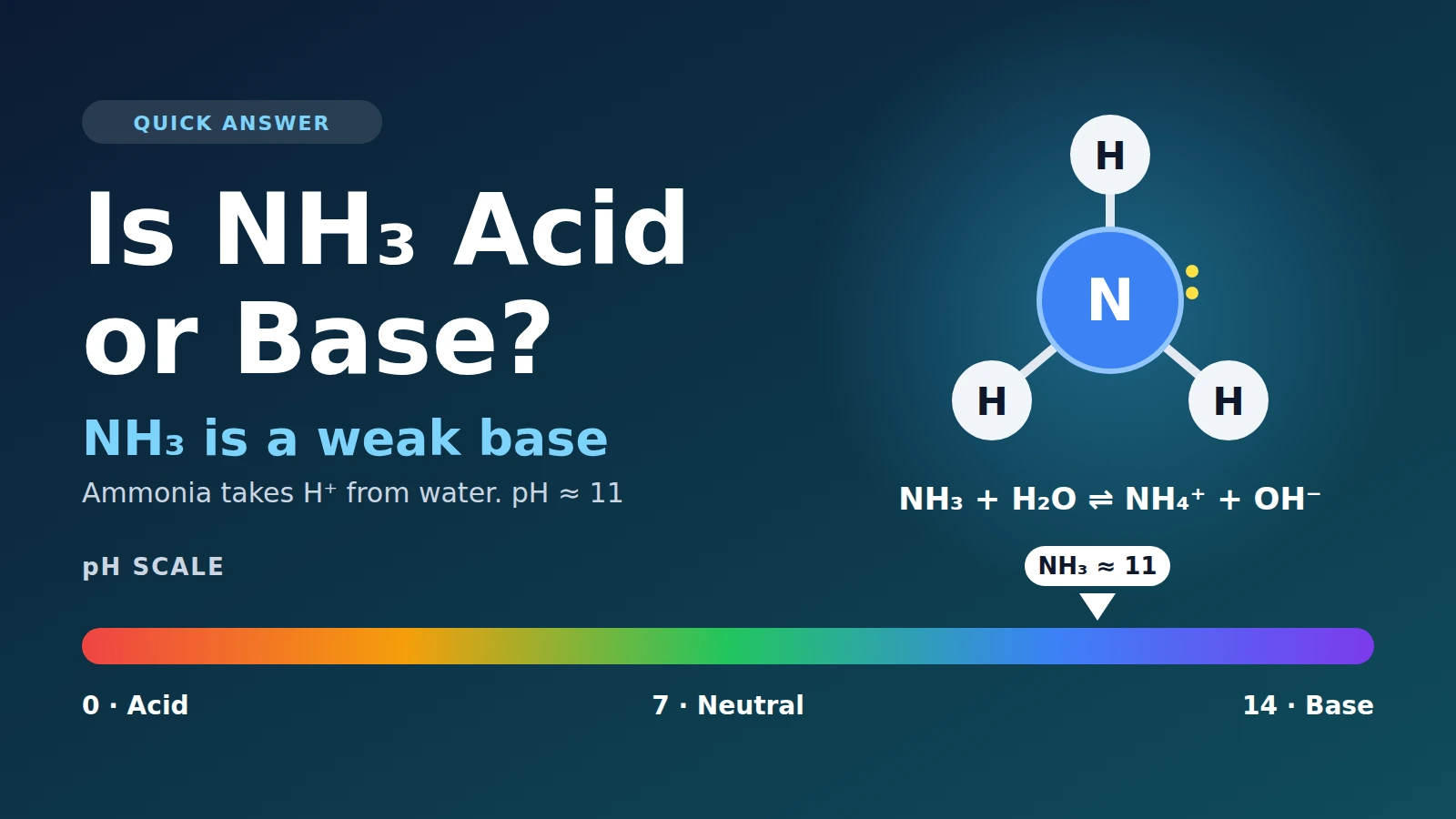
NH3 is a base. It is a weak base.
Here is why. A base takes a hydrogen ion (H+) from water. NH3 does this. It grabs one H+ and becomes NH4+, called ammonium. Water, now missing an H+, becomes OH−. Extra OH− makes the water basic.
NH3 + H2O ⇌ NH4+ + OH−
It is “weak” because only a small part of the NH3 does this at one time. Most stays as NH3.
Quick facts:
- Type: weak base
- Base strength (Kb): about 1.8 × 10⁻⁵
- pH of a 0.1 M solution: about 11
- Lewis view: it gives away a pair of electrons, so it is a Lewis base
- Feels slippery, tastes bitter (never taste it!), turns red litmus paper blue
Examples:
- Window cleaner: ammonia in water, a mild base
- Lab test: red litmus paper turns blue in ammonia solution
- Reaction with acid: NH3 + HCl → NH4Cl (a salt)
Can NH3 ever act as an acid? Yes, but only in extreme cases. It would need a very strong base to pull off an H+. In school and daily life, treat NH3 as a base.
The Origin of NH3 and the Word “Ammonia”
The name has an old story. The ancient Egyptians honored a god named Amun (also written Ammon). Near his temple in North Africa, people found a salt. Romans called it sal ammoniacus, or “salt of Ammon.” We now call it sal ammoniac, or ammonium chloride.
In 1774, the English chemist Joseph Priestley made the gas. He called it “alkaline air.” In 1782, the Swedish chemist Torbern Bergman used the name ammoniaca for the gas, linking it to the old salt. The name stuck. Soon the gas was called ammonia.
The formula NH3 means one nitrogen atom (N) and three hydrogen atoms (H). Chemists settled on that formula in the early 1800s.
Why do spelling differences exist? Words in chemistry came from Latin, Greek, and French. Britain and the US took different paths:
- Noah Webster pushed simple spelling in the US in the early 1800s. He cut extra letters.
- Britain kept more of the French and Latin shapes.
- Chemistry names were also set by committees. Some spellings were later made the same worldwide.
That is why you see sulphur in some books and sulfur in others.
British English vs American English Spelling
The word “ammonia” is spelled the same in both. But words around it, like those in a chemistry lesson, often differ.
Here are the main rules:
- ize vs ise: The US uses ize. The UK often uses ise (Oxford style also allows ize).
- or vs our: The US writes color. The UK writes colour.
- f vs ph: The US writes sulfur. The UK used sulphur for years.
- um vs ium: The US writes aluminum. The UK writes aluminium.
- Single vs double L: The US writes labeled. The UK writes labelled.
| Word in a chemistry context | American English | British English |
| To make neutral | neutralize | neutralise |
| To make ions | ionize | ionise |
| Yellow element | sulfur | sulphur (older UK; sulfur now standard in science) |
| Light metal | aluminum | aluminium |
| Lab tag | labeled | labelled |
| Smell of NH3 gas | odor | odour |
| Hue of litmus | color | colour |
| Sorry-free lab room | laboratory | laboratory (same) |
| Our keyword | ammonia | ammonia (same) |
Good news: The formula NH3 and the idea “weak base” are the same everywhere. Only the nearby words change.
Which Spelling Should You Use?
Pick the spelling that matches your reader.
Writing for the US: Use American spelling. Write neutralize, sulfur, aluminum, odor.
Writing for the UK, Australia, India, or other Commonwealth readers: Use British spelling. Write neutralise, aluminium, odour. For sulfur, use sulfur, as science bodies in the UK now do.
Writing for a global reader: Choose one style and stay with it. Do not mix. Many international science journals use American spelling with IUPAC names (sulfur, aluminium). If unsure, follow the rules of the school, journal, or company you write for.
Simple tip: Match your word processor’s language setting to your audience. It will catch mixed spelling for you.
Common Mistakes with NH3 Acid or Base
| Mistake | Fix |
| Saying NH3 is an acid because it has hydrogen | Hydrogen alone does not make an acid. NH3 takes H+, so it is a base. |
| Calling NH3 a strong base | It is a weak base. Only a little reacts with water. |
| Mixing up NH3 and NH4+ | NH3 is ammonia (the base). NH4+ is ammonium (its partner acid). |
| Writing “NH₃” as “NH 3” or “Nh3” | Write NH3 or NH₃. N and H are capital letters. |
| Writing “ammonia is an alkali” and “a base” as if they differ | Ammonia in water is an alkaline solution. It is a base. |
| Mixing US and UK spelling in one page | Choose one style and keep it. |
| Thinking ammonia is the same as bleach | They are different. Never mix them. The fumes are toxic. |
NH3 Acid or Base in Everyday Examples
Email (student to teacher): “Hello Ms. Reed, I am confused. Is NH3 acid or base? I think it is a weak base because it accepts H+. Thank you.”
News: “Workers cleaned the spill with water. Ammonia, a weak base, can burn skin and eyes in large amounts.”
Social media: “Quick chem tip: NH3 is a base, not an acid. Red litmus turns blue. Easy points on your exam! #chemistry”
Formal writing (lab report): “Ammonia (NH3) acts as a Brønsted Lowry base. It accepts a proton from water and forms ammonium ions and hydroxide ions.”
Product label: “Contains ammonia. Do not mix with bleach. Use in a well-aired room.”
Google Trends and Usage Data
Note: exact numbers change often. Check Google Trends yourself at trends.google.com for live data. Here is what usually shows up for this kind of search.
When people search:
- Interest tends to rise during school terms and exam seasons.
- It dips in summer holidays and mid-December.
Where people search:
- Countries with big student groups, such as India, the US, the UK, Pakistan, the Philippines, Nigeria, and Canada, tend to show steady interest.
- Searchers in the US and Canada often write “acid or base.” Searchers in India and the UK often add words like “weak base” or “Lewis base.”
Why they search:
- Homework and exam prep (most common)
- Safety questions about cleaners
- Curiosity about related terms like pH, ammonium, and alkali
How to use this: Write short, direct answers. Most people want the answer in the first few lines.
| Keyword variation | Typical searcher | Common intent |
| nh3 acid or base | Students, global | Quick answer |
| is nh3 an acid or base | Students, US/UK | Quick answer |
| is ammonia an acid or a base | General public | Safety and basics |
| is nh3 a weak base | Students, India/UK | Strength detail |
| nh3 lewis base | College students | Deeper theory |
| nh3 acid base reaction | Students | Equations |
| ammonia alkaline or alkali | UK, Commonwealth | Word choice |
FAQs
1. Is NH3 an acid or a base? NH3 is a weak base. It takes H+ from water and makes OH−.
2. Why is NH3 a base and not an acid? It has a pair of free electrons on nitrogen. That pair grabs H+. Things that grab H+ are bases.
3. What is the pH of ammonia? A 0.1 M solution has a pH near 11. Stronger mixes have a higher pH.
4. Is NH3 a strong or weak base? Weak. Only a small share of NH3 turns into NH4+ and OH− in water.
5. What is the difference between NH3 and NH4+? NH3 is ammonia, the base. NH4+ is ammonium, the acid made when NH3 takes an H+.
6. Is ammonia an alkali? An alkali is a base that dissolves in water. Ammonia in water makes an alkaline solution, so many people call it an alkali.
7. Does the spelling of ammonia change in UK and US English? No. It is “ammonia” in both. Nearby words like neutralise/neutralize and aluminium/aluminum do change.
8. Is it safe to mix ammonia with bleach? No. It makes toxic gas. Never mix them.
Conclusion
So, is NH3 acid or base? The answer is simple. NH3 is a weak base. It takes ahydrogen ion from water and leaves extra hydroxide behind. That is why red litmus paper turns blue and why the pH rises above 7.
You also learned that the word ammonia is old. It goes back to the Egyptian god Amun and a salt found near his temple. The word itself has one spelling worldwide, but many nearby science words change between British and American English. Remember a few easy pairs: neutralize/neutralise, aluminum/aluminium, odor/odour.
Here is your quick advice:
- Say “weak base” when you answer NH3 questions.
- Keep NH3 (base) and NH4+ (acid partner) apart.
- Pick US or UK spelling to match your reader, and do not mix them.
- Never mix ammonia with bleach.
With these points, you can answer any basic question on this topic with confidence. Bookmark this page for your next quiz or lab report.