Your skin is red, itchy, and flaky. You search online for answers. Two words keep popping up: psoriasis and eczema. They look similar. They act similar. But they are not the same.
People search “psoriasis vs eczema” because they want a clear answer fast. Doctors often use both words loosely. Skin conditions can overlap. This confuses patients.
This article gives you a quick answer first. Then it explains the details. You’ll learn the history of both words, common mix-ups, real-world examples, and how each condition shows up in daily life. By the end, you’ll know which term fits your situation and when to see a doctor.
Quick Answer
- Psoriasis is an autoimmune condition. Skin cells build up fast. This creates thick, silvery scales. It often shows up on elbows, knees, and the scalp.
- Eczema (also called atopic dermatitis) is a skin barrier problem. It causes dry, itchy, red patches. It often appears in the folds of elbows and knees, and on the face in babies.
Example: If your skin has thick, scaly patches that don’t itch much, think psoriasis. If your skin is intensely itchy and looks more like a rash, think eczema.
Both need a doctor’s diagnosis. Home guesses aren’t enough.
The Origin of the Words
Psoriasis comes from the Greek word psora, meaning “itch.” Doctors used this term as far back as ancient Greece. Hippocrates described skin scaling conditions, though he didn’t separate them the way we do today.
Eczema comes from the Greek word ekzein, meaning “to boil out.” It described skin that looked like it was bubbling or oozing.
Both words entered English through medical Latin. Doctors needed precise terms to describe different skin problems. Over centuries, definitions became clearer as medicine advanced. That’s why the words still confuse people they were often used interchangeably in old medical texts.
Naming and Spelling: US vs UK Usage
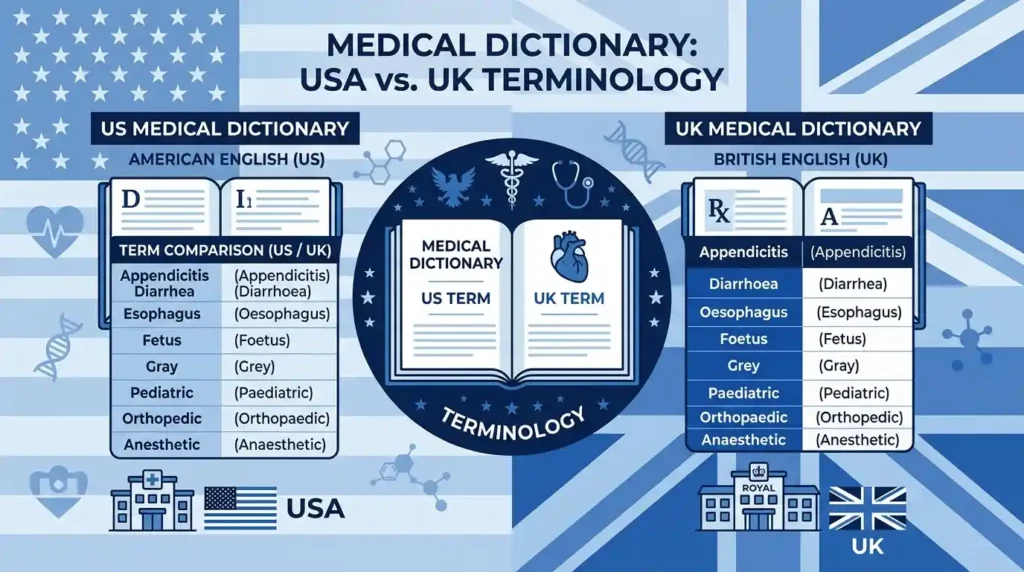
Good news: both words are spelled the same in American and British English. There’s no “psoriasis vs psoriasis” split like you see with “color vs colour.”
But naming habits differ slightly:
| Term | US Usage | UK/Commonwealth Usage |
| Eczema | Often called “eczema” | Sometimes called “atopic dermatitis” in clinical settings |
| Psoriasis | “Psoriasis” | “Psoriasis” (same) |
| Pronunciation | suh-RY-uh-sis | suh-RY-uh-sis (same) |
| Medical shorthand | “AD” for atopic dermatitis | “AD” also common |
The real variation isn’t spelling; it’s which term doctors default to in casual speech.
Which Term Should You Use?
- Talking to a US doctor: Say “eczema” for general dryness and itching. Say “psoriasis” if you notice thick, scaly plaques.
- Talking to a UK or Commonwealth doctor: Same rule applies. “Atopic dermatitis” may come up more often in formal notes.
- Writing for a global audience: Use both terms together once, then pick one for consistency. Example: “eczema (atopic dermatitis).”
- Talking to family or friends: Either word works. Most people understand “eczema” faster than “atopic dermatitis.”
Common Mistakes with Psoriasis and Eczema

- Mistake: Calling all itchy skin “eczema.”
Fix: Itchy plus scaly and thick often means psoriasis. - Mistake: Assuming psoriasis is contagious.
Fix: It’s autoimmune, not contagious. Neither condition spreads by touch. - Mistake: Using “psoriasis” and “dermatitis” as the same word.
Fix: Dermatitis is a broad term for skin inflammation. Eczema is one type of dermatitis. Psoriasis is a separate disease. - Mistake: Treating both with the same cream.
Fix: Treatments differ. A psoriasis cream may not help eczema, and vice versa. - Mistake: Ignoring flare triggers.
Fix: Eczema often reacts to allergens and irritants. Psoriasis often reacts to stress, infections, or skin injury.
Everyday Examples
In an email to a dermatologist:
“I’ve had scaly patches on my elbows for three weeks. Could this be psoriasis or eczema?”
In a news headline:
“New Study Links Eczema to Gut Bacteria”
On social media:
“Finally got diagnosed turns out it’s psoriasis, not just dry skin like I thought. #skincare #psoriasis”
In formal writing (medical report):
“The patient presents with erythematous plaques consistent with plaque psoriasis, distinguished from atopic dermatitis by scale characteristics.”
Psoriasis and Eczema Search Trends & Usage Data

Search interest for both terms stays steady year-round, with small spikes in winter when dry air worsens symptoms.
- The US and UK show the highest search volume for both terms.
- “Eczema” gets searched more often globally than “psoriasis,” largely because eczema is more common in children.
- Psoriasis searches spike around awareness campaigns, like World Psoriasis Day in October.
- Mobile searches for both terms often include “pictures,” “vs,” or “treatment,” showing people want fast visual comparison and next steps.
Comparison Table: Psoriasis vs Eczema
| Feature | Psoriasis | Eczema |
| Cause | Autoimmune | Skin barrier dysfunction |
| Appearance | Thick, silvery scales | Red, dry, sometimes weepy patches |
| Common locations | Elbows, knees, scalp | Inner elbows, behind knees, face |
| Itch level | Mild to moderate | Often intense |
| Age of onset | Often adults (15–35) | Often infants and children |
| Triggers | Stress, infection, skin injury | Allergens, irritants, weather |
| Contagious? | No | No |
FAQs
1. Can you have both psoriasis and eczema at the same time?
Yes. It’s uncommon but possible. A dermatologist can tell them apart with a skin exam or biopsy.
2. Is psoriasis worse than eczema?
Neither is “worse.” Both range from mild to severe. Severity depends on the person, not the condition name.
3. Can eczema turn into psoriasis?
No. They are separate diseases with different causes. One does not become the other.
4. Are psoriasis and eczema genetic?
Both have genetic links. Family history raises your risk for either condition.
5. What’s the fastest way to tell them apart at home?
Look at the scale. Thick and silvery points to psoriasis. Red and intensely itchy points to eczema. Still, only a doctor can confirm.
6. Do psoriasis and eczema require different treatments?
Yes. Psoriasis often needs treatments that calm immune activity. Eczema often needs moisturizers and barrier-repair treatments. Some medications overlap, but plans differ.
7. Why do doctors sometimes confuse the two conditions?
Early-stage symptoms can look similar. Redness and scaling appear in both. A trained eye and sometimes a biopsy settle the diagnosis.
Conclusion
Psoriasis and eczema are two different skin conditions with different causes. Psoriasis is autoimmune and shows thick, scaly patches.
Eczema comes from a weak skin barrier and causes intense itching with red, dry patches. Both words come from old Greek terms, and neither has a US vs UK spelling difference.
The real confusion comes from overlapping symptoms and mixed terminology, not language variation.
If you’re dealing with unclear symptoms, don’t self-diagnose from search results. Track your symptoms, note your triggers, and see a dermatologist.
Use the comparison table and quick answer guide in this article as a starting point for your conversation with a doctor.
Getting the right label matters. It leads to the right treatment and less guessing.

I am content creator and comparison blogger focused on analyzing key differences between terms, concepts, and ideas to deliver accurate, easy-to-understand information. So I decided to create a platform where these differences are explained in the simplest way possible.