The difference between disorder and disease is simple. A disease usually has a known cause, symptoms, and medical signs. A disorder means the body or mind is not working normally, but the exact cause may not always be clear.For example, diabetes is a disease, while anxiety is often called a disorder.
Health words can be confusing. One doctor may say a person has a disorder, while another says disease. Many people think both words mean the same thing. But they are not exactly alike.
Imagine a student who often feels sad, tired, and unable to focus. One doctor calls it a mental disorder. Another talks about a disease affecting brain chemistry. This confusion happens every day. That is why understanding the difference between disorder and disease matters so much.
The difference between disorder and disease affects medical treatment, communication, diagnosis, and even public understanding. Students, writers, bloggers, and teachers often use these terms incorrectly. Knowing the correct meaning improves communication and helps people understand health conditions better.
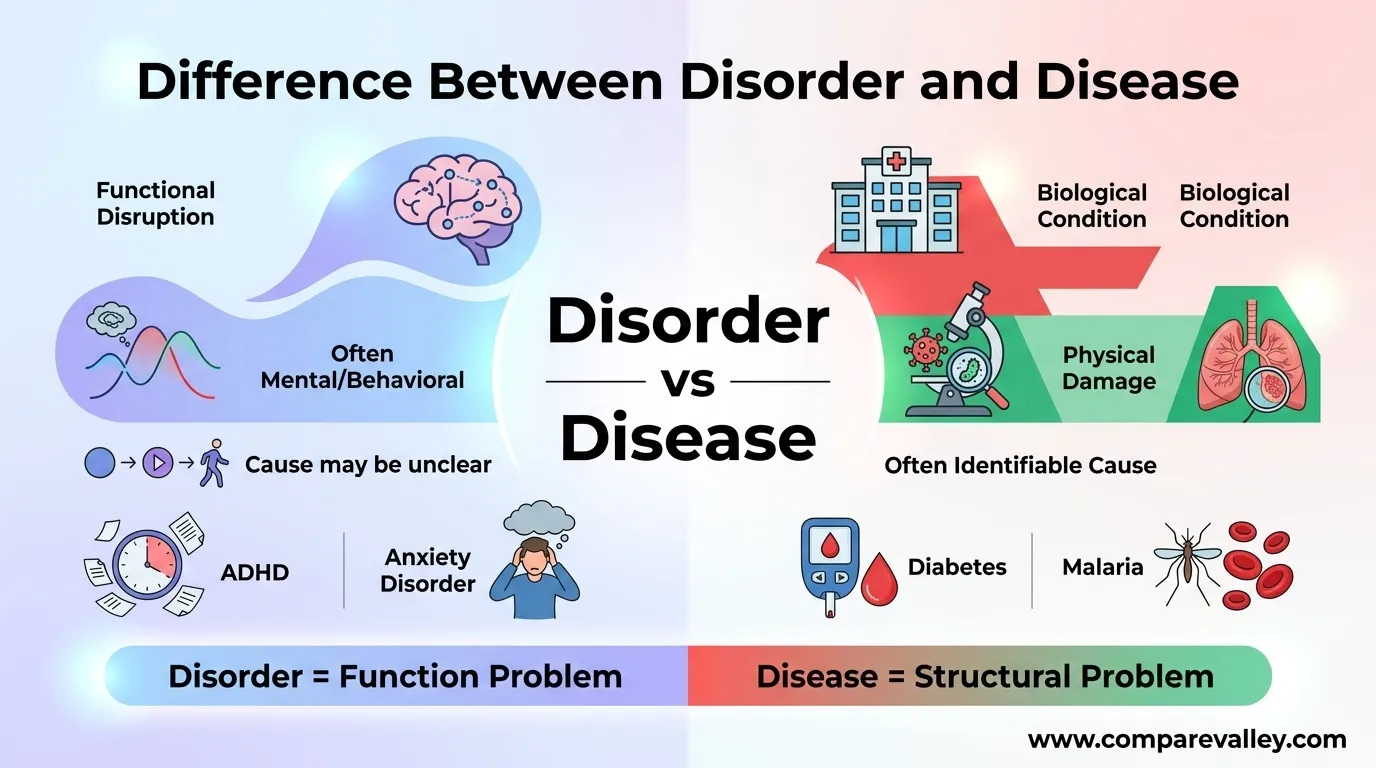
In simple words, a disease usually has a known cause and clear symptoms. A disorder describes a disruption in normal body or mental function that may not always have a clear cause. Understanding the difference between disorder and disease helps people use medical language correctly and avoid confusion.
Key Difference Between Disorder and Disease
The core difference between disorder and disease is based on cause and structure.
A disease usually damages organs, tissues, or body systems in a measurable way. Doctors can often identify its source through tests, infections, genetics, or physical changes.
A disorder, on the other hand, mainly affects normal function or behavior. It may not show visible damage in the body. Many mental health conditions are called disorders because their exact biological cause is still being studied.
In short:
- Disease = known medical condition with identifiable cause
- Disorder = abnormal function or behavior
People often use disorder vs disease interchangeably, but medical experts treat them differently.
Why Knowing the Difference Matters
Understanding the difference between disorder and disease improves communication in many fields.
Students need accurate terms in science and literature classes. Writers and bloggers use these words in storytelling and content creation. Teachers explain health topics more clearly when they know the distinction.
In publishing and communication, word choice matters. A novelist, editor, copywriter, or scriptwriter must use medical language carefully. Wrong wording can spread confusion.
The difference also matters in society. Some people feel less stigma when a condition is called a disorder instead of a disease. Others believe disease sounds more medically serious.
That is why disorder vs disease is more than grammar. It shapes understanding and public opinion.
Pronunciation of Both Words
Disorder
- US pronunciation: dis-OR-der
- UK pronunciation: dis-OR-duh
- Simple phonetics: /dis-or-der/
Disease
- US pronunciation: dih-ZEEZ
- UK pronunciation: dih-ZEEZ
- Simple phonetics: /di-zeez/
Now that the pronunciation is clear, let’s explore the detailed difference between disorder and disease.
Difference Between Disorder and Disease
1. Meaning
A disease is a medical condition with clear symptoms and causes.
Examples:
- Tuberculosis
- Malaria
A disorder means something is not functioning normally.
Examples:
- Anxiety disorder
- Sleep disorder
2. Cause
Diseases usually have known causes such as bacteria, viruses, or genetics.
Examples:
- COVID-19 from a virus
- Cancer from abnormal cell growth
Disorders may have unclear or multiple causes.
Examples:
- Bipolar disorder
- Eating disorder
3. Physical Damage
Disease often causes physical damage in the body.
Examples:
- Liver disease damages the liver
- Heart disease affects blood vessels
Disorders may affect behavior or function without visible damage.
Examples:
- Panic disorder
- Attention disorders
4. Diagnosis
Doctors can often diagnose diseases through tests and scans.
Examples:
- Blood tests
- X-rays
Disorders may require observation and psychological evaluation.
Examples:
- Autism spectrum disorder
- Personality disorder
5. Treatment
Diseases often need medicine or surgery.
Examples:
- Antibiotics
- Chemotherapy
Disorders may require therapy, lifestyle changes, or counseling.
Examples:
- Cognitive therapy
- Behavioral therapy
6. Duration
Some diseases are temporary.
Examples:
- Flu
- Infection
Many disorders can be long-term.
Examples:
- OCD
- ADHD
7. Mental vs Physical Focus
Disease usually relates to physical health.
Examples:
- Kidney disease
- Lung disease
Disorders commonly relate to mental or functional problems.
Examples:
- Anxiety disorder
- Mood disorder
8. Medical Recognition
Diseases often have internationally accepted causes.
Examples:
- Diabetes
- Hypertension
Disorders may still be under research.
Examples:
- Sensory processing disorder
- Conversion disorder
9. Social Perception
People often fear diseases because they sound serious or contagious.
Examples:
- Infectious diseases
- Viral diseases
Disorders may carry emotional or psychological stigma.
Examples:
- Mental disorders
- Personality disorders
10. Scope
A disease can affect one organ or the whole body.
Examples:
- Skin disease
- Autoimmune disease
A disorder often affects systems, behavior, or processes.
Examples:
- Language disorder
- Learning disorder
Nature and Behaviour of Both
Diseases usually follow a biological pattern. They can spread, damage tissues, and show physical symptoms. Doctors often track diseases using medical tests and research.
Disorders behave differently. They often affect thinking, emotions, communication, or body function. Some disorders change how a person interacts with society or performs daily tasks.
In disorder vs disease discussions, diseases are often structural, while disorders are usually functional.
Why People Get Confused?
People confuse these terms because both involve health problems. Doctors, media, and society sometimes use disorder and disease together.
Another reason is that some conditions fit both categories. For example, Alzheimer’s disease also causes mental disorders.
Comparison Table
| Feature | Disorder | Disease |
| Main Meaning | Abnormal function | Medical illness |
| Cause | Often unclear | Usually known |
| Physical Damage | Not always visible | Often visible |
| Diagnosis | Observation-based | Test-based |
| Focus | Function and behavior | Body structure |
| Treatment | Therapy and support | Medicine and surgery |
| Examples | Anxiety disorder | Heart disease |
| Mental Health | Common | Less common |
| Research Status | Sometimes uncertain | More established |
| Public Understanding | Often misunderstood | More recognized |
Which Is Better in Different Situations?
When Disorder Is Better
The word disorder works better when discussing mental health, behavior, communication, or functional problems. It sounds less harsh in some cases and focuses on imbalance instead of damage.
For example, doctors often prefer terms like anxiety disorder or learning disorder. In communication and publishing, this wording may reduce stigma and support better understanding.
When Disease Is Better
Disease is better when a condition has a clear medical cause and physical symptoms. It gives a stronger scientific meaning and is widely accepted in medicine.
Examples include heart disease, liver disease, and infectious diseases. In medical literature, education, and content creation, disease is often used for conditions with biological evidence.
Metaphors and Similes
People sometimes use these words metaphorically.
Examples:
- “Jealousy is a disease that destroys friendship.”
- “Confusion spread like a disease.”
- “His bad habits became a disorder in his life.”
These expressions add creativity to storytelling and literature.
Connotative Meaning
Positive Meaning
Neither word is strongly positive, but disorder may sound softer in some situations.
Example:
- “Learning disorder support improved the student’s confidence.”
Negative Meaning
Disease often sounds more dangerous or serious.
Example:
- “The disease spread rapidly.”
Neutral Meaning
Both words can be neutral in medical communication.
Example:
- “The doctor explained the condition clearly.”
Idioms and Proverbs
Some common expressions include:
- “Prevention is better than cure.”
- Meaning: Stop problems before they start.
- “An idle mind is the devil’s workshop.”
- Sometimes linked to mental and emotional disorders.
- “Laughter is the best medicine.”
- Meaning: Happiness supports health.
These phrases appear often in literature and communication.
Literary Works Related to Topic
- The Plague
- Genre: Fiction
- Author: Albert Camus
- Year: 1947
- Brain on Fire
- Genre: Memoir
- Author: Susannah Cahalan
- Year: 2012
- The Bell Jar
- Genre: Novel
- Author: Sylvia Plath
- Year: 1963
- Awakenings
- Genre: Medical memoir
- Author: Oliver Sacks
- Year: 1973
Movies Related to Topic
- A Beautiful Mind
- Release Year: 2001
- Country: USA
- Still Alice
- Release Year: 2014
- Country: USA
- Rain Man
- Release Year: 1988
- Country: USA
- The Theory of Everything
- Release Year: 2014
- Country: UK
Importance in Society
Understanding the difference between disorder and disease improves daily communication. It helps doctors explain conditions more clearly and supports better public awareness.
Writers, teachers, editors, and content creators also benefit. Correct language improves storytelling, publishing quality, and educational communication.
The topic also matters emotionally. Better understanding can reduce fear, stigma, and misunderstanding around mental and physical health.
Top 10 Comparison Table
| Aspect | Disorder | Disease |
| Definition | Functional problem | Medical illness |
| Cause | Often uncertain | Usually identified |
| Symptoms | Behavioral or functional | Physical and biological |
| Body Damage | Limited or unclear | Often measurable |
| Diagnosis Method | Observation | Testing |
| Treatment Type | Therapy | Medication |
| Medical Field | Psychology and neurology | General medicine |
| Duration | Often chronic | Can be temporary |
| Examples | ADHD, anxiety | Diabetes, malaria |
| Public Perception | Emotional stigma | Medical seriousness |
Final Words About Both
The difference between disorder and disease may seem small, but it matters greatly in medicine, education, communication, and society.
Disease usually points to a clear medical illness. Disorder focuses on abnormal function or behavior. Both affect health, but they are used differently by doctors, writers, teachers, and publishers.
Knowing the correct term improves understanding and avoids confusion.
Conclusion
The difference between disorder and disease becomes clearer when we examine cause, function, symptoms, and medical understanding. Diseases usually have known causes and physical effects. Disorders mainly describe disruptions in normal mental or physical function.
Understanding disorder vs disease helps students, bloggers, teachers, healthcare workers, and content creators communicate more accurately. It also improves awareness and reduces misunderstanding in society.
Whether discussing mental health, literature, communication, or medicine, using the right word matters. The next time you hear disorder and disease used together, you will understand the real difference with confidence.
FAQs
What is the main difference between disorder and disease?
A disease usually has a known cause and physical symptoms, while a disorder mainly affects normal function or behavior.
Is every disorder a disease?
No. Some disorders may not have a clearly identified medical cause.
Can a disease become a disorder?
Yes. Some diseases can lead to mental or functional disorders over time.
Which term is more serious: disorder or disease?
Disease often sounds more medically serious, but both can greatly affect life.
Why do doctors use disorder instead of disease?
Doctors may use disorder when the exact biological cause is unclear or related to behavior and function.

I am content creator and comparison blogger focused on analyzing key differences between terms, concepts, and ideas to deliver accurate, easy-to-understand information. So I decided to create a platform where these differences are explained in the simplest way possible.