🟩 Quick Answer:
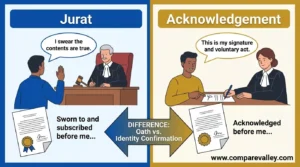
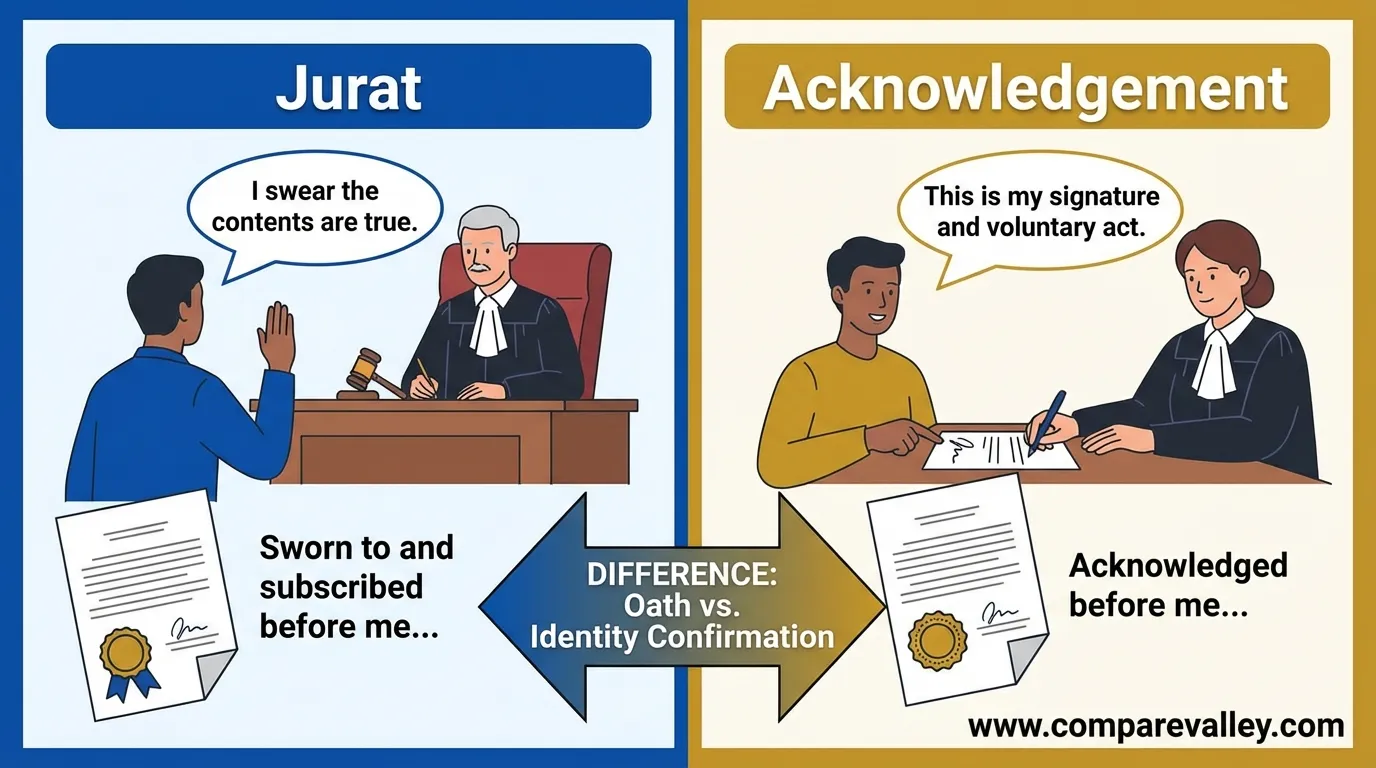
A jurat is a notarial act where a signer swears or affirms that the contents of a document are true, while an acknowledgement confirms the signer’s identity and that they signed the document willingly. 🟦 Simple Tip:Think: Jurat = oath about truth. Acknowledgement = proof of identity and consent.
Introduction
I once helped a friend prepare legal documents. At the notary office, the officer asked whether we needed a jurat or an acknowledgement. We were confused at first because both seemed similar.
The difference between jurat and acknowledgement became clear when the notary explained it. A jurat requires an oath, while an acknowledgement only confirms identity and willingness.
Understanding the difference between jurat and acknowledgement is important for legal accuracy. Whether you are signing affidavits or contracts, knowing jurat vs acknowledgement ensures your documents are valid and accepted.
Key Difference Between the Both
A jurat requires the signer to swear or affirm that the document is true.
An acknowledgement confirms that the signer signed the document voluntarily.
In short, jurat = truth under oath, acknowledgement = identity and consent.
Why Is Their Difference Necessary to Know for Learners and Experts?
For learners, knowing jurat vs acknowledgement avoids legal mistakes.
For professionals like lawyers and notaries, understanding the difference between jurat and acknowledgement ensures compliance with legal standards.
The difference between jurat and acknowledgement is important in society because incorrect notarization can make documents invalid in courts, banks, or government offices.
Pronunciation of the Both (US & UK)
- Jurat:
- US: /ˈjʊr.æt/
- UK: /ˈdʒʊə.ræt/
- Acknowledgement:
- US: /əkˈnɑː.lɪdʒ.mənt/
- UK: /əkˈnɒl.ɪdʒ.mənt/
Now, let’s explore their differences in detail.
Difference Between the Keywords
1. Definition
- Jurat: A sworn statement before a notary.
- Acknowledgement: A declaration of voluntary signing.
Examples:
- Jurat: Signing an affidavit under oath.
- Acknowledgement: Signing a property document voluntarily.
2. Oath Requirement
Jurat requires an oath or affirmation.
Acknowledgement does not require an oath.
Examples:
- Jurat: “Do you swear this is true?”
- Acknowledgement: “Do you confirm this is your signature?”
3. Purpose
Jurat ensures truthfulness of content.
Acknowledgement ensures identity and willingness.
Examples:
- Jurat: Court affidavit.
- Acknowledgement: Business contract.
4. Presence of Signer
Jurat requires signing in front of the notary.
Acknowledgement may be signed earlier but confirmed before the notary.
Examples:
- Jurat: Sign at notary office.
- Acknowledgement: Already signed document presented.
5. Focus
Jurat focuses on document content.
Acknowledgement focuses on signature authenticity.
Examples:
- Jurat: Verifying truth of statements.
- Acknowledgement: Verifying identity.
6. Legal Use
Jurat is used for affidavits and sworn statements.
Acknowledgement is used for contracts and agreements.
Examples:
- Jurat: Witness statement.
- Acknowledgement: Real estate deed.
7. Notary Role
Jurat: Administers oath and witnesses signing.
Acknowledgement: Verifies identity and confirms willingness.
Examples:
- Jurat: Notary asks you to swear.
- Acknowledgement: Notary checks ID.
8. Risk Level
Jurat carries higher legal responsibility due to oath.
Acknowledgement has lower risk as no oath is involved.
Examples:
- Jurat: False statement may lead to perjury.
- Acknowledgement: Less severe legal consequences.
9. Wording
Jurat includes phrases like “subscribed and sworn.”
Acknowledgement includes “acknowledged before me.”
Examples:
- Jurat: “Sworn to before me…”
- Acknowledgement: “Acknowledged before me…”
10. Timing
Jurat is completed at the time of signing.
Acknowledgement confirms a past or present signature.
Examples:
- Jurat: Immediate oath and signature.
- Acknowledgement: Confirming earlier signing.
Discuss the Nature and Behaviour of the Both Separately
Jurat is formal, strict, and oath-based. It emphasizes honesty and legal truth.
Acknowledgement is flexible and identity-based. It emphasizes consent and authenticity of signature.
Why People Are Confused About Their Use?
| Feature | Jurat | Acknowledgement | Similarity |
| Purpose | Truth verification | Identity verification | Both notarized |
| Oath | Required | Not required | Legal process |
| Signing | In front of notary | Before or during | Need notary |
| Use | Affidavits | Contracts | Used in legal documents |
Confusion arises because both involve notarization and legal documents.
Which Is Better in What Situation?
A jurat is better when the document requires truth verification, such as affidavits or sworn statements.
An acknowledgement is better for agreements, contracts, and property documents where identity and willingness matter.
How the Keywords Used in Metaphors and Similes
- “A jurat is like a promise under oath.”
- “An acknowledgement is like a handshake confirming agreement.”
Connotative Meaning of Both the Keywords
- Jurat:
- Positive: truthful, serious
- Neutral: legal term
- Negative: strict and risky if false
- Acknowledgement:
- Positive: agreement, confirmation
- Neutral: formal process
- Negative: less strict
Examples:
- Jurat: “He signed under jurat, confirming truth.”
- Acknowledgement: “She gave acknowledgement of her signature.”
Idioms or Proverbs Related to the Words
- “Swear by the truth” – relates to jurat
- “Seal of approval” – relates to acknowledgement
Examples:
- Jurat: He swore by the truth before signing.
- Acknowledgement: The document had a seal of approval.
Works in Literature
- Legal Writing and Notarization Guide – 2016 – Law
- Understanding Notary Acts – 2019 – Legal Studies
Movie Names Made on Keywords
- No direct movies, but legal dramas include such concepts:
- A Few Good Men – 1992 – USA
How Both Are Useful for Surroundings
Jurat ensures truth in legal documents, protecting justice.
Acknowledgement ensures identity and consent, protecting agreements.
Together, they help maintain trust in legal and business systems.
Top 10 Comparison Table
| Point | Jurat | Acknowledgement |
| Oath | Required | Not required |
| Focus | Truth of content | Identity & consent |
| Signing | Before notary | Before/after |
| Use | Affidavits | Contracts |
| Risk | High | Moderate |
| Wording | Sworn statements | Acknowledged statements |
| Purpose | Verify truth | Verify identity |
| Role of Notary | Administer oath | Verify identity |
| Timing | At signing | Before/after |
| Nature | Strict | Flexible |
Final Words for the Both
Jurat and acknowledgement serve different legal purposes. Jurat confirms truth under oath, while acknowledgement confirms identity and willingness. Understanding jurat vs acknowledgement ensures correct legal documentation.
Conclusion
The difference between jurat and acknowledgement is simple but critical. Jurat involves an oath about truth, while acknowledgement confirms identity and consent.
Both are essential in legal systems, and knowing jurat vs acknowledgement helps avoid costly mistakes and ensures documents are valid and enforceable.
Frequently Asked Questions
1. What is the main difference between jurat and acknowledgement?
Jurat requires an oath; acknowledgement confirms identity and voluntary signing.
2. Can a document have both jurat and acknowledgement?
Usually no, one type is selected based on purpose.
3. Which is used for affidavits?
Jurat is used for affidavits.
4. Is acknowledgement less strict?
Yes, because it does not involve an oath.
5. Why is jurat more serious?
Because false statements under oath can lead to legal penalties like perjury.

I am content creator and comparison blogger focused on analyzing key differences between terms, concepts, and ideas to deliver accurate, easy-to-understand information. So I decided to create a platform where these differences are explained in the simplest way possible.