You are writing an email. You type, “Please setup the meeting.” Then you stop. Is it “setup” or “set up”? You are not alone. Millions of people ask this question.
The two forms look almost the same. They sound the same too. But they are not the same word.
People search for “setup or set up” because spell check does not help. Both forms are real, so no red line shows up. You have to know the rule yourself. Many people also think this is a British versus American spelling issue. It is not. It is a grammar issue.
This article clears up the confusion. You will get a quick answer first. Then you will learn where the words come from, how to use them, and which mistakes to avoid. You will also see real examples, comparison tables, and an FAQ.
By the end, you will know exactly when to write setup and when to write set up. No more guessing.
Quick Answer
Here is the rule:
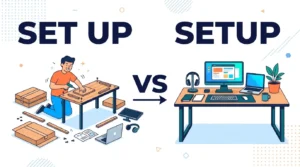
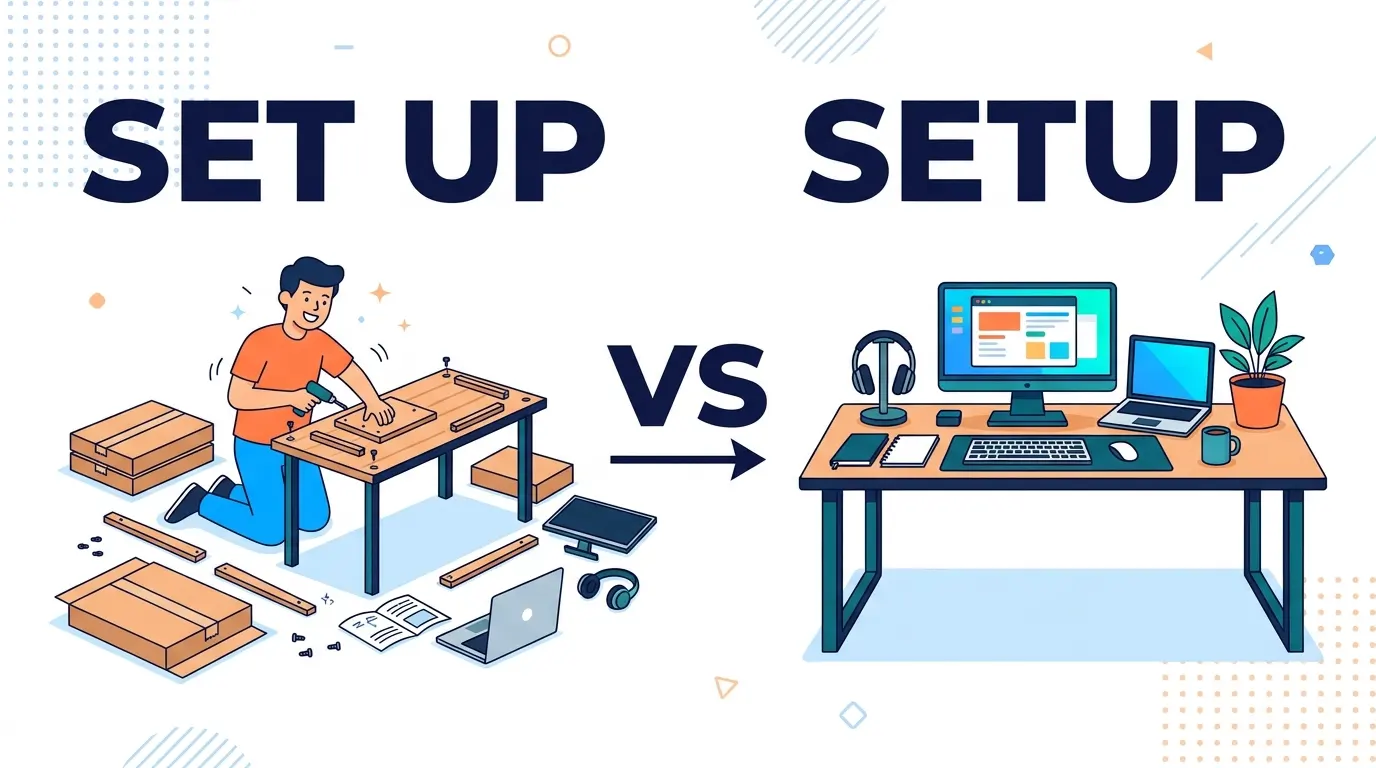
- Set up (two words) is a verb. It is an action.
- Setup (one word) is a noun or an adjective. It is a thing.
Examples of “set up” (verb):
- I will set up the printer today.
- Can you set up a meeting for Monday?
- They set up a new company last year.
Examples of “setup” (noun or adjective):
- The setup was easy.
- Our home office setup is simple.
- Click the setup button to begin.
A fast test: Can you put “did” or “will” before it? If yes, use two words. “I will set up the desk.” The answer is set up.
The Origin of Setup and Set Up
The roots are old. “Set” comes from Old English settan, which means to put or place. “Up” is also Old English. People have joined the two words as a phrase for centuries. The phrase “set up” meant to raise something or to place it in position.
The one-word form, setup, came later. English often turns verb phrases into nouns by joining them. We did it with log in and login, back up and backup, check out and checkout. Setup followed the same path. It started as a noun for how something is arranged or put together.
Why do spelling differences exist? English has no single rulebook. Writers joined and split words in different ways for years. Some chose a hyphen, as in set-up. Over time, most style guides settled on one rule: verb = two words, noun = one word. Some British writers still use the hyphen for the noun.
British English vs American English Spelling
Here is the surprise: this is not mainly a UK versus US issue. The verb and noun rule holds in both. The difference is small and comes down to the hyphen.
| Use | American English | British English |
| Verb (action) | set up | set up |
| Noun (thing) | setup | setup or set-up |
| Adjective | setup (e.g., setup guide) | setup or set-up |
| Common in tech writing | setup | setup |
Examples:
- US: “Follow the setup guide, then set up your account.”
- UK: “Follow the set up guide, then set up your account.”
Both are fine in their own region. The hyphenated noun looks a little older, and it is more common in British print. Most online writing in both countries now uses setup.
Which Spelling Should You Use?
If your audience is in the US: Use set up for the verb and setup for the noun. Skip the hyphen.
If your audience is in the UK or the Commonwealth: Use set up for the verb. For the noun, setup and set-up are both accepted. Pick one and stay consistent.
If your audience is global: Use set up (verb) and setup (noun). It is the safest choice. Everyone will understand it.
If you follow a style guide: Check it first. Your company or publisher may have its own rule.
The main point: Do not change spelling by country for the verb. Always use two words. The only real choice is the hyphen on the noun.
Common Mistakes with Setup and Set Up
Mistake 1: Using “setup” as a verb.
- Wrong: “I will setup the router.”
- Right: “I will set up the router.”
Mistake 2: Using “set up” as a noun.
- Wrong: “The set up was easy.”
- Right: “The setup was easy.”
- “Set” does not change in the past tense.
- Wrong: “She setted up the room.”
- Right: “She set up the room.”
- Wrong: “Set up your setup.” (This one is correct but confusing. Say, “Build your workspace.”)
- Better: “Set up your desk. A good setup helps you focus.”
- “He sets up the table.” “She is setting up the table.” “They set up the table.” Keep set and up as two words each time.
Setup and Set Up in Everyday Examples
In emails:
- “Can you set up a call for Friday?”
- “Please find the setup instructions below.”
In news:
- “Police set up a road block on Main Street.”
- “The team’s new setup helped them win.”
On social media:
- “Just finished my new gaming setup!”
- “Time to set up my new phone.”
In formal writing:
- “The committee will set up a review panel.”
- “The experiment setup is described in Section 2.”
In tech:
- “Run the setup file to install the app.”
- “You need to set up two-step login.”
Google Trends & Usage Data
I can’t pull live Google Trends numbers here, so I won’t invent any. Check yourself before publishing, and add the real figures. Here is what to look for.
What to compare: Search “setup”, “set up”, and “set-up” side by side.
Patterns writers usually see:
- Tech topics lead. “Setup” is very common in software, gaming, and hardware. Think “router setup” or “desk setup.”
- “Set up” is common in how-to searches. People search “how to set up email” or “how to set up a business.”
- The hyphen is rarer. “Set-up” appears less often, mostly in British publishing.
- Country view: Check the “Interest by region” chart. Compare the US, UK, India, Canada, and Australia. Look for any spelling gaps.
Tip: Change the date range to 5 years or more. You will see if the one word noun is growing.
Comparison Table: Keyword Variations Side by Side
| Form | Part of Speech | Correct? | Example |
| set up | Verb | ✅ Yes | I will set up the TV. |
| setup | Noun | ✅ Yes | The setup took ten minutes. |
| setup | Adjective | ✅ Yes | Open the setup menu. |
| set-up | Noun / Adjective | ✅ Yes (mostly UK) | The set up was simple. |
| setup | Verb | ❌ No | I will setup the TV. |
| set up | Noun | ❌ No | The set up was fast. |
| setted up | Verb | ❌ No | She setted up the room. |
| setting up | Verb (-ing form) | ✅ Yes | She is setting up the room. |
FAQs
1. Is it “setup” or “set up”?
Both are correct. Use set up for the verb. Use setup for the noun or adjective.
2. Is “setup” one word or two?
As a noun, it is one word. As a verb, it is two words: set up.
3. Is “set-up” with a hyphen correct?
Yes, but mostly in British English and mostly as a noun. The no-hyphen form is more common today.
4. Is “setup” a verb?
No. The verb is always set up. “I will setup the app” is wrong.
5. What is the past tense of “set up”?
It is set up. The word “set” does not change. “She set up the meeting yesterday.”
6. Is this a British or American spelling difference?
No. It is a grammar rule used in both. The only small difference is the hyphen on the noun.
7. Which one should I use in a job application or resume?
Use set up for actions: “Set up a new filing system.” Use setup for the thing: “Improved the team setup.”
8. How do I remember the difference?
If it is something you do, use two words. If it is something you have, use one word.
Conclusion
The rule for “setup or set up” is short and easy. Set up is a verb. Setup is a noun or an adjective. If you can add “will” or “did” before it, use two words. If you can add “the” or “a” before it, use one word.
This is not a British versus American problem. Both groups follow the same rule. The one small difference is the hyphen. British writers sometimes write set-up for the noun. Most others skip it.
Remember the common mistakes. Do not write “I will setup the printer.” Do not write “The set up was easy.” And never write “setted up.” The past tense is just set up.
For a global audience, the safest choice is simple: set up for actions, setup for things. Stay consistent. Check your style guide if you have one.
Now you know the rule. Use it in your emails, reports, and posts. Your writing will look clean and professional. And you will never have to stop mid-sentence and wonder again.

I am content creator and comparison blogger focused on analyzing key differences between terms, concepts, and ideas to deliver accurate, easy-to-understand information. So I decided to create a platform where these differences are explained in the simplest way possible.