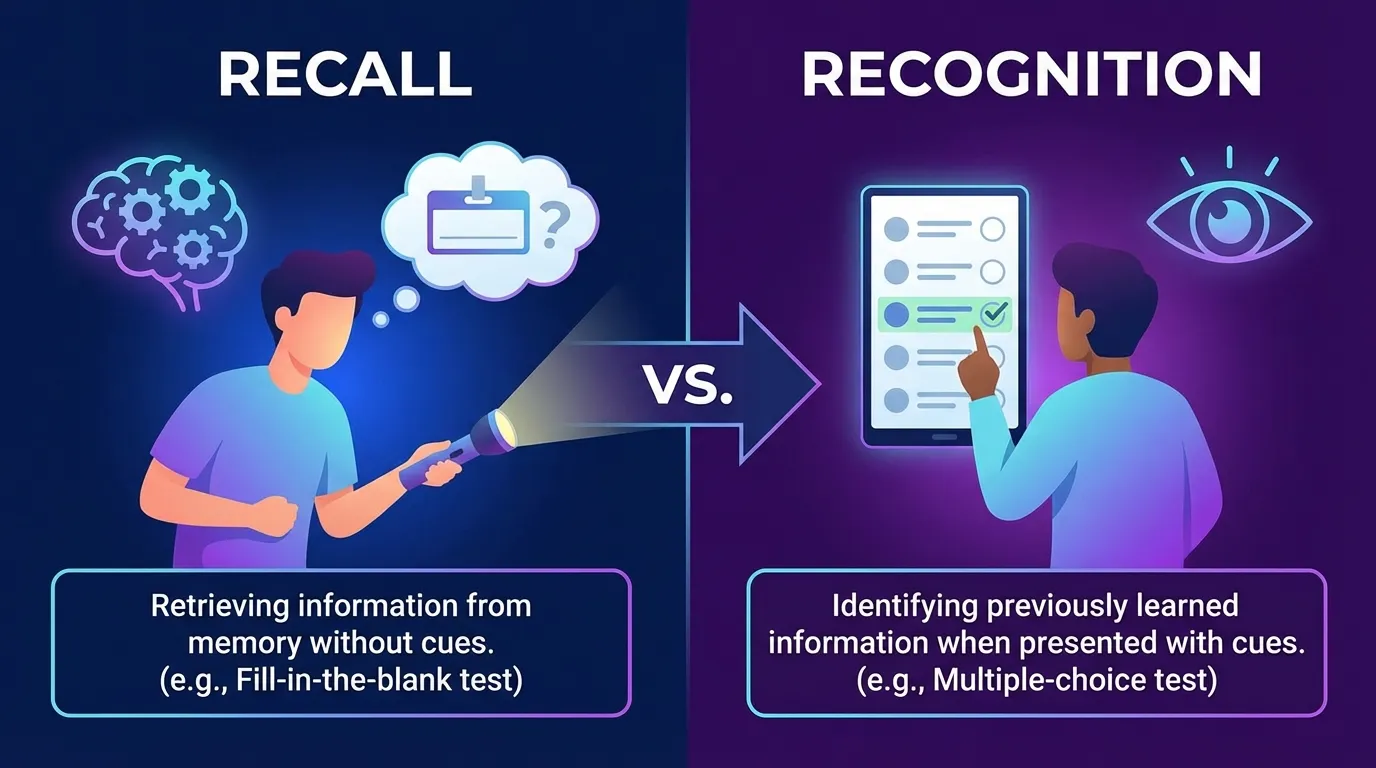
The difference between recall and recognition is a key concept in psychology and learning. In simple terms, recall means retrieving information from memory without cues, while recognition means identifying information when it is presented again.
Imagine meeting someone at a conference. Later, you try to remember their name without any hint—this is recall. But when you see their name on a list and instantly realize you met them earlier, that is recognition.
Understanding the difference between recall vs recognition helps explain how our memory works in everyday situations like exams, conversations, and learning new skills. Students often rely on both abilities when studying. Teachers design tests based on these memory processes as well.
By exploring the difference between recall and recognition, learners and professionals can improve memory techniques and communication. In fact, recognizing the difference between recall and recognition also helps researchers study how the brain stores and retrieves knowledge in real-world situations.
Key Difference Between the Both
The fundamental difference between recall vs recognition lies in the presence of cues. Recall requires retrieving information without help, while recognition involves identifying information with the help of cues or options.
For example, an essay question in an exam requires recall because the student must produce information independently. A multiple-choice question tests recognition because the correct answer is already listed among options.
Why Their Difference Is Necessary to Know for Learners and Experts
Understanding the difference between recall and recognition is important for both students and professionals. In education, teachers design exams to evaluate different memory skills. Recall questions test deep understanding, while recognition questions check familiarity with concepts. Knowing the difference between recall vs recognition also helps learners choose better study methods, such as flashcards for recognition and practice tests for recall.
In research and cognitive psychology, experts analyze the difference between recall and recognition to study memory disorders, learning patterns, and brain function. This knowledge helps in fields like education, neuroscience, marketing, and even artificial intelligence. Overall, awareness of the difference between recall vs recognition benefits society by improving learning systems and memory-related studies.
Pronunciation of Both (US & UK)
- Recall
- US: /rɪˈkɔːl/
- UK: /rɪˈkɔːl/
- US: /rɪˈkɔːl/
- Recognition
- US: /ˌrekəɡˈnɪʃən/
- UK: /ˌrekəɡˈnɪʃən/
- US: /ˌrekəɡˈnɪʃən/
Before exploring deeper memory concepts, understanding their pronunciation makes it easier to discuss and analyze these terms in academic and professional contexts.
Difference Between the Keywords
1. Presence of Cues
Recall happens without hints, while recognition uses cues.
Examples:
- Recall: Writing an essay about World War II from memory.
- Recall: Remembering a friend’s phone number without checking.
- Recognition: Choosing the correct historical date from multiple options.
- Recognition: Identifying a familiar face in a crowd.
2. Level of Difficulty
Recall is usually harder than recognition.
Examples:
- Recall: Memorizing and writing a poem without looking.
- Recall: Listing the planets from memory.
- Recognition: Selecting the correct poem line from options.
- Recognition: Picking the right planet name from a chart.
3. Memory Retrieval Process
Recall requires active retrieval, while recognition requires comparison.
Examples:
- Recall: Describing yesterday’s lecture without notes.
- Recall: Repeating instructions from memory.
- Recognition: Identifying lecture topics in a slide list.
- Recognition: Spotting correct instructions among choices.
4. Usage in Exams
Recall appears in essay or short-answer questions. Recognition appears in objective questions.
Examples:
- Recall: Writing definitions in your own words.
- Recall: Explaining a scientific theory.
- Recognition: Choosing a definition from options.
- Recognition: Selecting the correct theory in MCQs.
5. Brain Effort
Recall requires stronger memory effort than recognition.
Examples:
- Recall: Remembering all steps of a math formula.
- Recall: Recalling historical events in order.
- Recognition: Picking the correct formula from a list.
- Recognition: Identifying the correct event from choices.
6. Learning Method
Recall improves through practice tests and writing. Recognition improves through review and exposure.
Examples:
- Recall: Practicing essay writing.
- Recall: Reciting vocabulary from memory.
- Recognition: Reviewing flashcards.
- Recognition: Matching words with meanings.
7. Memory Strength
Recall shows deeper learning. Recognition shows familiarity.
Examples:
- Recall: Explaining a concept without help.
- Recall: Teaching a topic to someone else.
- Recognition: Identifying the concept in a textbook.
- Recognition: Recognizing a term during reading.
8. Speed of Response
Recognition responses are usually faster than recall.
Examples:
- Recall: Taking time to remember a person’s name.
- Recall: Thinking before recalling a fact.
- Recognition: Instantly recognizing the name when you see it.
- Recognition: Quickly spotting the correct answer.
9. Application in Technology
Recall is used in memory-based tasks; recognition is used in identification systems.
Examples:
- Recall: Typing passwords from memory.
- Recall: Recalling commands in programming.
- Recognition: Facial recognition systems.
- Recognition: Voice recognition software.
10. Everyday Use
Recall appears in storytelling and explanations, while recognition appears in identification.
Examples:
- Recall: Narrating childhood memories.
- Recall: Remembering directions without GPS.
- Recognition: Recognizing a song you heard before.
- Recognition: Identifying a landmark while traveling.
Nature and Behaviour of Both
Recall is an active memory process. It requires effort, concentration, and strong mental connections. People use recall when explaining ideas, writing essays, or remembering detailed information.
Recognition, on the other hand, is a passive or assisted process. The brain identifies information when it appears again. This behavior makes recognition easier and faster than recall.
Why People Are Confused About Their Use
| Feature | Recall | Recognition | Similarity |
| Definition | Retrieving memory without cues | Identifying memory with cues | Both involve memory |
| Difficulty | Harder | Easier | Both require prior learning |
| Use in Exams | Essays, short answers | Multiple choice | Both test knowledge |
| Memory Process | Active retrieval | Identification | Both involve brain processing |
Which Is Better in What Situation?
Recall:
Recall is better when deep understanding is required. For example, writing essays, explaining concepts, or giving speeches depends on recall. It shows strong learning because the person can retrieve knowledge independently without prompts.
Recognition:
Recognition works better when quick identification is needed. Tasks like security systems, quizzes, or identifying objects depend on recognition. It saves time and allows people to make decisions quickly when cues are available.
How the Keywords Are Used in Metaphors and Similes
- “Her memory worked like recognition software, instantly identifying familiar faces.”
- “His mind struggled for recall like searching for a book in a dark library.”
- “The memory appeared through recognition like a light switching on.”
Connotative Meaning of Both Keywords
Recall (Neutral to Positive)
- Positive: “Her excellent recall helped her succeed in exams.”
- Neutral: “He had poor recall of the meeting details.”
Recognition (Positive)
- Positive: “The artist received recognition for her talent.”
- Neutral: “Facial recognition technology is widely used.”
Idioms or Proverbs Related to the Words
- “Ring a bell” – Something sounds familiar.
Example: The name rings a bell, but I cannot recall where I heard it. - “Jog someone’s memory” – Help someone remember something.
Example: The photo helped jog my memory and I recognized the place.
Works in Literature Related to the Keywords
- Recognition: The Literary Plot Device – Literary theory discussion, Aristotle, ancient Greece.
- An Essay Concerning Human Understanding – Philosophy, John Locke, 1689.
- Memory and Recall in Literature – Literary criticism, various scholars.
Movies Related to the Keywords
- Total Recall – 1990, United States
- Total Recall – 2012, United States/Canada
- Recognition – 2012, United States (independent film)
Frequently Asked Questions
1. What is the main difference between recall vs recognition?
Recall retrieves information without hints, while recognition identifies information when it appears again.
2. Which is harder, recall or recognition?
Recall is usually harder because it requires stronger memory retrieval.
3. Why do exams use both recall and recognition questions?
Because they test different levels of memory and understanding.
4. Can recognition lead to recall?
Yes, recognizing a cue can trigger the recall of deeper information.
5. Which improves learning more effectively?
Recall generally strengthens long-term learning more than recognition.
How Both Are Useful for Surroundings
Recall and recognition help people interact effectively with their environment. Recall allows individuals to remember instructions, experiences, and knowledge when needed. Recognition helps them identify objects, faces, places, and signals quickly. Together, they support learning, communication, safety, and decision-making in daily life.
Final Words for Both
Recall and recognition are essential parts of human memory. They complement each other and help people store, identify, and retrieve information efficiently in different situations.
Conclusion
The difference between recall and recognition reveals how the human memory system functions in different situations. Recall requires retrieving information without external help, making it more demanding but also a stronger indicator of learning. Recognition, however, allows people to identify previously learned information when cues are present, making it faster and easier. Both processes play important roles in education, psychology, and daily life. By understanding the difference between recall vs recognition, students can improve study habits, teachers can design better assessments, and researchers can explore how memory works in the brain. Ultimately, these two processes work together to support learning, decision-making, and communication in society.

I am content creator and comparison blogger focused on analyzing key differences between terms, concepts, and ideas to deliver accurate, easy-to-understand information. So I decided to create a platform where these differences are explained in the simplest way possible.