When someone experiences chest discomfort or irregular heartbeat, doctors often recommend heart tests to understand what is happening inside the body. Imagine a patient visiting a cardiology clinic after feeling unusual heart palpitations. The doctor might order an ECG to check the heart’s electrical activity and an echocardiogram to view the heart’s structure and movement. At first, the patient may feel confused because both tests examine the heart. This confusion highlights the importance of understanding the difference between ECG and echocardiogram.
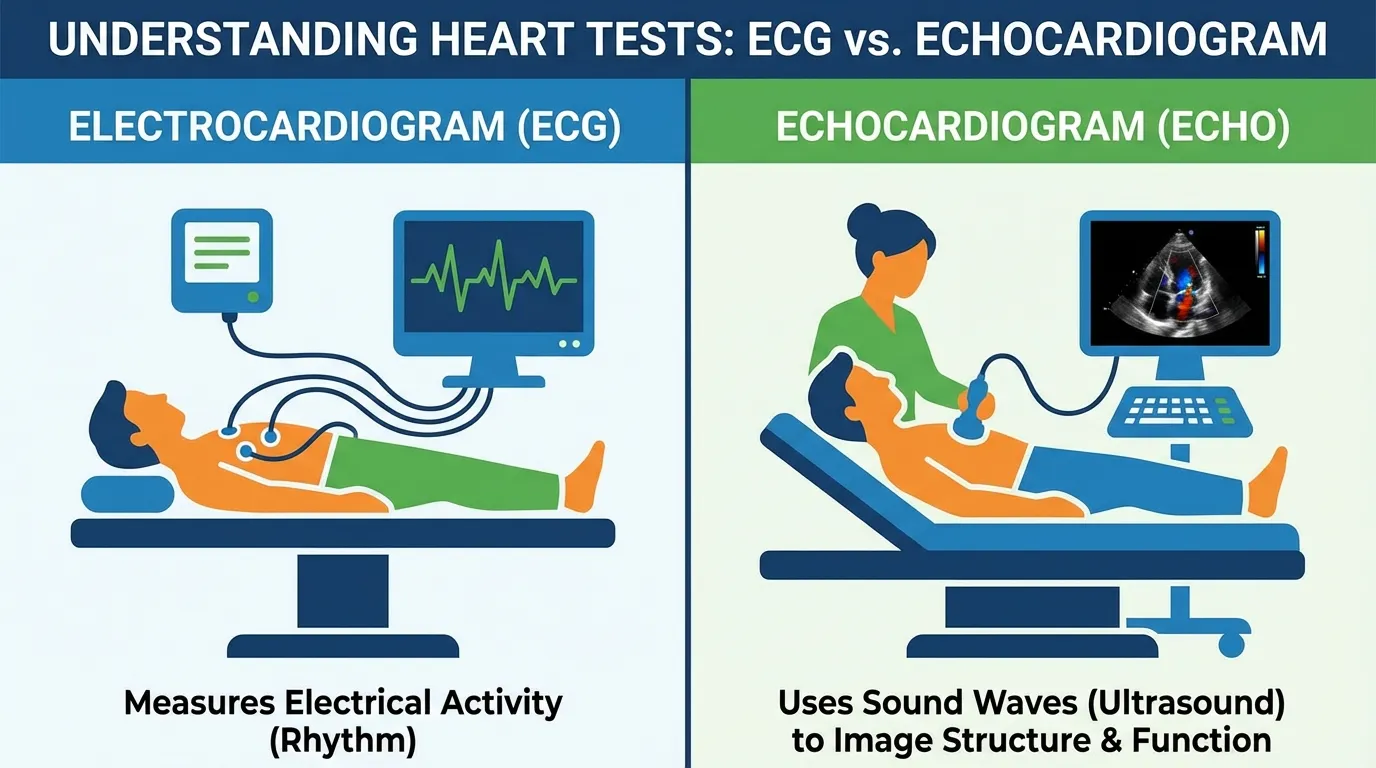
The difference between ECG and echocardiogram lies in how each test studies the heart. An ECG records electrical signals that control the heartbeat, while an echocardiogram uses sound waves to create images of the heart’s structure and function. Learning the difference between ECG vs echocardiogram helps patients, students, and medical professionals interpret medical advice correctly. In healthcare discussions, knowing the difference between ECG and echocardiogram makes it easier to understand diagnoses and treatments.
Key Difference Between the Both
The main difference between ECG and echocardiogram is the method used to examine the heart.
- ECG (Electrocardiogram) records the electrical activity of the heart using electrodes attached to the skin.
- Echocardiogram uses ultrasound waves to create images of the heart’s chambers, valves, and movement.
In simple terms, ECG checks heart rhythm and electrical signals, while an echocardiogram shows the heart’s physical structure and function.
Why Is Their Difference Necessary to Know for Learners and Experts?
Understanding the difference between ECG and echocardiogram is essential in healthcare and education. Medical students must clearly know the difference between ECG vs echocardiogram to diagnose heart problems correctly. These tests help doctors detect conditions such as arrhythmias, heart valve issues, and heart muscle damage.
For patients and society, recognizing the difference between ECG and echocardiogram helps reduce confusion during medical consultations. When doctors explain tests, people who understand the difference between ECG and echocardiogram can follow instructions better and feel more confident about their treatment plans.
Pronunciation of Both (US & UK)
- ECG (Electrocardiogram)
- US: /ˌiː siː ˈdʒiː/ or /ɪˌlɛktroʊˈkɑːrdiəˌɡræm/
- UK: /ˌiː siː ˈdʒiː/ or /ɪˌlɛktrəʊˈkɑːdiəɡræm/
- US: /ˌiː siː ˈdʒiː/ or /ɪˌlɛktroʊˈkɑːrdiəˌɡræm/
- Echocardiogram
- US: /ˌɛkoʊˈkɑːrdiəˌɡræm/
- UK: /ˌɛkəʊˈkɑːdiəɡræm/
- US: /ˌɛkoʊˈkɑːrdiəˌɡræm/
Once we understand how these medical terms are spoken, we can better explore the difference between ECG and echocardiogram in detail.
Difference Between the Keywords
1. Purpose of the Test
ECG: Measures electrical activity of the heart.
Examples:
- Doctors use ECG to detect irregular heartbeat.
- ECG helps identify heart rhythm problems.
Echocardiogram: Shows images of the heart’s structure.
Examples:
- Doctors examine heart valves with an echocardiogram.
- An echocardiogram reveals heart chamber size.
2. Technology Used
ECG: Uses electrical sensors called electrodes.
Examples:
- Electrodes record heart signals.
- ECG machines track heart rhythm patterns.
Echocardiogram: Uses ultrasound sound waves.
Examples:
- Ultrasound waves produce heart images.
- A probe sends sound waves to the heart.
3. Type of Information Provided
ECG: Shows electrical patterns.
Examples:
- ECG identifies arrhythmia.
- ECG shows heart rate changes.
Echocardiogram: Shows heart structure and motion.
Examples:
- Echocardiogram shows valve movement.
- It displays heart pumping action.
4. Visual Output
ECG: Produces a graph on paper or screen.
Examples:
- ECG graphs display peaks and waves.
- Doctors read ECG charts.
Echocardiogram: Produces moving images of the heart.
Examples:
- Echocardiograms show beating heart images.
- Doctors observe real-time heart movement.
5. Duration of the Test
ECG: Usually takes only a few minutes.
Examples:
- A routine ECG lasts about 5 minutes.
- Emergency ECG tests are quick.
Echocardiogram: Takes longer to complete.
Examples:
- Echocardiograms may take 30 minutes.
- Detailed scans require more time.
6. Equipment Used
ECG: Uses electrodes and wires attached to the chest.
Examples:
- ECG electrodes stick to the skin.
- ECG machines record signals.
Echocardiogram: Uses an ultrasound probe and monitor.
Examples:
- A probe moves across the chest.
- The monitor displays heart images.
7. Medical Conditions Detected
ECG: Detects rhythm problems and heart attacks.
Examples:
- ECG identifies arrhythmia.
- ECG helps detect past heart attacks.
Echocardiogram: Detects structural heart problems.
Examples:
- Echocardiogram reveals valve damage.
- It shows heart muscle weakness.
8. Patient Experience
ECG: Non-invasive and painless.
Examples:
- Patients lie still during ECG.
- Electrodes are attached briefly.
Echocardiogram: Also non-invasive but involves gel and scanning.
Examples:
- A technician moves the probe across the chest.
- Patients may change positions during the scan.
9. Detail Level
ECG: Focuses on electrical signals.
Examples:
- ECG monitors heartbeat timing.
- ECG detects electrical irregularities.
Echocardiogram: Provides visual heart anatomy.
Examples:
- Echocardiograms show blood flow.
- Doctors view heart valves clearly.
10. Use in Diagnosis
ECG: Often the first heart test performed.
Examples:
- Doctors start evaluation with ECG.
- ECG is common in emergency rooms.
Echocardiogram: Used after ECG for detailed analysis.
Examples:
- Echocardiogram confirms structural issues.
- Doctors order it for deeper investigation.
Nature and Behaviour of Both
ECG is a diagnostic test that focuses on electrical signals controlling the heartbeat. Its nature is analytical, providing quick information about heart rhythm and rate.
Echocardiogram is an imaging test that reveals the physical structure and movement of the heart. Its nature is visual and diagnostic, helping doctors study the heart’s anatomy and function.
Why People Are Confused About Their Use?
| Aspect | ECG | Echocardiogram | Similarity |
| Purpose | Measures electrical activity | Shows heart images | Both examine the heart |
| Technology | Electrical sensors | Ultrasound waves | Both non-invasive tests |
| Output | Graph of heart signals | Moving heart images | Both help diagnose disease |
| Usage | Quick screening test | Detailed structural test | Both used by cardiologists |
Which Is Better in What Situation?
ECG is better for situations where doctors need quick information about heart rhythm or suspected heart attack symptoms. It is commonly used in emergency departments and routine checkups. Because it takes only a few minutes, it is an efficient first step in heart diagnosis.
Echocardiogram is better when doctors need detailed images of the heart’s structure and function. It is especially useful for examining heart valves, measuring heart chambers, and assessing blood flow. This test provides deeper insight into structural heart diseases.
How the Keywords Are Used in Metaphors and Similes
Although primarily medical terms, they can appear metaphorically.
- “The report read like an ECG of the company’s performance.”
- “Her emotions were as clear as an echocardiogram image.”
- “The market showed ECG-like spikes in activity.”
- “The system worked like an echocardiogram revealing hidden details.”
Connotative Meaning
ECG
- Neutral: The doctor ordered an ECG test.
- Positive: ECG helped detect the problem early.
Echocardiogram
- Neutral: The echocardiogram showed the heart valves.
- Positive: The echocardiogram confirmed the heart was healthy.
Idioms or Proverbs Related to the Words
These medical terms do not have traditional idioms, but they appear in modern expressions.
- “Read someone like an ECG.”
Example: The coach could read the player’s emotions like an ECG. - “Clear as an echocardiogram.”
Example: The evidence was clear as an echocardiogram image.
Works in Literature
- The ECG Made Easy — Medical textbook, John Hampton, 1973
- Echocardiography in Clinical Practice — Medical reference, Roger C. Schlant, 1991
- Clinical Echocardiography Review — Medical guide, Allan L. Klein, 2011
Movies with Related Names
Medical films sometimes reference heart monitoring.
- Flatliners — 1990, USA
- Something the Lord Made — 2004, USA
- The Doctor — 1991, USA
Frequently Asked Questions
1. What is the main difference between ECG and echocardiogram?
ECG measures electrical signals of the heart, while echocardiogram shows images of the heart using ultrasound.
2. Are both tests painless?
Yes, both are non-invasive and painless diagnostic tests.
3. Which test is faster?
ECG usually takes only a few minutes, while an echocardiogram takes longer.
4. Can both tests be done together?
Yes, doctors often use both to get a complete understanding of heart health.
5. Which test shows heart structure?
An echocardiogram provides images of the heart’s structure and movement.
How Both Are Useful for Surroundings
ECG helps detect heart rhythm problems quickly, which can save lives during emergencies. Echocardiograms help diagnose structural heart diseases, allowing doctors to plan treatments and improve overall community health.
Final Words for the Both
ECG and echocardiogram are complementary tests. One studies electrical signals, while the other visualizes the heart’s structure.
Conclusion
Understanding heart health often requires multiple diagnostic tools, and two of the most common are ECG and echocardiogram. While both tests examine the heart, they serve different purposes. ECG focuses on recording the heart’s electrical activity and detecting rhythm problems, whereas echocardiograms use ultrasound technology to create detailed images of the heart’s structure and movement. Learning the difference between ECG and echocardiogram helps patients better understand medical advice and enables students and professionals to interpret diagnostic results correctly. Together, these tests provide a comprehensive picture of heart health, helping doctors diagnose conditions early and guide effective treatment.

I am content creator and comparison blogger focused on analyzing key differences between terms, concepts, and ideas to deliver accurate, easy-to-understand information. So I decided to create a platform where these differences are explained in the simplest way possible.